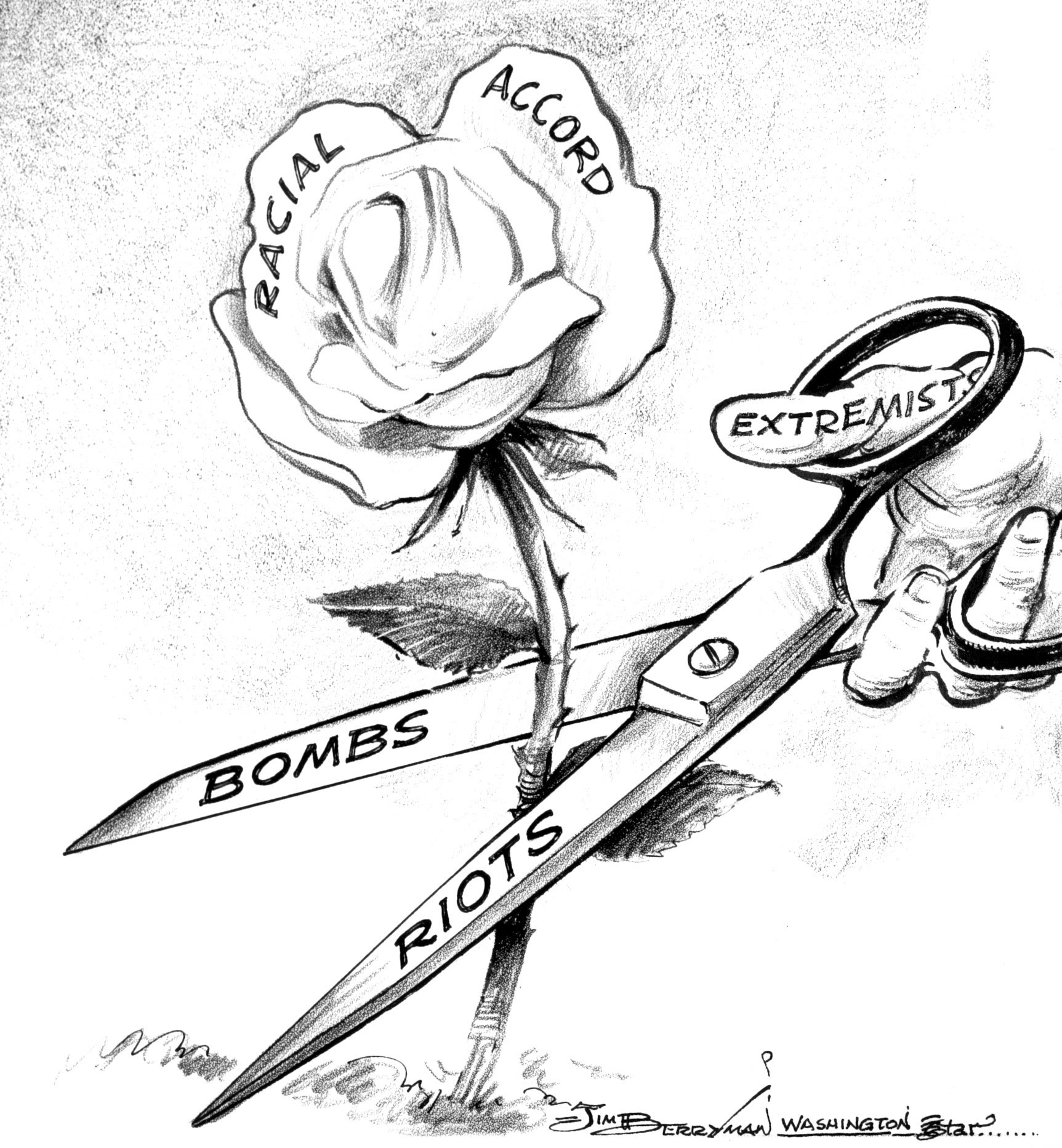
Jim Berryman's Washington Star cartoon of 14 May 1963 draws a rose labeled "Racial Accord" about to be cut by scissors marked "Bombs" and "Riots," held by a hand whose ring reads "Extremists."
Content note: a 1963 newspaper cartoon about bombings and rioting in Birmingham, Alabama, during the civil rights campaign.
The drawing
One rose stands on a thin stem. Its petals carry the words "Racial Accord." A pair of open scissors closes on the stem from the side, and each blade has a name. The hand on the scissors wears a ring with a third name. Those four labels and the signature are the whole text.
RACIAL ACCORD
EXTREMISTS
BOMBS
RIOTS
JIM BERRYMAN WASHINGTON STAR
What it argues, and what it leaves out
The archive tags the sheet as glittering generalities: "racial accord" is a virtue word with no stated terms. Berryman's point is that violence threatens a settlement. That is fair as far as it goes. Bombs in Birmingham were real crimes, and the cartoon is right to name them.
What the drawing blurs is who held the scissors. This site's case study on the period records that Klan bombs hit the A. G. Gaston Motel and the home of A. D. King on 11 May 1963, that Black residents rioted that night, and that earlier in the month city police and firemen had turned dogs and hoses on marchers. The cartoon ran three days after the bombings. It puts the bombers and the rioters on one hand under one ring, "Extremists," and leaves the city government out of the picture. Two blades of equal size suggest two equal threats to a peaceful middle. The record does not show that balance, and the drawing offers no evidence for it. It also never asks what "accord" would mean to the people who had been marching.
For how organized segregationists, some with state money, answered marches and lawsuits in these years, see Citizens' Councils, state money, and the civil rights campaign. Later the same year Berryman drew the civil rights bill as a hooded figure jostling a tax cut in the Senate doorway: Let Me Through! The March on Washington came fifteen weeks after this cartoon.
Record and rights
The maker is the Washington Evening Star, cartoonist Jim Berryman. The original is in the Jim Berryman Political Cartoons series of the Records of the U.S. Senate at the National Archives, NAID 5730852 (series) and NAID 5743297 (item), retrieved 3 October 2026. The rights line, as FRAME records it, reads public domain (U.S. government work).
Sources
- FRAME object record, A Flower Tries to Grow in Birmingham, 14 May 1963. Jim Berryman, Washington Evening Star. National Archives, Records of the U.S. Senate, Jim Berryman Political Cartoons (NAID 5730852), item NAID 5743297, retrieved 3 October 2026.