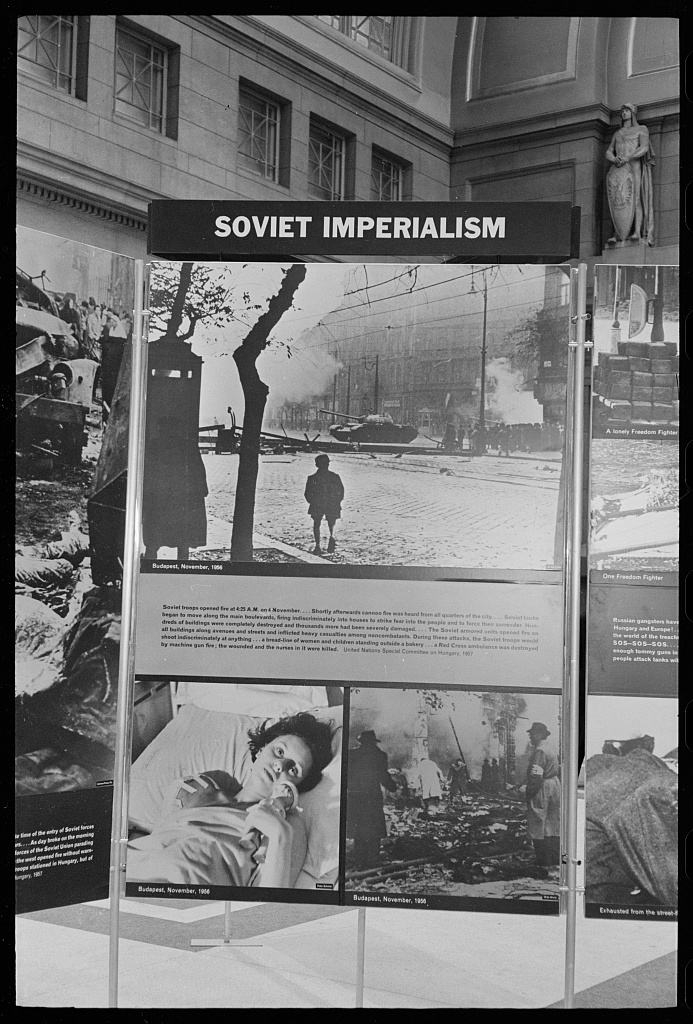
A Warren K. Leffler photograph for U.S. News & World Report, 24 March 1958, of a panel from the AFL-CIO "Soviet Empire" exhibit at Union Station in Washington. Headed "Soviet Imperialism," it pairs Budapest street photographs from November 1956 with a passage credited to the UN Special Committee on Hungary, 1957.
What the panel says
A free-standing board with a two-word headline. The large photograph is a tank in a Budapest street. Smaller pictures show a wounded woman and a fighter. Side panels, partly cut off by the camera, carry captions about a "lonely Freedom Fighter." The center is a long quoted passage, and it ends with a credit line.
SOVIET IMPERIALISM
Budapest, November, 1956
Soviet troops opened fire at 4:25 A.M. on 4 November. . . . [...] Soviet tanks began to move along the main boulevards, firing indiscriminately into houses to strike fear into the people and to force their surrender. [...] a Red Cross ambulance was destroyed by machine gun fire; the wounded and the nurses in it were killed. United Nations Special Committee on Hungary, 1957
Who made it
The exhibit was the AFL-CIO's, a private federation of American labor unions, shown in a public railway station in the capital. The photograph is by Warren K. Leffler for U.S. News & World Report, dated 24 March 1958, now in the Library of Congress Prints and Photographs Division with no known restrictions on publication. FRAME classes the source as open: the speaker is who it says it is.
How to read it
FRAME tags the headline name-calling and the passage testimonial. The second tag is worth a closer look. The panel does not invent its account. It quotes a United Nations committee report and says so, which lets a visitor go and check. The headline is a judgement, and an argument can be had about it; the casualties in the quotation are reported evidence.
This is what open persuasion looks like in a free country. A union, not a ministry, put up the board. It named its source. Anyone walking to a train could stop, read, disagree, or keep walking. A USIA-distributed poster made the same point about Hungary in Manila the year before, in a handful of words and with no citation. The contrast is the lesson.
Sources
- FRAME object record, "Soviet Imperialism": exhibit placard on Hungary, 1956, at Union Station, Washington, D.C., 24 March 1958.
- Library of Congress, Prints and Photographs Division, U.S. News & World Report Magazine Photograph Collection, LC-DIG-ppmsca-77971, photograph by Warren K. Leffler, loc.gov. Rights as recorded: no known restrictions on publication.