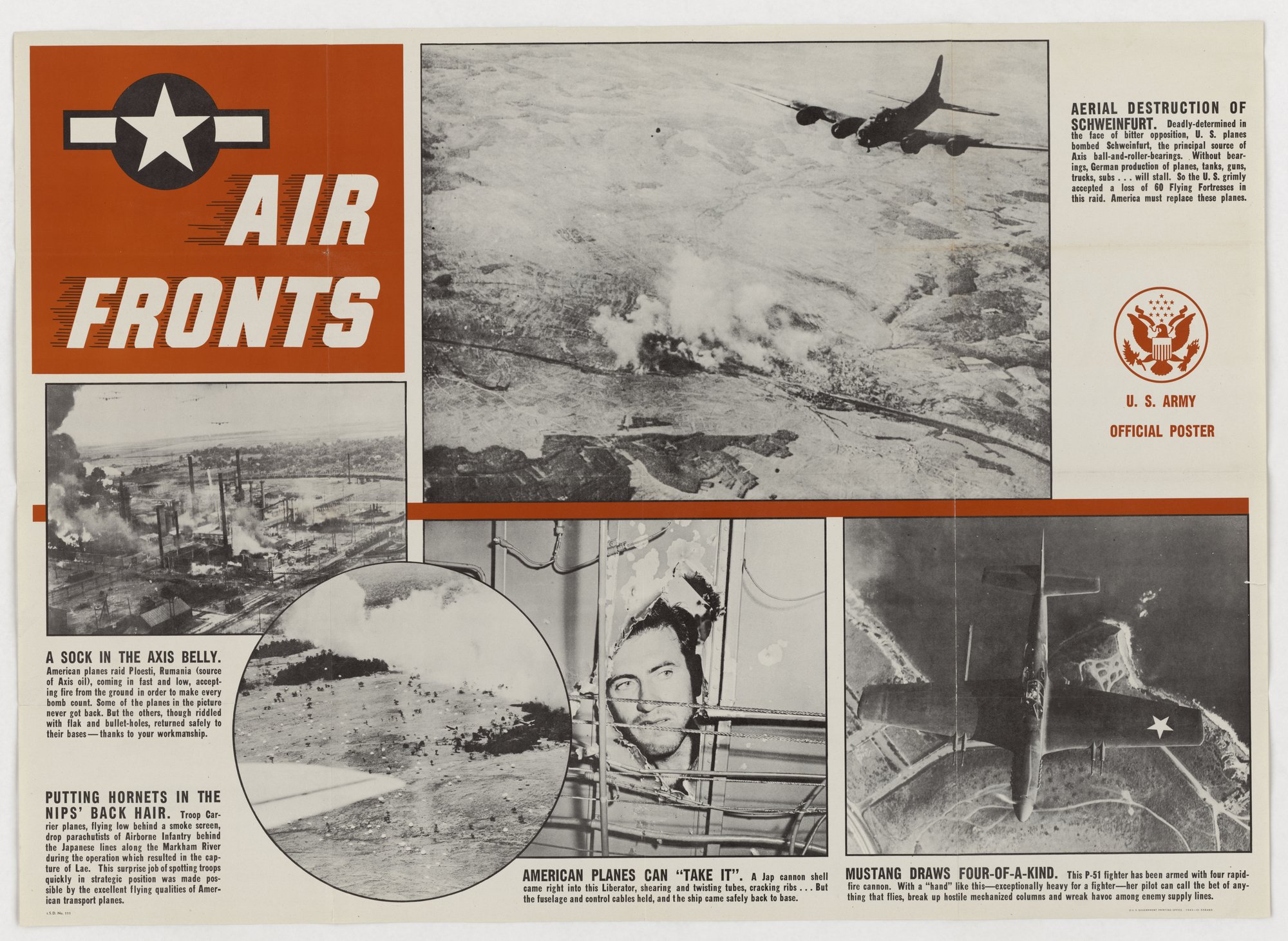
Air Fronts, numbered I.S.D. No. 111, is a 1943 U.S. Army photo sheet with five captioned pictures, from the Schweinfurt raid to a P-51 armed with four cannon. The captions credit "your workmanship," admit lost bombers, and name the Japanese with the slurs "NIPS'" and "Jap" (NAID 513765).
Five pictures, five captions
The sheet is headed AIR FRONTS and labeled "U. S. ARMY OFFICIAL POSTER." Per the archive's description, it holds a B-17 over burning Schweinfurt, the Ploesti oil raid, paratroops dropping near Lae, a crewman looking through a flak hole, and a P-51 seen from above. Each photograph has a capitalized headline and a short paragraph. Three of the five are excerpted here.
AERIAL DESTRUCTION OF SCHWEINFURT. [...] So the U.S. grimly accepted a loss of 60 Flying Fortresses in this raid. America must replace these planes.
A SOCK IN THE AXIS BELLY. [...] Some of the planes in the picture never got back. But the others, though riddled with flak and bullet-holes, returned safely to their bases--thanks to your workmanship.
PUTTING HORNETS IN THE NIPS' BACK HAIR. Troop Carrier planes, flying low behind a smoke screen, drop parachutists of Airborne Infantry behind the Japanese lines along the Markham River during the operation which resulted in the capture of Lae. [...]
U. S. ARMY OFFICIAL POSTER
I.S.D. No. 111
Written for the people who built the planes
The tombstone gives the audience as "Domestic public." The captions are more specific than that. The phrases "thanks to your workmanship" and "America must replace these planes" speak to whoever built aircraft, and the Liberator caption praises a fuselage and control cables that held. The sheet is a production report with the factory left out of the frame.
The sheet does print losses. It states that 60 Flying Fortresses were lost at Schweinfurt and that some planes in the Ploesti picture "never got back." The archive still tags it card stacking, for its selection of success reports, and the losses are put to work too: each one becomes a reason to build more.
The words for the enemy
Two captions name the Japanese with slurs: "THE NIPS' BACK HAIR" and "A Jap cannon shell." The sentence right after the "NIPS'" headline says "the Japanese lines," so the plain word was in the writer's hands. The archive tags this name-calling. An Army information sheet put the slur beside the neutral term and printed both.
FRAME object record, Air Fronts (Aerial Destruction of Schweinfurt, A Sock in the Axis Belly, American Planes Can Take It), 1943. U.S. Army. Rights as recorded: public domain (U.S. government work).
U.S. National Archives and Records Administration, Record Group 44, World War II Posters, 44-PA-318, NAID 513765, retrieved by the archive 4 October 2026.