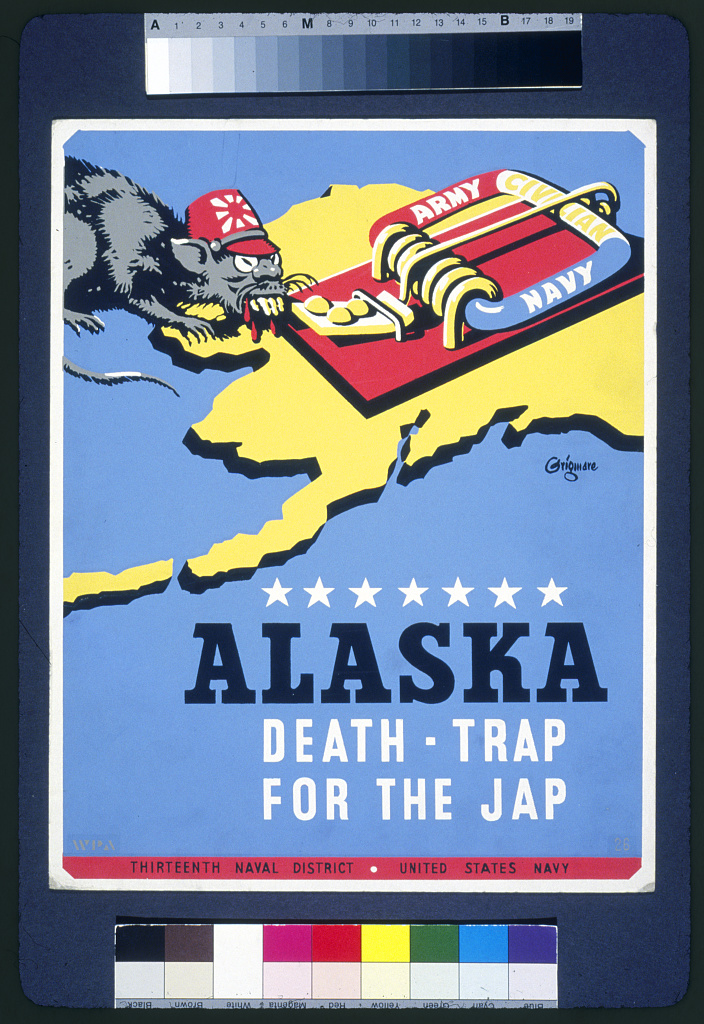
Alaska - Death-Trap for the Jap (1942), a rat at the trap
"Alaska - Death-Trap for the Jap": a 1942 WPA poster for the Navy's Thirteenth Naval District draws the enemy as a rat at a trap over a map of Alaska.
Techniques named on the archive record
Name-calling
Date
1942
Made by
WPA Art Project poster for the Thirteenth Naval District, U.S. Navy (artist signed Grigware)
Medium
Poster
Country
United States
Regime
Roosevelt Administration
Source
Identified Openly sourced: the speaker is who they say they are
Source
Library of Congress, Prints and Photographs Division (POS - WPA - WASH .G76, no. 1) , retrieved October 2, 2026
Source
Public domain (U.S. government work: WPA Federal Art Project poster for the U.S. Navy) Library of Congress, Prints and Photographs Division, Work Projects Administration Poster Collection (digital id cph.3b48885). Library of Congress rights statement: 'No known restrictions on publication.'
Object, image, and catalog record from the FRAME archive. Text on this page is CC BY 4.0. Image rights are as the archive records.
Alaska - Death-Trap for the Jap is a 1942 WPA Art Project poster for the Thirteenth Naval District, U.S. Navy, signed Grigware. A grey rat in a red rising-sun cap creeps toward a mousetrap lettered Army, Civilian and Navy, laid over a map of Alaska.
What the sheet prints
Content note: the slogan uses an ethnic slur for Japanese people, and the enemy is drawn as a rat. Both are described here as printed.
The archive describes a grey rat wearing a red cap with the rising-sun emblem. It creeps toward a mousetrap set over a map of Alaska. Three words are lettered on the trap, and the slogan runs above it.
ALASKA
DEATH-TRAP
FOR THE JAP
ARMY
CIVILIAN
NAVY
THIRTEENTH NAVAL DISTRICT • UNITED STATES NAVY
WPA
26
Who made it
The maker line reads WPA Art Project poster for the Thirteenth Naval District, U.S. Navy, with the artist signed Grigware. The archive's copy comes from the Library of Congress Work Projects Administration Poster Collection, not the National Archives poster file, so this page gives no NAID. The record gives no first name for the artist, no print run and no posting places. The archive files the sheet as aimed at the domestic public, with the purpose of mobilizing or securing compliance.
What it does
Two techniques are tagged in the record: name-calling and dehumanization. The second is the heavier one. A rat is vermin, and vermin are not fought; they are exterminated. Putting the nation's rising-sun cap on the rodent makes the whole people the pest, not a navy or an army. The last word of the slogan is the slur, and it is quoted here because it is the poster.
The trap's three labels carry a message that could stand on its own: Army, Navy and civilians as one defense. The picture did not need the rat to say it. A federal art project made a poster for a Navy district that drew an ethnic group as vermin. That was wrong in 1942.
A similar rat-and-trap image appears in a private company's sheet from the same year, the Douglas conservation poster Jap Trap. Other sheets of this kind are gathered on the anti-Japanese propaganda hub and its poster gallery. The Roosevelt administration essay separates posters aimed at a regime from those aimed at a race.
Sources
FRAME object record, Alaska - Death-Trap for the Jap, 1942. WPA Art Project poster for the Thirteenth Naval District, U.S. Navy (artist signed Grigware).
Library of Congress, Prints and Photographs Division, Work Projects Administration Poster Collection (POS - WPA - WASH .G76, no. 1; digital id cph.3b48885), catalog record, retrieved by the archive 2 October 2026. Rights as recorded: public domain (U.S. government work); Library of Congress rights statement "No known restrictions on publication."