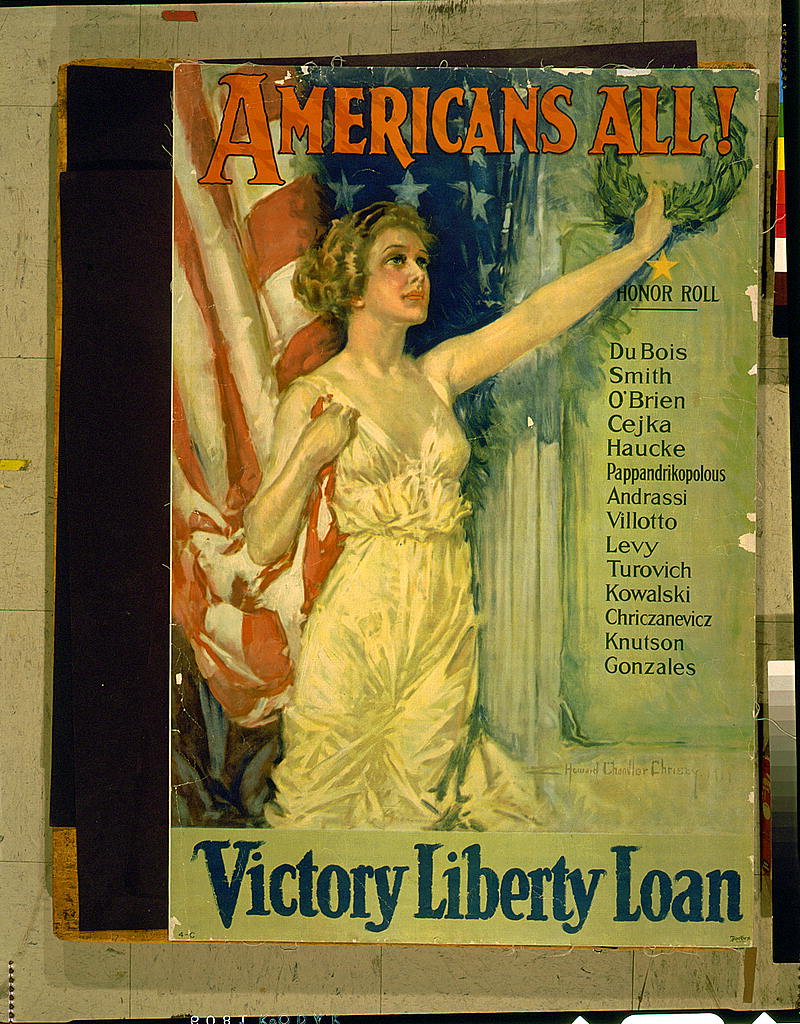
Howard Chandler Christy's 1919 poster for the Victory Liberty Loan sets a woman in white, the flag behind her, raising a laurel wreath over an "Honor Roll" of fourteen surnames, from Du Bois and Smith to Pappandrikopolous, Kowalski and Gonzales.
What it shows
A woman in a white gown stands in front of the Stars and Stripes and holds a laurel wreath out over a panel. The panel is a list of family names, and the list is the whole message.
AMERICANS ALL!
HONOR ROLL
Du Bois · Smith · O'Brien · Cejka · Haucke · Pappandrikopolous · Andrassi · Villotto · Levy · Turovich · Kowalski · Chriczanevicz · Knutson · Gonzales
Victory Liberty Loan
Who made it
Howard Chandler Christy (1873–1952) drew it for the Treasury's Victory Liberty Loan in 1919, according to the FRAME record. The image is the Library of Congress copy, LC-USZC4-5845, public domain in the United States as a pre-1931 publication. The record gives no National Archives identifier. Christy also drew the Navy's Gee!! I Wish I Were a Man and the Third Liberty Loan's "Fight or Buy Bonds," both in the archive.
How to read it
The Victory Liberty Loan came after the fighting stopped, and this sheet has no enemy in it at all. There is no spiked helmet and no burning city. The appeal is to belonging. FRAME tags it transfer and bandwagon: the flag and the wreath lend their dignity, and the roll presents the buyers as a crowd already assembled.
Who is in the crowd is the point. Smith and O'Brien sit beside Cejka, Andrassi, Villotto, Levy, Turovich and Chriczanevicz. The poster says, in a list, that all of these are Americans and all of them are honored.
That message deserves credit, and it deserves a date. During the war, the same government's leaders had spoken differently. Wilson told Congress in 1915 that some citizens "born under other flags" had poured "the poison of disloyalty" into the country's life. In May 1918 Iowa's governor banned the public use of foreign languages, the telephone included. Both are recorded on this site's Committee on Public Information case study and the Wilson administration page. "Americans All!" is the better sentence. It came after the shooting was over and the money was still needed.
Read for liberty, the poster can be taken at its word and the government held to it. If Kowalski and Haucke were Americans in 1919, they were Americans in 1917, with the same right to read a paper in their own language and to argue about the war.
Sources
FRAME object record, Americans All! Victory Liberty Loan, 1919. U.S. Treasury Department (Victory Liberty Loan); Howard Chandler Christy, artist.
Library of Congress, item 97520325, LC-USZC4-5845, retrieved by the archive 27 September 2026. Rights as recorded: public domain in the U.S. (published before 1931).