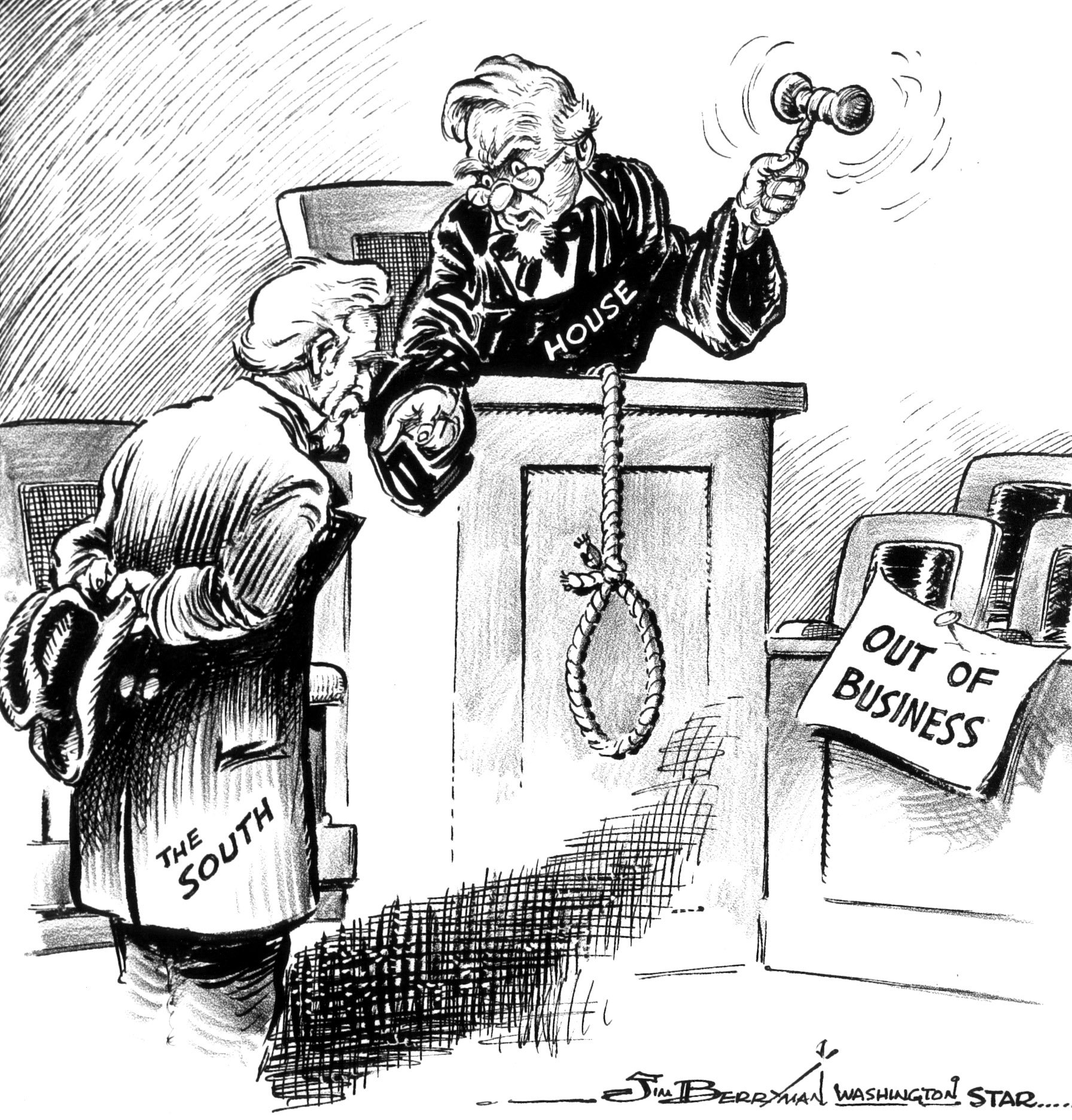
Jim Berryman's Washington Star cartoon of 16 June 1957 draws a judge robed "House" lifting a gavel over a bent, white-haired man labeled "The South." A noose hangs from the bench, and the jury box carries an "Out of Business" sign.
Content note: a 1957 newspaper cartoon that uses a hangman's noose as an image.
The drawing
Three figures and three words. The judge sits high, gavel raised, and his robe reads "House." Below him an old man with white hair stands bent, hat held behind his back like a defendant waiting for sentence; he is labeled "The South." A rope with a noose hangs from the bench. The jury box is empty, and a sign pinned to it says the jury has closed.
HOUSE
THE SOUTH
OUT OF BUSINESS
JIM BERRYMAN WASHINGTON STAR....
What it argues
The caption speaks for the judge, and the sneer in "the likes of you" is the point: the House, as Berryman draws it, has decided that Southerners do not get juries. FRAME tags the sheet fear appeal. The rope supplies the fear. It tells the reader that a man tried without a jury is a man already condemned.
The cartoon names no bill; the archive files it under the event "Civil Rights Act of 1957." Six days later the same artist drew a "Civil Rights Bill" being chased through the Senate, in The Place Is Full of Simon Legrees! Read side by side, the two cartoons take the bill's side in the Senate and the South's side on juries within one week. A cartoonist is allowed to hold both views, and a reader is allowed to notice them.
How to read it
Trial by jury is a real right, and a cartoon defending it deserves to be heard on its merits. Any reading that limits state power takes it seriously when a legislature proposes to try people without one. A jury is also only as fair as the list it is drawn from. The drawing never raises that question. Its only people are the old man and a judge who stands for a chamber of Congress.
The noose is the hard part. A noose is the emblem of lynching, and in a 1957 cartoon about the South it could not be a neutral prop. Berryman hangs it over "The South" as the accused, with Congress at the bench. That is a choice, and it borrows the weight of real killings to argue a point of procedure. He had used the same image two and a half years earlier for an unlabeled political victim in Lynching Bee, a December 1954 cartoon in the same Senate collection.
Where the movement and its opponents stood on juries, courts, and state power in these years is the subject of Citizens' Councils, state money, and the civil rights campaign. The wider set of cartoons, photographs, and overseas sheets is on the hub, US civil rights era messaging, 1954–1969.
Record and rights
Washington Evening Star, cartoonist Jim Berryman. Jim Berryman Political Cartoons, Records of the U.S. Senate, National Archives: series NAID 5730852, item NAID 5743242, retrieved 3 October 2026. FRAME classes the source as openly identified and records the rights as public domain (U.S. government work).
Sources
- FRAME object record, No jury trial for the likes of you, 16 June 1957. Jim Berryman, Washington Evening Star. National Archives, Records of the U.S. Senate, Jim Berryman Political Cartoons (NAID 5730852), item NAID 5743242, retrieved 3 October 2026.
- FRAME object record, Lynching Bee, 9 December 1954. Jim Berryman, Washington Evening Star. NAID 5743193.