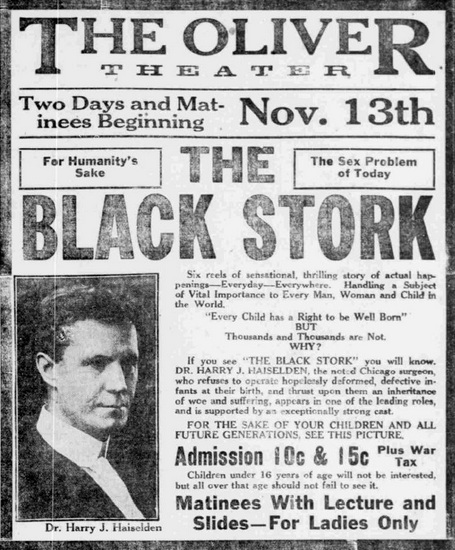
A November 1917 Oliver Theater newspaper advertisement promotes The Black Stork, a film in which Chicago surgeon Harry J. Haiselden, who the ad says refuses to operate on "hopelessly deformed, defective infants at their birth," appears in a leading role.
What the ad prints
Content note: the advertisement promotes letting disabled newborns die and uses the words "deformed" and "defective" for them. It is quoted so the claim can be judged in its own words.
THE OLIVER THEATER
Two Days and Matinees Beginning Nov. 13th
For Humanity's Sake / THE SEX PROBLEM OF TODAY
THE BLACK STORK
[...]
"Every Child has a Right to be Well Born" BUT Thousands and Thousands are Not. WHY?
If you see "THE BLACK STORK" you will know. DR. HARRY J. HAISELDEN, the noted Chicago surgeon, who refuses to operate on hopelessly deformed, defective infants at their birth, and thereupon lets an inheritance of woe and suffering, appears in one of the leading roles, and is supported by an exceptionally strong cast.
FOR THE SAKE OF YOUR CHILDREN AND ALL FUTURE GENERATIONS, SEE THIS PICTURE.
Admission 10c & 15c Plus War Tax
[...]
Matinees With Lecture and Slides—For Ladies Only
Who made it
The Oliver Theater placed the ad for a two-day run beginning November 13; the FRAME record dates it November 1917 and gives it as public domain via Wikimedia Commons. It names no city for the theater. The film's selling point is Haiselden himself, a practicing surgeon appearing on screen.
What it gets wrong
The ad borrows the language of rights to argue against a right. "Every child has a right to be well born" sounds like a promise to children. In the next lines it becomes a reason to let some of them die, on a doctor's judgment, at birth. The "inheritance of woe and suffering" is the eugenic claim that disability is a hereditary burden the community should stop, and the newborn is the one who pays for that theory.
That was wrong. A child born with a disability is a person with the same claim on life and medical care as any other, and a doctor deciding otherwise does not become right by putting it in a film. The ad's other moves, "for humanity's sake," "all future generations," and the ladies-only lecture with slides, dress a death sentence as science and public service.
The record shows a private theater and a private physician, not a government office. That matters for who is responsible, and it is a reminder that the push to sort people by fitness came from respectable professionals and paying audiences, not only from officials. The archive's posters from the same war, such as The Greatest Mother in the World, used the image of care for the wounded. This sheet used the image of care to sell its opposite. The eugenics case study discusses this film and its Oliver Theater advertisement alongside the fitter-family contests and the sterilization laws.
Sources
- FRAME object record, The Black Stork (cinema advertisement), November 1917. Oliver Theater, advertising the film starring Dr. Harry J. Haiselden.
- Wikimedia Commons, retrieved by the archive 27 September 2026. Rights as recorded: public domain (U.S. publication before 1930).