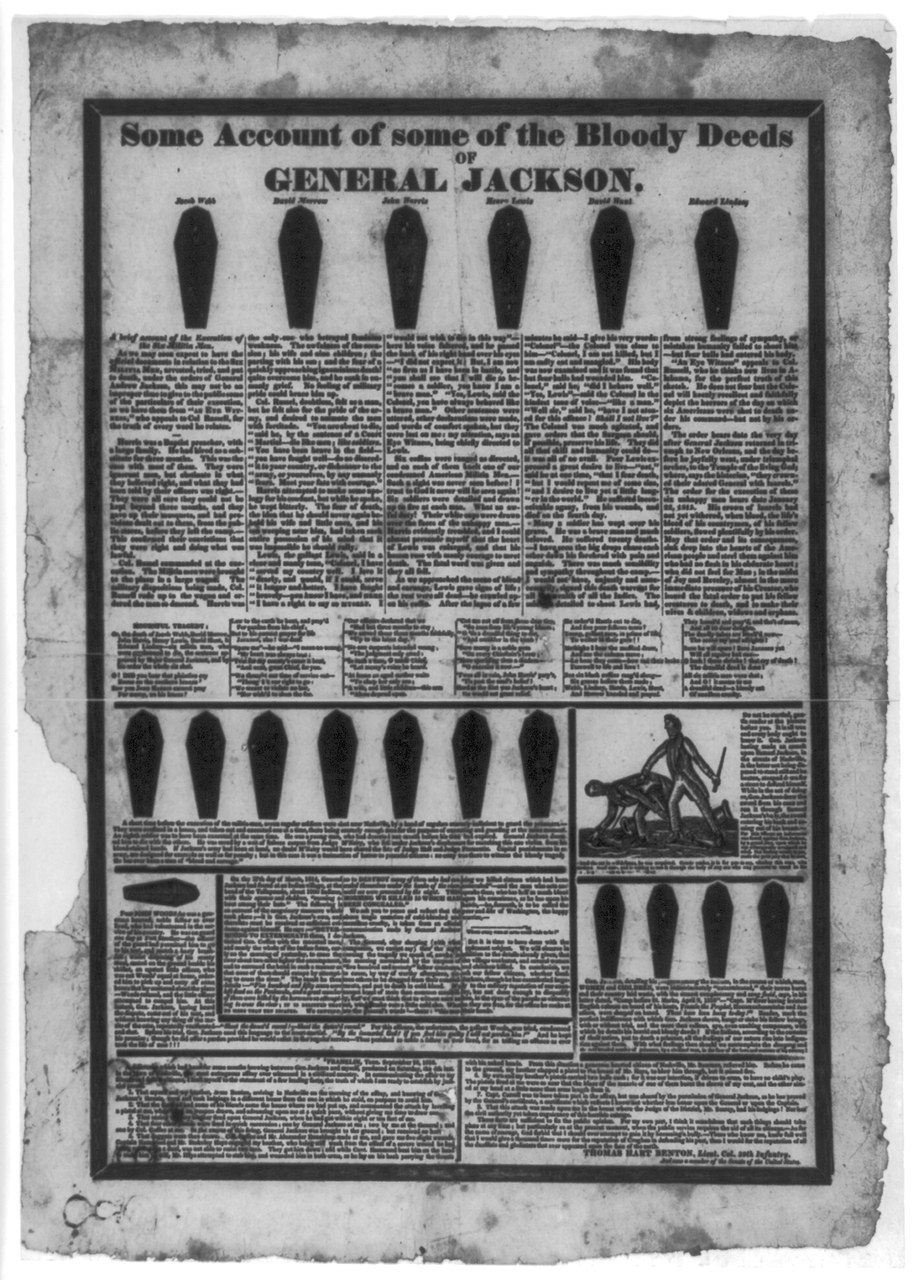
An 1828 broadside from the pro-Adams side prints six coffins named for executed militiamen and charges Andrew Jackson with "bloody deeds." The Library of Congress says the coffin handbills originated with the Philadelphia editor John Binns.
What the sheet prints
The headline does the work before a single column is read. Six black coffins run across the top, each lettered with a man's name. Below them come columns of narrative about the execution of six militia men, verse under the heading "Mournful Tragedy," more coffins, a woodcut of Jackson striking a man, and a statement signed by Thomas Hart Benton. Most of the small type is not legible at the Library of Congress resolution, and the archive marks it illegible rather than guessing. This page does the same.
Some Account of some of the Bloody Deeds OF GENERAL JACKSON.
Jacob Webb / David Morrow / John Harris / Henry Lewis / David Hunt / Edward Lindsey
A brief account of the Execution of the Six Militia Men. [illegible]
Harris was a Baptist preacher, with a large family. [illegible]
THOMAS HART BENTON, Lieut. Col. 39th Infantry, And now a member of the Senate of the United States.
Who issued it
The sheet is campaign literature from the side backing John Quincy Adams against Jackson in 1828. The Library of Congress catalog says the coffin handbills originated with John Binns, a Philadelphia editor. No party committee signs the sheet. The Benton signature is there to borrow a witness: a former officer, now a senator, whose statement the handbill sets beside its own charges.
How to read it
The title says "some account of some" deeds, and that modesty is a cover. Every item chosen is a death charged to Jackson. Nothing on the sheet gives the military situation, the charges against the men, or the court that tried them, at least not in any text that can be read today. A voter is handed a list of graves and asked to supply the verdict. The archive tags it for name-calling and card stacking, and the coffins are the card stacking made visible.
The coffin as a political image was not new. The Boston Gazette set coffin cuts over its account of the King Street dead in 1770, as the case study on patriot and loyalist print describes. Whether those executions were lawful was a fair question to put to a man seeking the presidency. A row of coffins is a way of answering it before it is asked.
Rights
Published 1828 in the United States. The Library of Congress records no known restrictions on publication.
Sources
- FRAME object record, "Some Account of some of the Bloody Deeds of General Jackson" coffin handbill, 1828. Anti-Jackson (pro-Adams) campaign literature.
- Library of Congress, Prints and Photographs Division, Broadside Collection, portfolio 229, no. 8; LC-USZ62-43901. loc.gov/pictures/item/2008661734, retrieved by the archive 2 October 2026.