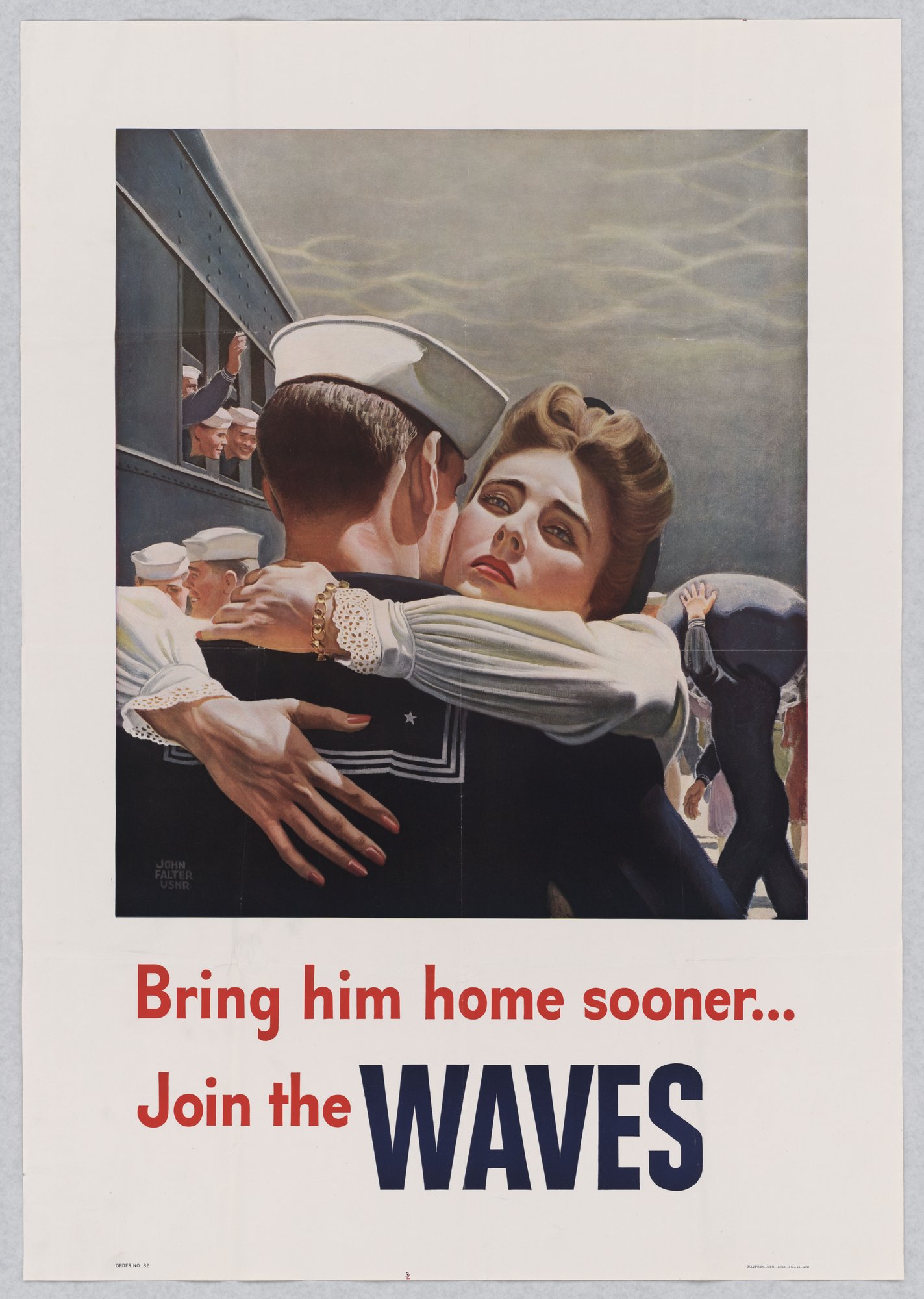
Bring him home sooner... Join the WAVES is a U.S. Navy recruiting poster by John Falter, USNR, whose imprint dates it to September 1944. A worried woman embraces a sailor beside a train while other sailors wave from the windows (NAID 515378).
A farewell at the train
John Falter painted a parting. A woman with a worried face holds a sailor at a train, and other sailors wave from the windows. The headline offers her a way to shorten the wait, and the rest of the sheet is a signature, an order number and a Navy print code.
Bring him home sooner...
Join the WAVES
[signature: JOHN FALTER USNR]
ORDER NO. 82
[imprint: NAVPERS-NRB-[illegible]-2 Sep 44-40M.]
Who signed and printed it
The poster is a U.S. Navy recruiting sheet signed John Falter, USNR. The archive reads its printed imprint as placing it in September 1944, and the code "2 Sep 44" appears in it. The audience FRAME records is "Domestic public" and the purpose "Recruit"; its description says the sheet is aimed at American women. The National Archives holds it in Record Group 44, World War II Posters.
The feeling does the arguing
FRAME tags one technique, transfer. The emotion of the parting is attached to the act of enlisting, and the archive's point is that the feeling persuades in place of a stated reason. The headline makes a claim of cause and effect, that a woman who joins will bring the man home sooner. The poster does not explain how.
The Navy's own 1943 poster on this site, Enlist in the WAVES, gave the reason in plain words: "RELEASE A MAN TO FIGHT AT SEA". That is the mechanism this sheet leaves out. On the 1943 poster's logic, a woman who enlisted freed a man for sea duty. Whether that brought anyone home sooner depends on how the war went, and no poster could promise it. Falter's sheet turns a staffing argument into a private hope, and leaves the arithmetic to the viewer.
Nothing here is coercive. The sheet asks and does not order, and a poster that speaks to a woman's own stake in the war treats her as someone with reasons of her own. Its weakness is the promise in the headline, which no recruiter could keep. Falter also signed the 1944 WAVES poster To Make Men Free, whose quoted line promises that "you will share the gratitude of a nation when victory is ours". The Roosevelt administration essay treats the war years as a whole.
Sources
- FRAME object record, Bring Him Home Sooner, Join the WAVES, 1944. U.S. Navy; artist John Falter, USNR. Rights as recorded: public domain (U.S. government work).
- U.S. National Archives and Records Administration, Record Group 44, World War II Posters, 44-PA-1707, NAID 515378, retrieved by the archive 4 October 2026.