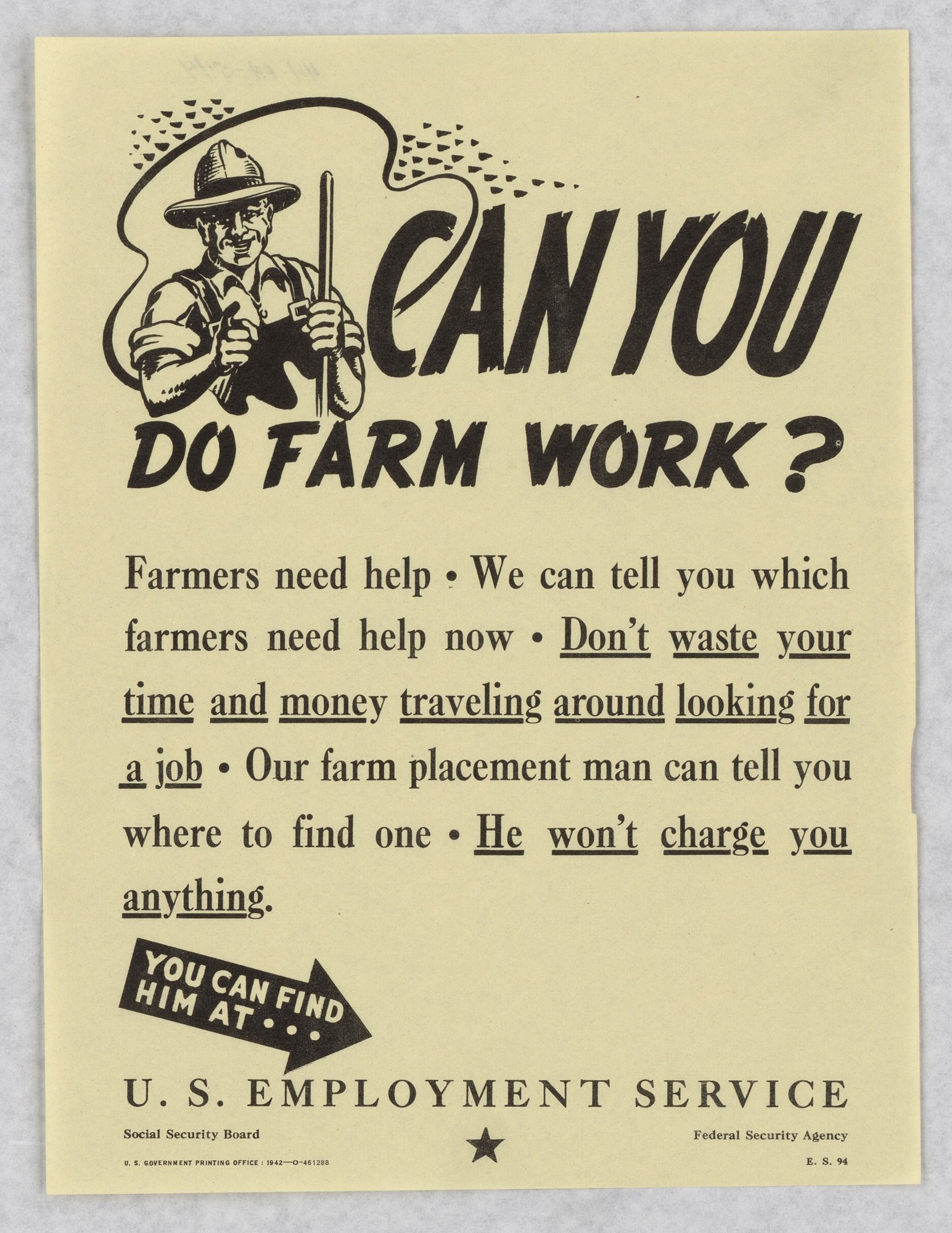
Can You Do Farm Work? is a 1942 handbill of the U.S. Employment Service, under the Social Security Board and the Federal Security Agency. A drawing of a smiling farmer with a pitchfork heads an offer to tell job seekers which farms need help, at no charge (NAID 514023).
An offer, not an order
A man looking for farm work in 1942 could walk from farm to farm, or he could ask a government placement office. This handbill makes the case for the second choice. The archive describes a drawing of a smiling farmer in a wide-brimmed hat with a pitchfork, above a short block of text in which some lines are underlined.
CAN YOU DO FARM WORK ?
Farmers need help • We can tell you which farmers need help now • Don't waste your time and money traveling around looking for a job • Our farm placement man can tell you where to find one • He won't charge you anything.
YOU CAN FIND HIM AT . . .
U. S. EMPLOYMENT SERVICE
Social Security Board
Federal Security Agency
[imprint: U. S. GOVERNMENT PRINTING OFFICE : 1942-O-461288]
E. S. 94
[handwritten pencil note at top, illegible]
Who printed it
Three federal names stack at the foot: the U.S. Employment Service, the Social Security Board, and the Federal Security Agency. The form number is E. S. 94, and the printing-office job number begins with 1942. The line "YOU CAN FIND HIM AT" is followed in the transcription by the agency names, not a street address; the only handwriting on the scanned copy is an illegible pencil note at the top. The record's purpose field reads "Recruit," and its themes are labor and the home front.
What it asks
Very little. The record describes no enemy, no flag, no casualty, and no claim that a worker who stays home is helping the Axis. The archive calls the technique faint: a plain-spoken farmer figure, talking to workers in everyday terms. The argument is practical. Traveling costs money and time, the office knows which farms are hiring, and the service is free.
That is the version of wartime labor policy a free country can live with comfortably: a public office offers information, and the worker decides. Compare When You're A.W.O.L. You're Working for the Axis, a War Production Board sheet of the same year that put an absent worker in the enemy's camp, or Americans All, a 1942 War Manpower Commission poster built around a non-discrimination pledge. The Roosevelt administration essay places the period's posters beside the government that issued them.
Sources
- FRAME object record, Can You Do Farm Work?, 1942. U.S. Employment Service, Social Security Board, Federal Security Agency. Rights as recorded: public domain (U.S. government work).
- U.S. National Archives and Records Administration, Record Group 44, World War II Posters, 44-PA-544, NAID 514023, retrieved by the archive 4 October 2026.