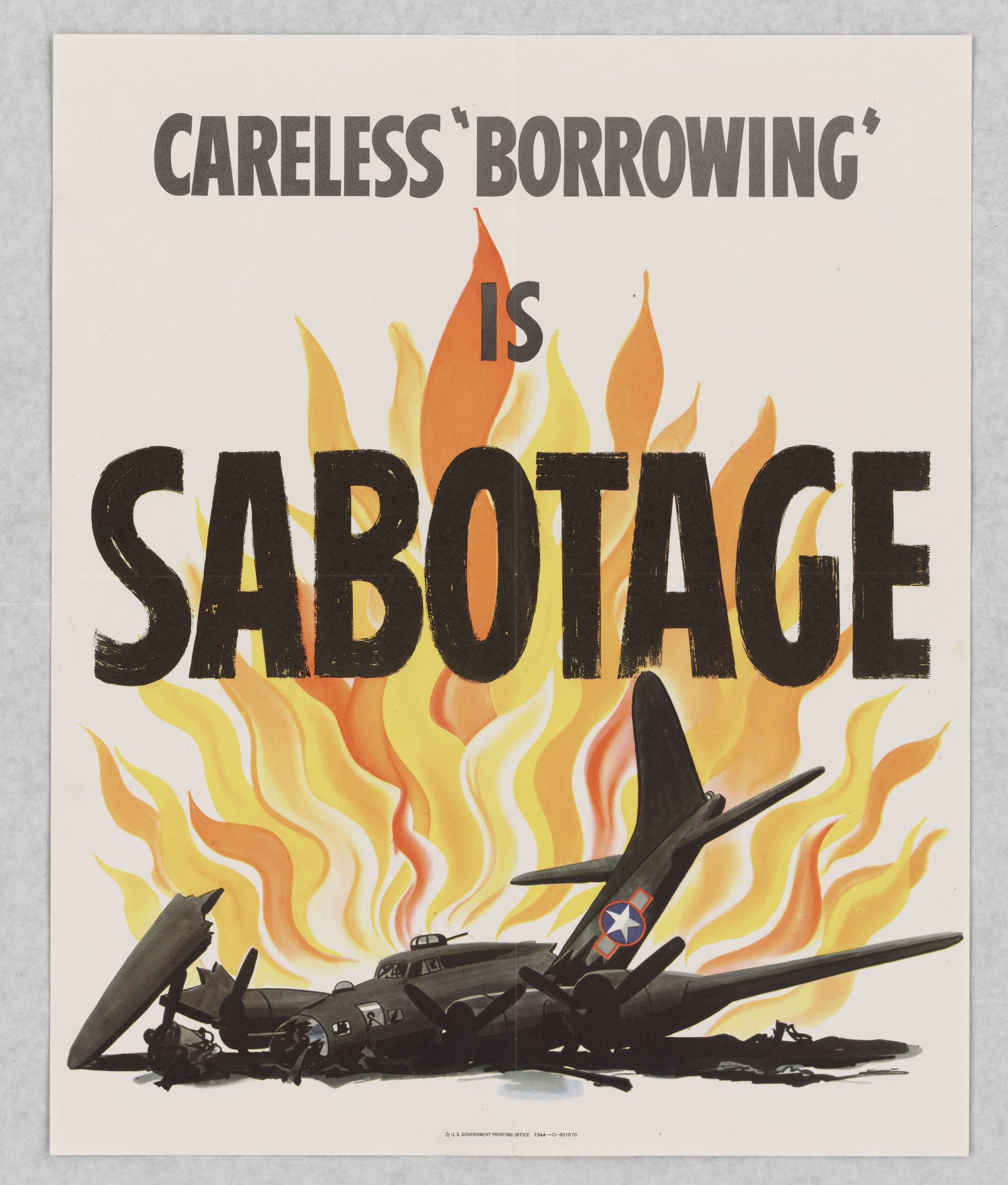
Careless 'borrowing' is sabotage is a 1944 workplace poster printed by the Government Printing Office, with no issuing agency named. A wrecked bomber with a star-and-bar roundel burns under tall flames, and the text calls taking tools without permission sabotage (NAID 514033).
Flames and a word in quotation marks
A wrecked bomber lies under tall flames, and the roundel on it is the American star and bar. In large type, the poster names the offense. The word 'BORROWING' is set in single quotation marks on the sheet, a sign that the poster doubts the polite word itself.
CARELESS 'BORROWING'
IS
SABOTAGE
[imprint:] U. S. GOVERNMENT PRINTING OFFICE: 1944—O—601870
A federal print job with no office named
The only maker's mark is the Government Printing Office imprint, dated 1944. No agency is named. FRAME describes it as a workplace poster warning against taking tools without permission, sets the issuer type to "State", the audience to "Domestic public" and the purpose to "Warn or inform", and lists labor and the home front as themes. The National Archives holds it in Record Group 44, World War II Posters.
Calling a habit a crime
FRAME tags name-calling and fear appeal. The name-calling, as the archive puts it, is the heavy label "sabotage" attached to a routine habit: here, taking a tool without permission. The fear appeal is the picture, which stages the harm the habit is said to cause. The poster draws a straight line from a missing tool to a burning American plane.
The underlying request is fair. Asking workers not to take tools without permission is ordinary management. The language is the problem. Sabotage is deliberate destruction, and a worker who borrows a tool carelessly has not done that. Calling him a saboteur blurs the line between carelessness and disloyalty, and that line matters most in wartime. A poster cannot convict anyone. It can teach a workforce to hear an accusation of disloyalty in a complaint about tools.
A private plant poster about tools, More Toolie You Crackie, More Happy Jappie, linked broken tools to the enemy, with a racial caricature added. Labor discipline appears from the government's side in Don't Be a Job Hopper, also from 1944. Workplace sheets like this one belong to the poster program described in the Roosevelt administration essay.
Sources
- FRAME object record, Careless 'Borrowing' Is Sabotage, 1944. U.S. government (issuer not printed; printed by U.S. Government Printing Office). Rights as recorded: public domain (U.S. government work).
- U.S. National Archives and Records Administration, Record Group 44, World War II Posters, 44-PA-554, NAID 514033, retrieved by the archive 4 October 2026.