The Children's Bureau's 1941 poster on child labor, and the law in its small print
A 1941 Children's Bureau poster says no child under 16 should leave school for work, then states the Fair Labor Standards Act rule and exemptions. NAID
Techniques named on the archive record
Glittering generalities
Date
1941
Made by
U.S. Department of Labor, Children's Bureau
Medium
Poster
Country
United States
Regime
Roosevelt Administration
NARA
NAID 514051; Record Group 44
Source
Identified Openly sourced: the speaker is who they say they are
Source
U.S. National Archives and Records Administration, Record Group 44, World War II Posters , retrieved October 4, 2026
Source
Public domain (U.S. government work) U.S. Department of Labor, Children's Bureau. National Archives and Records Administration, RG 44, 44-PA-571 (NAID 514051).
Object, image, and catalog record from the FRAME archive. Text on this page is CC BY 4.0. Image rights are as the archive records.
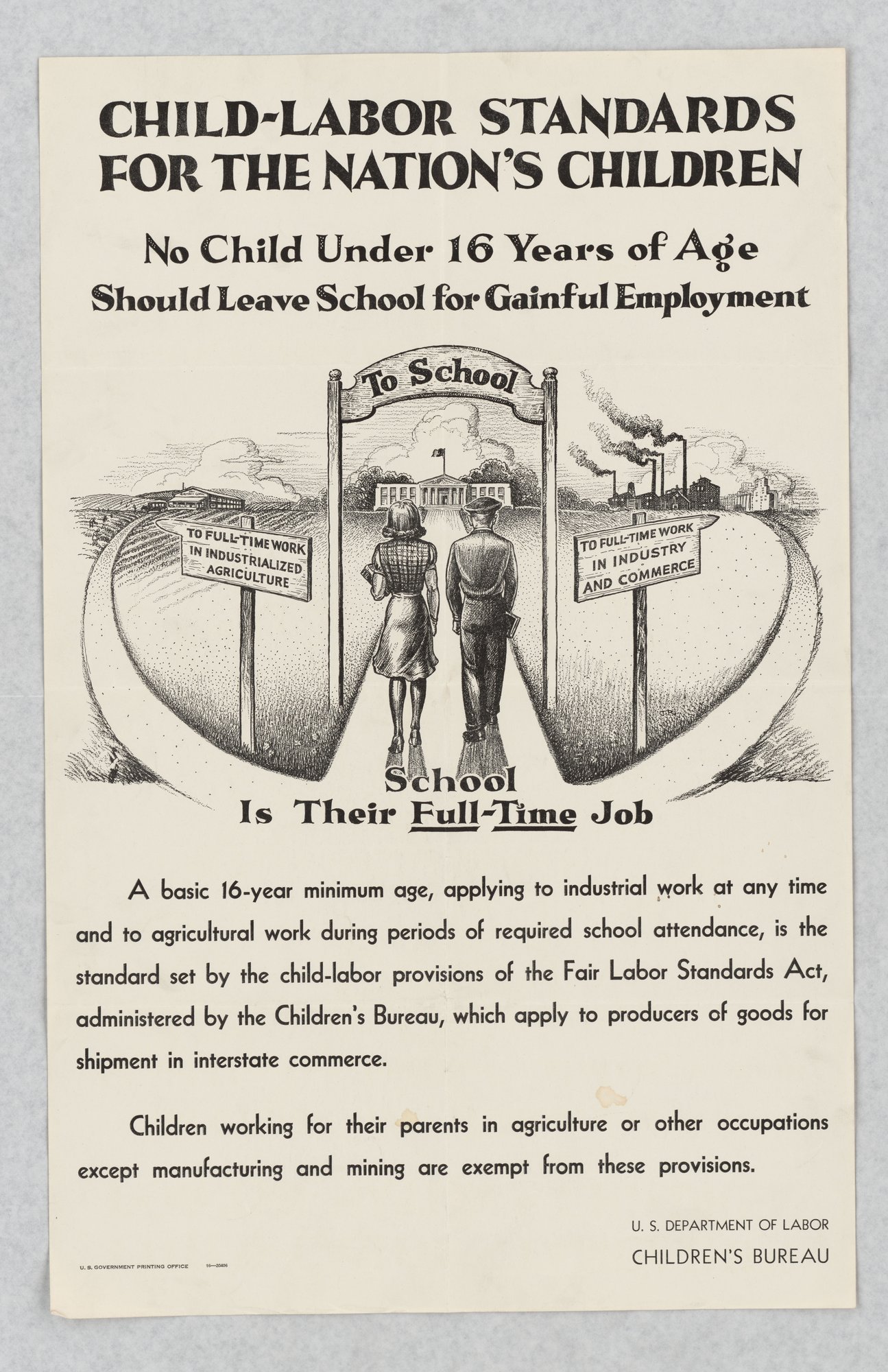
Child-labor standards for the nation's children is a 1941 U.S. Department of Labor, Children's Bureau poster. Two children with schoolbooks take the road marked "To School" between roads to full-time work, and the small print sets out the 16-year minimum of the Fair Labor Standards Act and its exemptions (NAID 514051).
Three roads
The poster is black and white. A girl and a boy carrying schoolbooks walk toward a school under an arch lettered "To School." Two side roads lead off, signposted to full-time work in industrialized agriculture and in industry and commerce. Under the picture is a slogan, and under the slogan is the law.
CHILD-LABOR STANDARDS FOR THE NATION'S CHILDREN
No Child Under 16 Years of Age Should Leave School for Gainful Employment
School Is Their Full-Time Job
A basic 16-year minimum age, applying to industrial work at any time and to agricultural work during periods of required school attendance, is the standard set by the child-labor provisions of the Fair Labor Standards Act, administered by the Children's Bureau, which apply to producers of goods for shipment in interstate commerce.
Children working for their parents in agriculture or other occupations except manufacturing and mining are exempt from these provisions.
U. S. DEPARTMENT OF LABOR CHILDREN'S BUREAU
"Should" and "must"
Read the headline and the small print together. The headline says no child under sixteen "should" leave school for paid work. The small print says what the law actually required, and it is narrower. The minimum applied to producers of goods shipped in interstate commerce. For farm work, it applied only while school attendance was required. Children working for their parents were exempt, except in manufacturing and mining.
So the poster states a goal broader than the statute and then, honestly, prints the statute. That is a fair way to do it. A reader learns what the agency wanted and what the law could make him do, and the two are not blurred. The archive's technique tag is glittering generalities, carried by the slogans "for the Nation's children" and "School Is Their Full-Time Job," and it calls the effect faint.
The family exemption
The exemption is worth noticing from a liberty angle. The federal rule reached employers in interstate commerce; it stopped, mostly, at the family farm and the family business. A child's work for a parent, outside manufacturing and mining, was left outside this federal rule. The poster prints the exemption in full.
FRAME object record, Child-labor standards for the nation's children, 1941. U.S. Department of Labor, Children's Bureau. Rights as recorded: public domain (U.S. government work).
U.S. National Archives and Records Administration, Record Group 44, World War II Posters, 44-PA-571, NAID 514051, retrieved by the archive 4 October 2026.