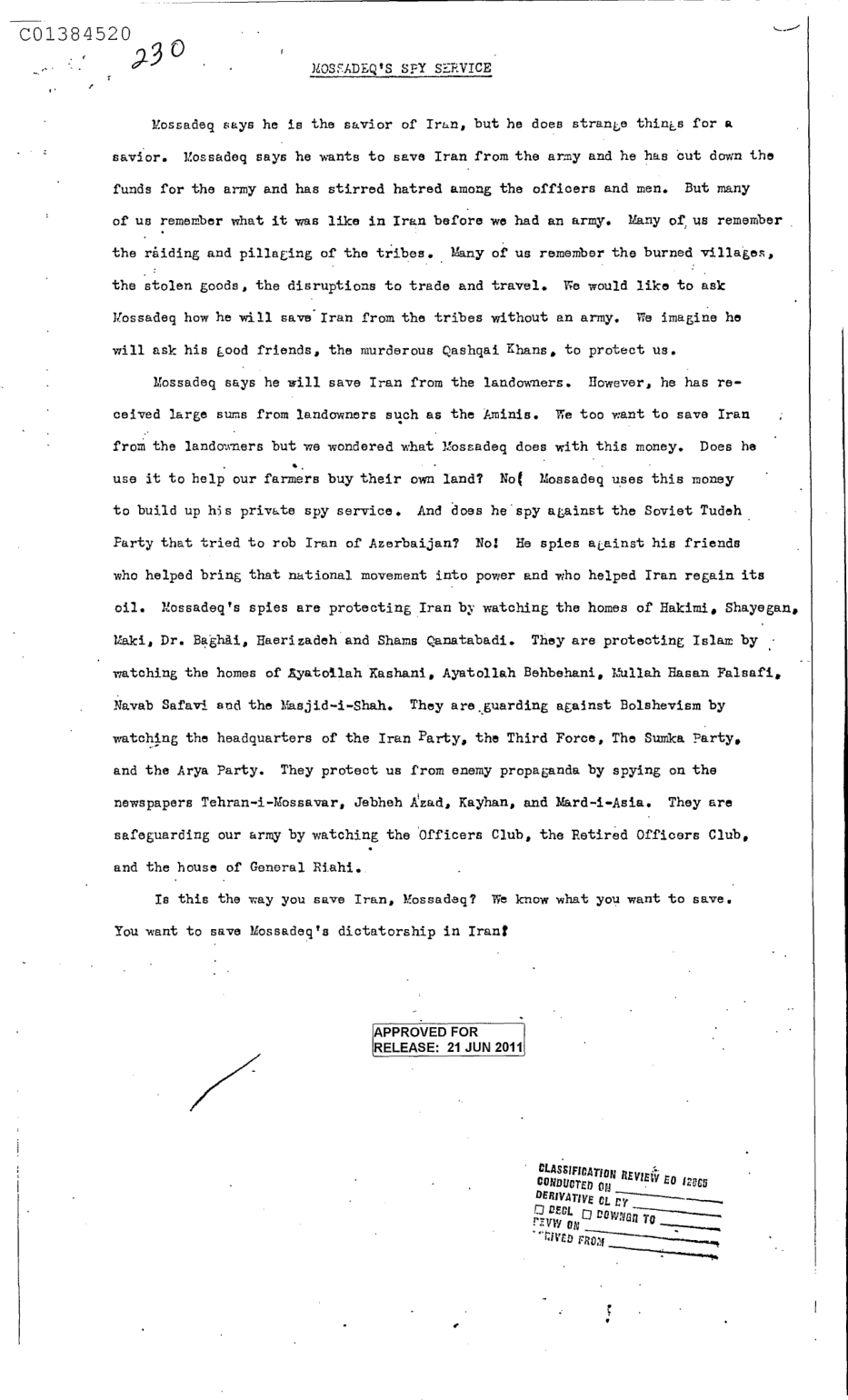
Mossadeq's Spy Service is a one-page English typescript prepared by the Central Intelligence Agency in 1953 for placement in Iranian media. It speaks as "us," ordinary Iranians, and accuses Prime Minister Mossadeq of spying on his own allies. The page names no author.
What the page says
The typescript runs to a single page under a capitalized heading. It never says who is speaking. Its voice is a collective "we" and "many of us," the voice of Iranians who remember tribal raids and want an army to stop them. Every paragraph turns a claim Mossadeq made into a charge against him.
MOSSADEQ'S SPY SERVICE
Mossadeq says he is the savior of Iran, but he does strange things for a savior. [...] But many of us remember what it was like in Iran before we had an army. [...]
Is this the way you save Iran, Mossadeq? We know what you want to save. You want to save Mossadeq's dictatorship in Iran!
The middle of the text is a list. It names politicians, clerics, parties, four newspapers and an officers' club as targets of the prime minister's watchers. It calls the Qashqai khans "murderous." No source is offered for any item on the list.
Who wrote it, and how that is known
The page itself does not say. The attribution comes from the release. FRAME records the maker as the Central Intelligence Agency, writing unattributed copy for Iranian outlets in the summer of 1953, and cites the National Security Archive at George Washington University, Electronic Briefing Book no. 435, Document 21. The archive files it under impersonated sources: a text built to look as if it came from someone else.
This page does not say where, or whether, the text was printed in Iran. The record does not show that, so neither can we.
Why the missing name matters
An American government may argue with a foreign leader in its own name. Diplomats do it in public, under their own letterhead. This page does something else. It borrows the voice of the other country's citizens and gives a reader no way to learn that an intelligence service wrote it. That is deception of the audience, whatever one thinks of Mossadeq, and it was wrong. The same hidden-author method turned up at home in the FBI's later media operations. The names on the technique tags, card stacking and name-calling, go back to the Institute for Propaganda Analysis.
The document is readable today because it was declassified and published. That part of the record is one a republic can be proud of.
Sources
- FRAME object record, 'Mossadeq's Spy Service' (CIA-prepared propaganda text, Iran, 1953). Document C01384520.
- National Security Archive, George Washington University, Electronic Briefing Book no. 435, Document 21 (CIA record released 21 June 2011), nsarchive2.gwu.edu. Rights as recorded: public domain (U.S. government work).