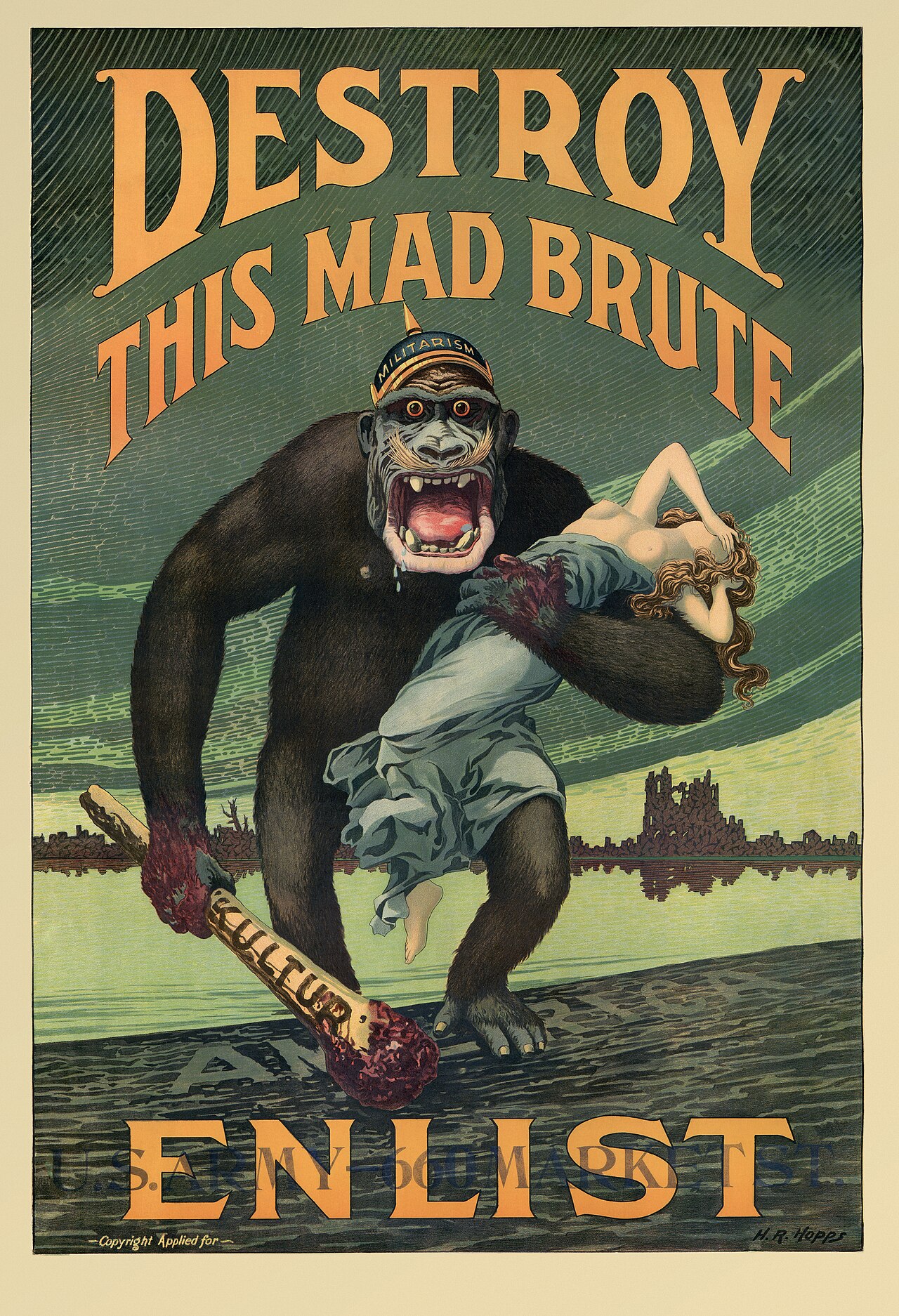
The archive's description of the picture: a rampaging ape in a German helmet carries off a half-naked woman and steps onto American shores with that club. The enemy arrives as one body, already ashore.
Who made it and why
FRAME credits the U.S. Army for recruitment and the artist Harry Ryle Hopps, 1917, Wilson administration. Source line: Library of Congress via Wikimedia Commons, retrieved 25 September 2026, LC-USZC4-4696. Rights note: public domain, author died 1937, term expired. Purpose: recruit.
The job was to make a man feel the war at his own door. A map of the Western Front does not do that in one glance. An ape on a beach does.
What it got right or wrong
Imperial Germany was a real belligerent, and "militarism" was a real charge in the Allied case, one Americans could accept or reject with evidence. The poster throws the evidence out. A beast cannot have war aims, a parliament, or civilians who are not the woman in its arm. Once the enemy is an animal, enlistment is pest control. That is the wrong the sheet does, even if the war itself was justified.
Content note: the ape and the club-word are quoted as the object, which is racist in the way it pictures a European enemy and sexual in the way it pictures the woman. Both are part of the method.
The constitutional and liberty angle
Enlistment here is still a request. The poster does not cite the Selective Service Act. The liberty problem is upstream of the signature at the recruiting station: a citizen asked to hate a caricature is a citizen less able to judge the war his representatives declared. The First Amendment also covers the artist. The government may print this. The rest of us may say it is a lie about human beings. Both are American. Only one of them is this poster.
Its legacy
The ape-at-the-shore picture is a template, and later wars found their own beasts. What to keep from Hopps is the small honest word at the bottom, "Enlist," and the refusal to let the rest of the sheet define a people. Destroying a brute is not a policy. It is an excuse for not having one on the page.
Sources
FRAME object record, "Destroy This Mad Brute — Enlist," 1917. Harry Ryle Hopps for U.S. Army recruitment. Library of Congress, LC-USZC4-4696.