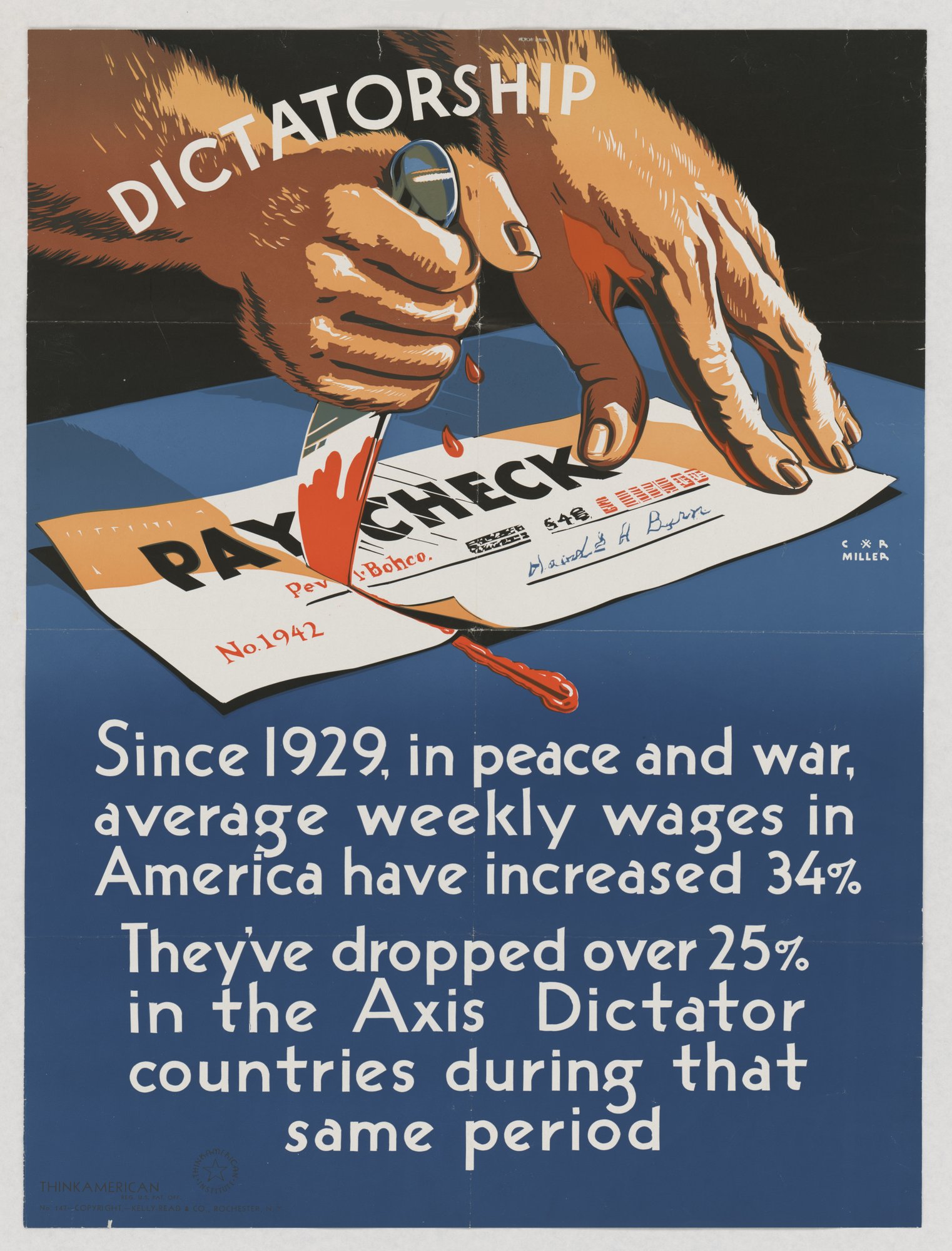
A Think American Institute poster catalogued at 1941, signed C. R. Miller and copyrighted by Kelly-Read and Co. of Rochester, shows a hairy hand marked "Dictatorship" driving a bloody knife through a pay check. The text says American weekly wages rose 34 percent since 1929 while Axis wages fell over 25 percent. NAID 515424.
What the sheet prints
A large, hairy hand, labelled DICTATORSHIP, drives a knife down through a pay check on a table. There is blood on the blade and on the wood. Beside the picture are two statistics and nothing else.
DICTATORSHIP
PAY CHECK
Since 1929, in peace and war, average weekly wages in America have increased 34%.
They've dropped over 25% in the Axis Dictator countries during that same period
[signature:] C R MILLER
[imprint:] THINKAMERICAN INSTITUTE (seal)
[imprint:] No. 147-COPYRIGHT,-KELLY-READ & CO., ROCHESTER, N.Y. [partly illegible]
Who issued it
The imprint names the Think American Institute and a copyright held by Kelly-Read and Co. of Rochester, New York, with the artist C. R. Miller. That is a private publisher's series, numbered 147. The National Archives holds a copy in Record Group 44 as 44-PA-1752, and the rights line as the archive records it calls it a U.S. government work. The sheet's own copyright notice says otherwise, and this page notes the conflict without settling it. The date is also loose: the catalog says 1941, while the check in the picture carries "No.1942." This page uses the catalog date.
How to read it
FRAME tags fear appeal and card stacking. The fear is the knife and the blood. The card stacking is in the numbers: two percentages, no source, no definition of wages, no account of prices, and no list of which countries count as "Axis Dictator countries." The figures might be roughly right. The poster gives the reader no way to find out.
The underlying argument is one a free-market reader can share: a dictatorship that controls labor and industry is a threat to the worker's pay, and free enterprise had a case to make. The trouble is that the poster makes the case by shouting rather than showing. A claim about wages is exactly the kind of claim that can be checked, and a sheet confident in its numbers would print where they came from. The Institute for Propaganda Analysis told readers to ask for that, and the advice applies to a message you agree with as much as to one you don't.
Sources
- FRAME object record, Dictatorship: since 1929, in peace and war, average weekly wages in America have increased 34%, catalogued 1941. Think American Institute (Kelly-Read and Co., Rochester, N.Y.); artist C. R. Miller.
- U.S. National Archives and Records Administration, Record Group 44, NAID 515424 (44-PA-1752), retrieved by the archive 4 October 2026. Rights as recorded: public domain (U.S. government work), Think American Institute / Kelly-Read and Co.