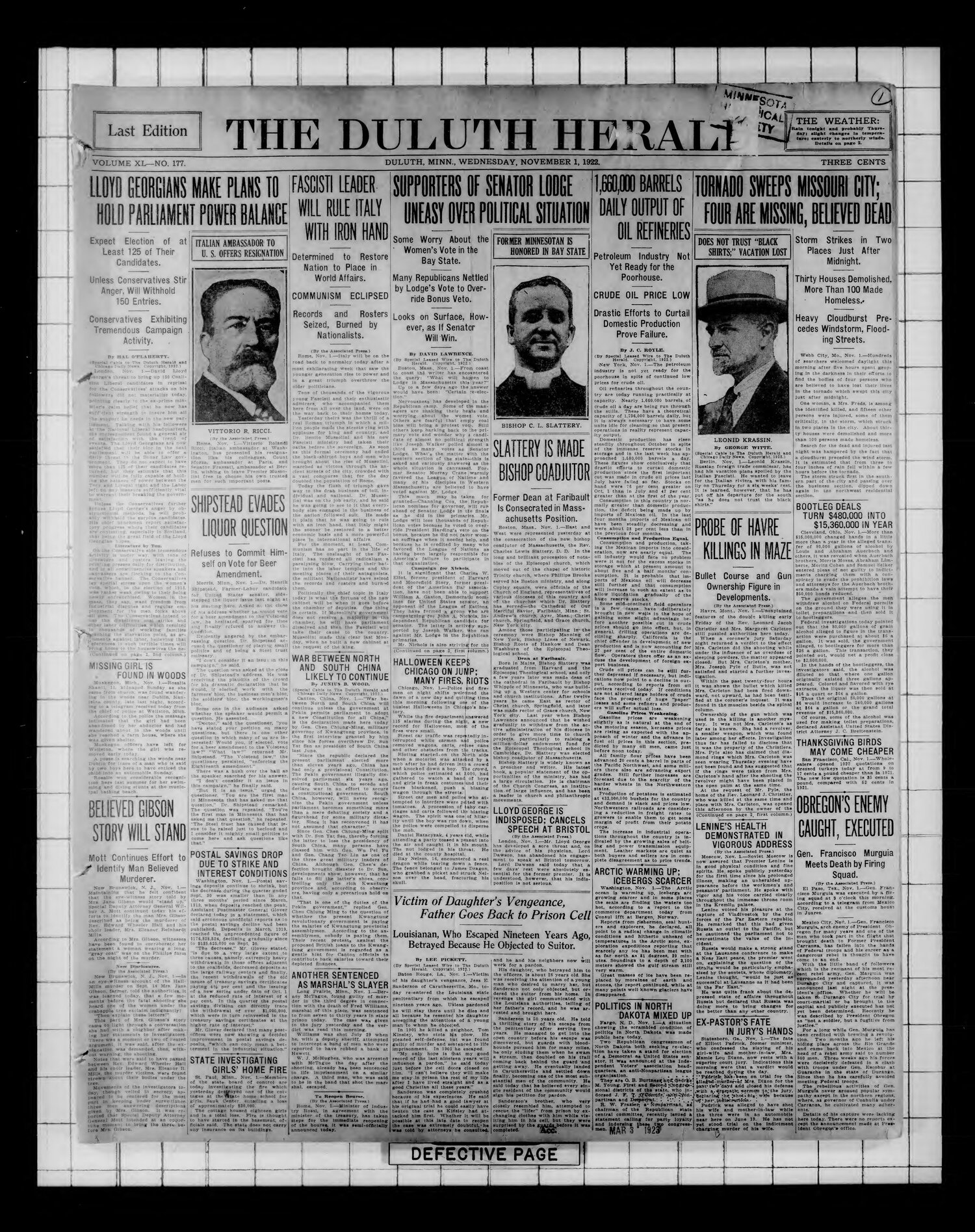
The Duluth Herald of 1 November 1922 ran Associated Press copy from Rome under the headline "Fascisti Leader Will Rule Italy with Iron Hand." The story describes the seizure and burning of opponents' records as communism being eclipsed.
The page
This is the Last Edition of a Duluth daily for Wednesday, 1 November 1922. The Mussolini story sits in the second column. It is wire copy, credited on the page to the Associated Press and datelined Rome the same day. A small box beside it reports that Italy's ambassador to the United States had offered his resignation. The FRAME record files the page under the March on Rome.
FASCISTI LEADER WILL RULE ITALY WITH IRON HAND
Determined to Restore Nation to Place in World Affairs.
COMMUNISM ECLIPSED
Records and Rosters Seized, Burned by Nationalists.
[...] For the moment, at least, Communism has no part in the life of Italy. The onslaught of the Fascisti has rendered all radicalism a paralyzing blow. Carrying their battle into the labor temples and the meeting places of their antagonists, the militant Nationalists have seized the records and rosters and burned them.
How to read it
Nothing here was written in Duluth or by any American government office. The persuasion is in the wire reporter's choice of words, which a local paper then set in large type. The young men in black shirts are "vigorous." Their march is "a real Roman triumph." The week was "most exhilarating." A million people cheered "for king and country."
Read the last paragraph slowly. Partisans entered union halls and the meeting rooms of rival parties, took the membership lists, and burned them. The story files that under "Communism Eclipsed," as if the only people on those rosters were communists and the only question were whose side won. An American reader would not accept that account of a mob raiding a union hall in Minnesota. The rule against it does not change at the Italian border. Lists of members are exactly what a free association has to be able to keep from its enemies.
FRAME tags the page for card stacking: the triumph is told in full and the cost is told as a victory. That device is one of the seven the Institute for Propaganda Analysis later taught Americans to spot. The record does not show what Duluth readers made of the story.
Sources
- FRAME object record, The Duluth Herald, daily edition, front page, 1 November 1922. Associated Press copy datelined Rome.
- Wikimedia Commons, Duluth Herald Vol. 40 No. 177, 1922-11-01 (Internet Archive digitisation), retrieved by the archive 2 October 2026. Rights as recorded: public domain in the United States (published before 1 January 1931).