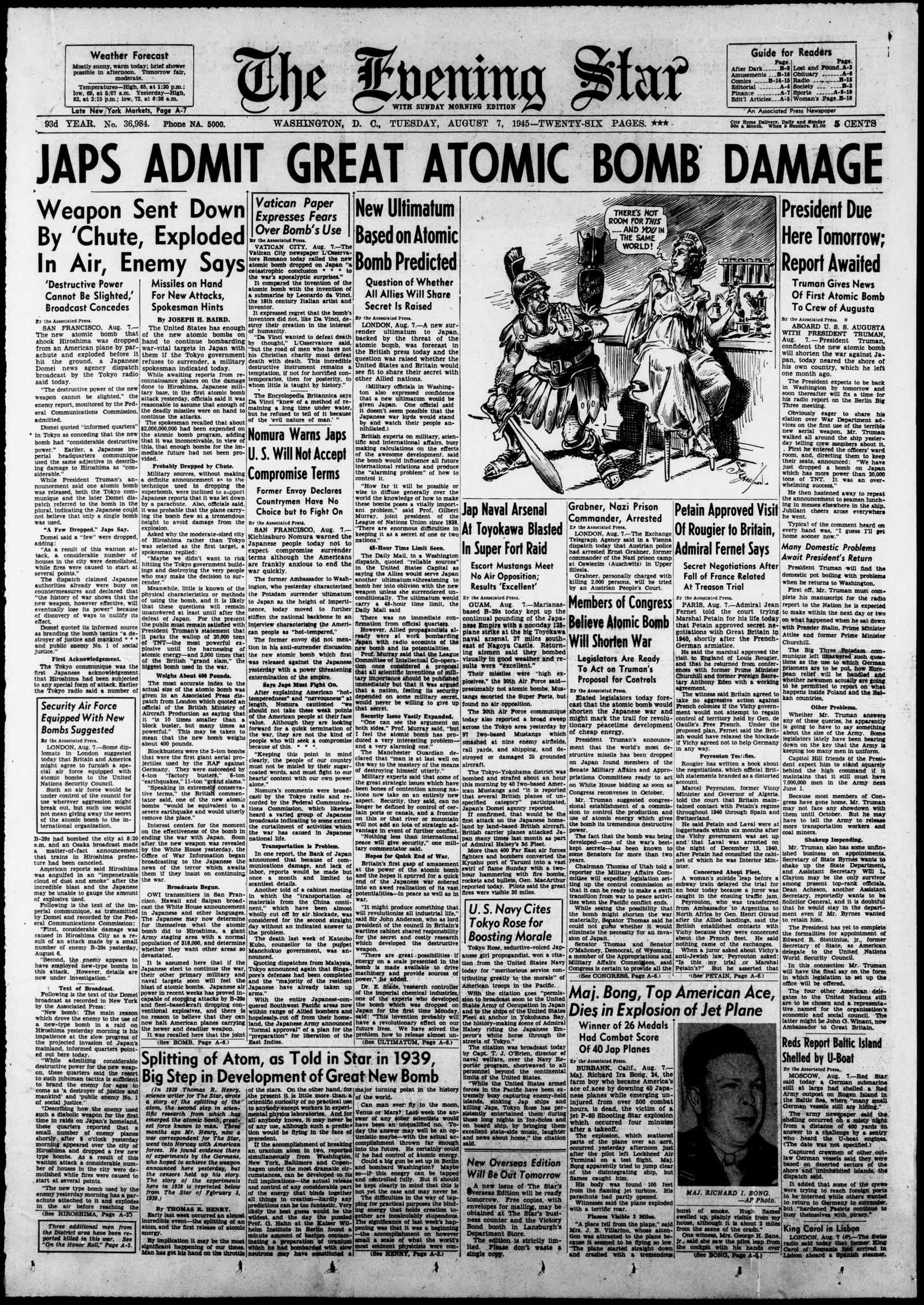
The Evening Star, daily edition, front page (Washington, D.C., August 7, 1945)
"Japs Admit Great Atomic Bomb Damage": Washington's Evening Star the day after Hiroshima
Evening Star front page, 7 August 1945: the banner "JAPS ADMIT GREAT ATOMIC BOMB DAMAGE," an AP lead from a Tokyo broadcast, and Congress and the Vatican
Identified Openly sourced: the speaker is who they say they are
Source
Library of Congress, Chronicling America , retrieved October 2, 2026
Source
Public domain / no known copyright restrictions (Library of Congress statement) The Evening Star (Washington, D.C.), 7 August 1945, p. A-1; Library of Congress, Chronicling America (LCCN sn83045462)
Object, image, and catalog record from the FRAME archive. Text on this page is CC BY 4.0. Image rights are as the archive records.
The front page of Washington's Evening Star for 7 August 1945, the day after the first atomic bomb. The banner reads "JAPS ADMIT GREAT ATOMIC BOMB DAMAGE." The lead is an Associated Press story built on a Japanese Domei broadcast, and smaller heads carry Truman, Congress, the Vatican and a cartoon.
The page
Content note: the banner headline uses the wartime slur for Japanese people. It is quoted here as the newspaper printed it.
A Tuesday paper, twenty-six pages, five cents, with "An Associated Press Newspaper" under the masthead. The banner runs the full width. Under it the lead story and a column of smaller headlines divide the news of the bomb by source: the enemy's radio, the President, Congress, the Vatican, and the paper's own back files. A cartoon sits among them.
JAPS ADMIT GREAT ATOMIC BOMB DAMAGE
Weapon Sent Down By 'Chute, Exploded In Air, Enemy Says
'Destructive Power Cannot Be Slighted,' Broadcast Concedes
[…]
Vatican Paper Expresses Fears Over Bomb's Use
New Ultimatum Based on Atomic Bomb Predicted
[…]
Members of Congress Believe Atomic Bomb Will Shorten War
[…]
Splitting of Atom, as Told in Star in 1939, Big Step in Development of Great New Bomb
THERE'S NOT ROOM FOR THIS ... AND YOU IN THE SAME WORLD!
Where the news came from
The lead story is datelined San Francisco and credited to the Associated Press. Its first sentence reports what a Japanese Domei news agency dispatch, broadcast by Tokyo radio, said about the bomb: that it came down by parachute and burst before it hit the ground. FRAME's record adds that the Federal Communications Commission monitored the broadcast. So the lead account of the weapon on this front page was the enemy's own, passed through a federal listening service and a wire service.
The other heads are attributed too. One head reports that Truman gave the news to the crew of the Augusta. Members of Congress "believe" the bomb will shorten the war. A Vatican paper "expresses fears." One head reminds readers that the Star wrote about splitting the atom in 1939.
How to read it
FRAME tags the page name-calling and card stacking. The name-calling is in the banner and in two smaller heads, one on Nomura's warning and one on a naval arsenal, where the same slur is used. That was common newspaper style in 1945, and it was wrong then as it is now: a word for a whole people was used as the name of an enemy government and army.
The card stacking is the selection. The bomb arrives on this page as a victory reported by the losing side, a weapon that will shorten the war, and a future ultimatum. The record transcribes only the first sentence of the lead, so this page cannot say what the story reported about the people of Hiroshima, and it does not guess.
One thing the page did right deserves notice. On the first full day of the atomic age a Washington paper put a religious authority's fears about the weapon on its front page beside the official account. Nobody had to license that. The Atlanta Daily World of the same date gave the bomb a single column under its own Okinawa banner. Both are on the civil defense and atomic age hub.
Sources
FRAME object record, The Evening Star, daily edition, front page (Washington, D.C., August 7, 1945).
Library of Congress, Chronicling America, The Evening Star, 7 August 1945, p. A-1 (LCCN sn83045462), retrieved by the archive 2 October 2026. Rights as recorded: public domain, no known copyright restrictions (Library of Congress statement).