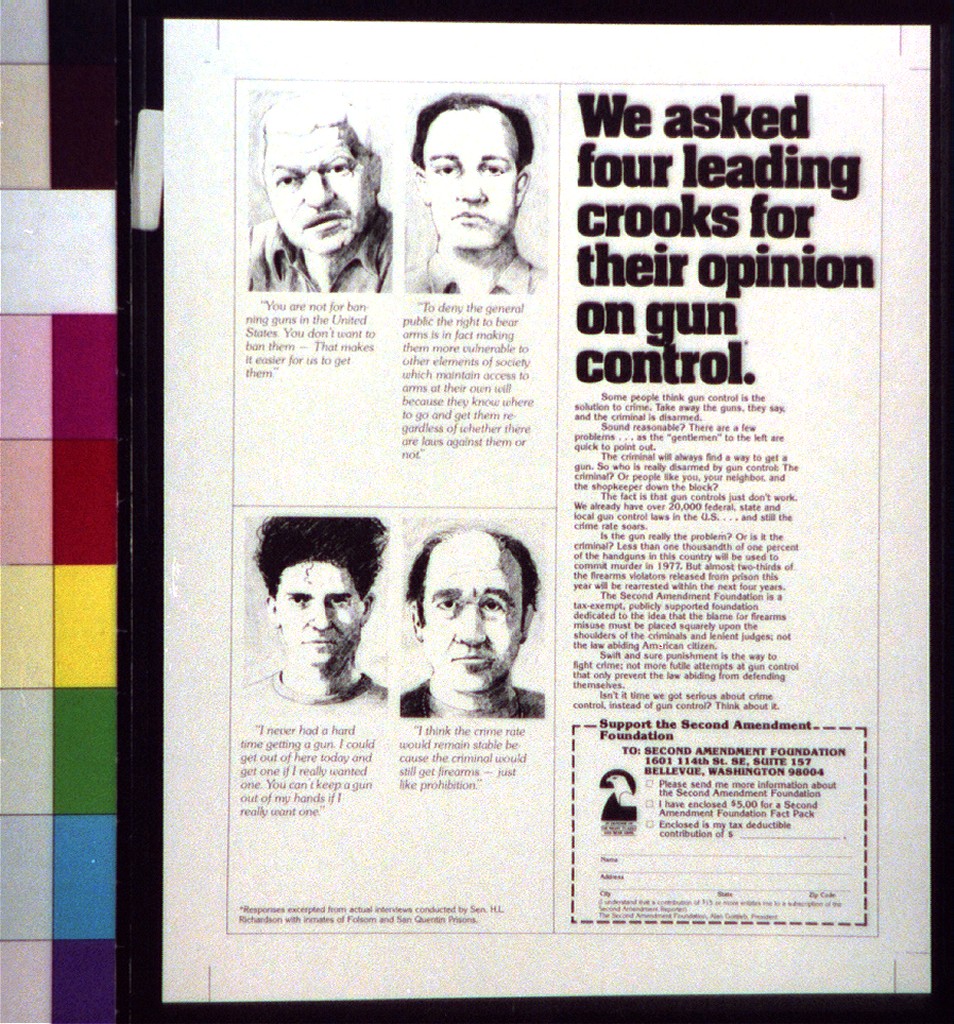
A 1977 Second Amendment Foundation poster prints drawn portraits of four inmates beside their quoted views on gun control, then argues for crime control instead and asks for contributions. Library of Congress.
What the sheet prints
Four drawn faces run down one side, each with a quotation. The other side carries the foundation's argument, a coupon, and a footnote on where the quotations came from. An excerpt from the FRAME transcription:
We asked four leading crooks for their opinion on gun control.
"You are not for banning guns in the United States. You don't want to ban them — That makes it easier for us to get them."
[...]
The fact is that gun controls just don't work. We already have over 20,000 federal, state and local gun control laws in the U.S. . . . and still the crime rate soars.
Is the gun really the problem? Or is it the criminal? Less than one thousandth of one percent of the handguns in this country will be used to commit murder in 1977.
[...]
Isn't it time we got serious about crime control, instead of gun control? Think about it.
[...]
*Responses excerpted from actual interviews conducted by Sen. H.L. Richardson with inmates of Folsom and San Quentin Prisons.
Who issued it
The Second Amendment Foundation of Bellevue, Washington, signs the poster, with Alan Gottlieb named as president. The coupon offers a $5.00 "Fact Pack" and a subscription to the Second Amendment Reporter for gifts of $15 or more. The Library of Congress holds it as item 2016648118 with no known restrictions; the archive retrieved it on 27 September 2026.
How to read it
The witnesses are the surprise. Inmates are not usually offered as authorities, and here their word is the proof that a criminal can always get a gun. The interviews are credited to "Sen. H.L. Richardson," and the inmates are not named, so a reader cannot check the full answers.
The numbers lean the same way the 1976 control poster's did, from the other direction. Dividing one year's murders by every handgun in the country yields the smallest fraction available. A count of 20,000 laws set beside a rising crime rate implies the laws failed, without saying what crime would have done without them.
The underlying argument is a serious one. Whether restrictions fall mostly on people who obey them is a fair question, and the right of a law-abiding person to defend himself is in the Constitution, not a favor from the legislature. The poster's statistics do not settle that question, and its case is stronger without them.
Its counterpart is "We need handguns like we need a hole in the head". The pair is read in the case study Two lobbies, one toolbox.
Sources
- FRAME object record, "We asked four leading crooks for their opinion on gun control," 1977. Second Amendment Foundation. Library of Congress, Prints and Photographs Division, retrieved by the archive 27 September 2026. Rights as recorded: public domain (published without copyright notice c. 1976-77; no known restrictions on publication).