What it said
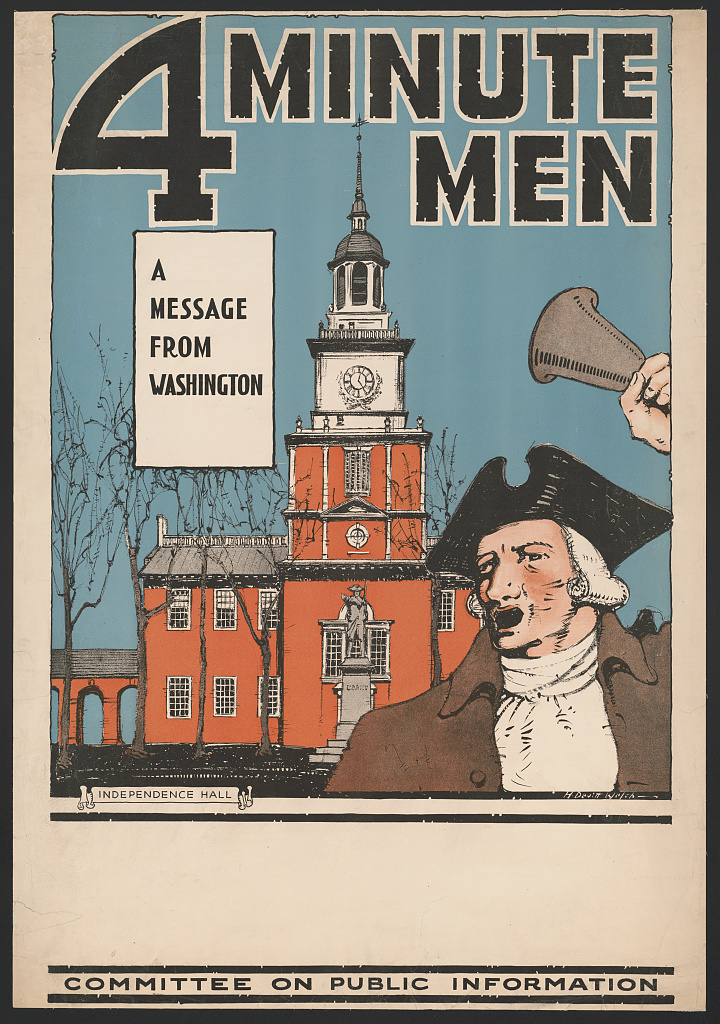
4 MINUTE MEN
A MESSAGE FROM WASHINGTON
INDEPENDENCE HALL
COMMITTEE ON PUBLIC INFORMATION
A crier in a tricorn rings a bell in front of Independence Hall. The card in the picture says the message is from Washington. The committee's name is at the foot, which is more honesty than the costume suggests.
Who made it and why
FRAME attributes the sheet to the Committee on Public Information, Four Minute Men division, artist H. Devitt Welsh, 1917. Library of Congress, LC-DIG-ppmsca-53577. Public domain in the United States as a pre-1931 publication. Issuer type on the record: state. Purpose: mobilize or secure compliance.
The division sent volunteer speakers into cinemas during reel changes, with topics and model talks from Washington. The committee's own final report later counted 75,000 speakers and 755,190 speeches. Those are the committee's counts, not an independent census. A slide was supposed to tell the audience the speaker was there under the committee. The poster does the same job in ink: it names the Committee on Public Information, then wraps the name in 1776.
What it got right or wrong
Right: the sponsor is printed. A viewer who reads the bottom line knows this is not a lost broadside from the Revolution. Wrong, as civics: the tricorn, the hall, and the "Minute Men" name transfer the standing of a local militia, raised against a distant government, onto a bulletin from that kind of government. The 1775 minute companies were neighbors. These speakers read copy from a federal office. The rhyme is the trick.
The constitutional and liberty angle
The speakers were volunteers. That is the part worth keeping. No statute in this poster's text compelled a man to stand up between reels. The pressure sat elsewhere in 1917 and 1918, in the Espionage Act and the Sedition Act, which the Justice Department enforced, and in copy that asked citizens to report a neighbor who "cries for peace." This sheet is the open, named end of the same administration's publicity. Disclosure is what a free audience is owed. Costume is what they have to see through.
Newton Baker, the secretary of war, later said the mobilizing of opinion around American participation "was in a sense the work of the Committee on Public Information." He said it at a dinner for George Creel on 29 November 1918, printed as the foreword to Creel's How We Advertised America (1920). The poster is that work with a bell.
Its legacy
Four minutes is short enough to dodge argument. The form survived: a prepared talk, a captive room, a symbol older than the agency. The useful remnant is the line at the bottom. If a message from Washington needs Independence Hall to land, read the message twice.
Sources
- FRAME object record, "4 Minute Men: A Message from Washington," 1917. Committee on Public Information; H. Devitt Welsh. Library of Congress, LC-DIG-ppmsca-53577.
- Committee on Public Information final report counts of speakers and speeches, as given on the FRAME case study of the committee.
- Newton D. Baker, 29 November 1918, foreword to George Creel, How We Advertised America (New York: Harper & Brothers, 1920), p. xiii, as quoted on the FRAME Wilson administration page.