What it said
NORMAN ROCKWELL
Freedom of Speech
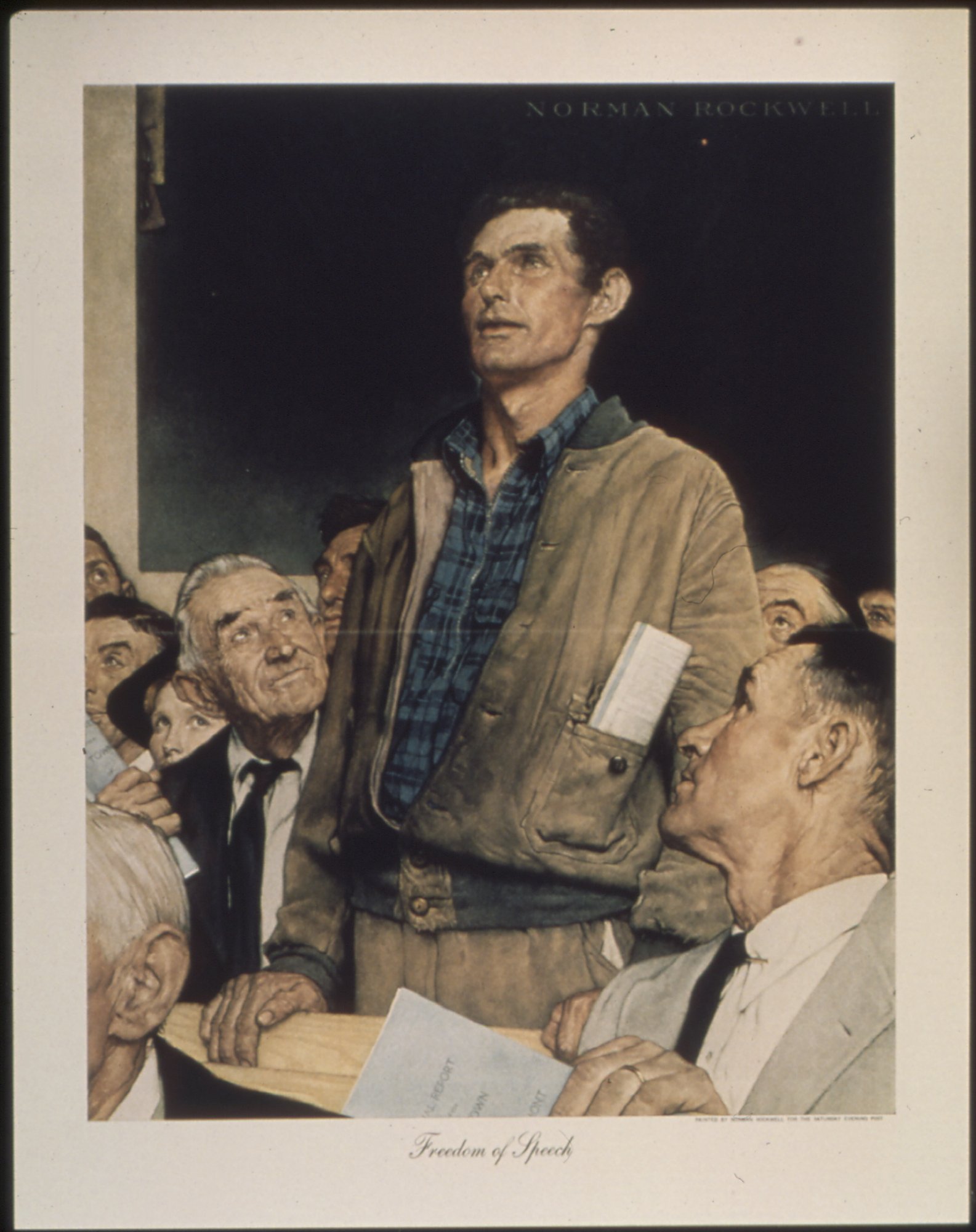
The archive describes the picture: a man in a worn jacket stands to speak at a town meeting, and seated neighbors look up at him. No slogan tells them they must agree.
Who made it and why
FRAME's maker line: Norman Rockwell for The Saturday Evening Post, and the Office of War Information, 1941, Roosevelt administration. Source: U.S. National Archives and Records Administration, Record Group 44, World War II Posters, retrieved 4 October 2026. Rights: public domain as a U.S. government work. The record cites RG 44, 44-PA-75, NAID 513536. Purpose: persuade or win support. The painting was made for the Post and then carried as a government poster. A magazine commission and a state imprint are not the same act. The sheet in the archive is the government one.
What it got right or wrong
It gets the ideal right as an ideal. Speech in America is supposed to look like this: a person without rank, a room that has to listen, no one dragged out for the attempt. It gets the wartime country wrong if the viewer thinks the painting was the policy. The same administration ran mail censorship, script review in Hollywood, and the exclusion of Japanese Americans under Executive Order 9066. A town meeting on canvas does not cancel those. It also does not make them the whole story. Americans did stand up in real rooms, including against the war, and some of them paid for it. The picture is the promise. The docket is the test.
The constitutional and liberty angle
The First Amendment binds Congress, and through later doctrine the states. It does not bind a neighbor to be polite, which is all the painting can show. Politeness is not the right. The right is the one that still exists when the room hates the speaker. Rockwell's man is brave in a friendly hall. The constitutional case is the hostile one: Debs in 1918, the Jehovah's Witnesses who refused a flag salute, a paper the postmaster would not carry. Those are not in the frame. A libertarian reading keeps the painting as a picture of a custom worth having, and refuses to let the Office of War Information spend it as proof that speech was safe because a poster said so.
Its legacy
The four freedoms became a bond drive. "Save Freedom of Speech: Buy War Bonds" is a separate OWI sheet in the same collection. Buying a bond does not enlarge the First Amendment. Remembering the painting might, if it sends someone back to the cases rather than to the catalog. The man should be allowed to finish his sentence. The government should be required to let him.
Sources
- FRAME object record, "Freedom of Speech," 1941. Norman Rockwell for The Saturday Evening Post; Office of War Information. NARA, RG 44, 44-PA-75, NAID 513536.