What it said
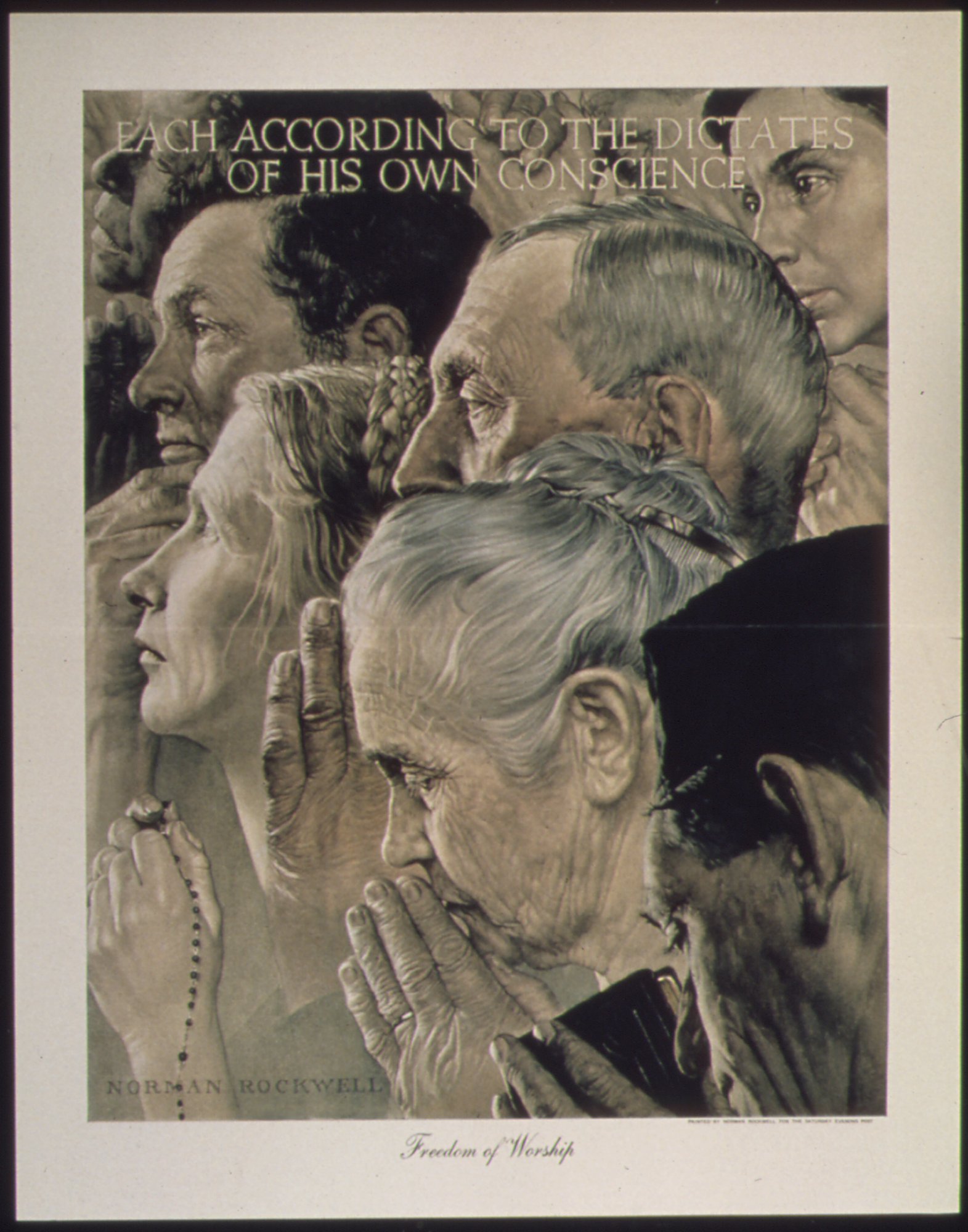
EACH ACCORDING TO THE DICTATES
OF HIS OWN CONSCIENCE
NORMAN ROCKWELL
Freedom of Worship
The archive describes faces in profile, hands clasped or raised, one rosary, under that legend. Several traditions share the rectangle. None is shown being left alone by an official.
Who made it and why
Same trail as the speech painting: Rockwell for the Saturday Evening Post, Office of War Information, 1941. NARA, Record Group 44, 44-PA-76, NAID 513537, retrieved 4 October 2026. Public domain as a government work. The line about conscience echoes older American religious language. It is not, on this sheet, a citation of the First Amendment's text.
What it got right or wrong
Right: the country does not have a national church, and the picture refuses to pick one face as the faithful American. Wrong if "worship" is taken to mean only the quiet, respectable prayer the painting prefers. Conscience also covers the person who will not pray, and the person whose rite looks nothing like this crowd. A glittering generality, which is how the archive tags the sheet, can honor a freedom and sand off its edges in the same glance.
The constitutional and liberty angle
The amendment is a limit on Congress: no establishment, no prohibition of free exercise. It is not a poster series. Wartime governments have treated odd faiths as disloyal. The libertarian point is the sharp one. Worship is free when the state cannot compel it, tax it for a rival altar, or punish its absence. A painting of devout profiles, issued to rally a war, is protected speech by the painter and by the government as speaker. It is not itself the protection. The protection is the clause that would still bind the Office of War Information if a citizen's conscience pointed the other way.
Its legacy
Paired with the speech canvas, this sheet taught a generation to picture rights as neighbors behaving well. That is a lovely custom and a weak constitution. Customs break in a panic. The text does not, unless the courts and the voters let it. Keep the painting. Read the amendment beside it, not underneath it as a caption the artist never lettered.
Sources
- FRAME object record, "Freedom of Worship," 1941. NARA, RG 44, 44-PA-76, NAID 513537.