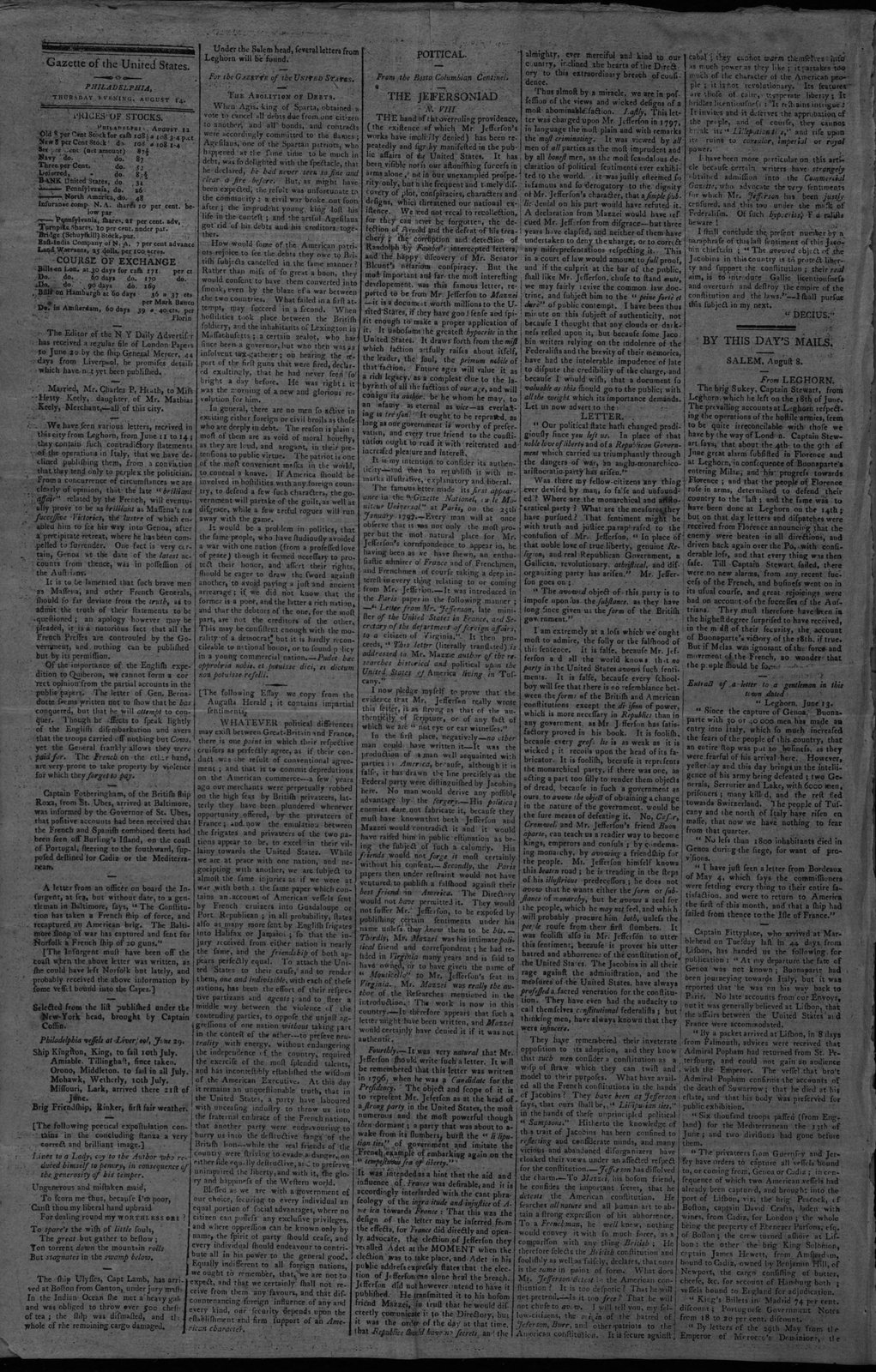
A Philadelphia Federalist daily reprinted an essay signed "Decius" from the Boston Columbian Centinel. It attacks Thomas Jefferson over the Mazzei letter and calls his party "Jacobins" who mean to destroy the Constitution.
What the page prints
This is page 2 of the Gazette of the United States & Daily Advertiser, Philadelphia, for Thursday evening, 14 August 1800. Under the heading "Political" sits the eighth installment of a series called "The Jeffersoniad," taken from the Boston Columbian Centinel and signed "Decius." The archive transcribed only the headline block and two passages, because the scan is dark and dense. The gaps below are omissions, not illegible text.
THE JEFFERSONIAD. N. VIII.
[...] Thus almost by a miracle, we are in possession of the views and wicked designs of a most abominable faction. [...]
I shall conclude the present number by a paraphrase of this last sentiment of this Jacobin chieftain; "The avowed object of the Jacobins in this country is to protect liberty and support the constitution; their real aim, is to introduce Gallic licentiousness and overturn and destroy the empire of the constitution and the laws."---I shall pursue this subject in my next.
"DECIUS."
How the argument works
The essay's target is the so-called Mazzei letter, which Decius says was "charged upon Mr. Jefferson in 1797." The writer then says that "a simple public denial on his part would have refuted it," which leaves the reader to treat Jefferson's silence as guilt. That is a trap, not a proof. A man who answers every newspaper charge has no time left to govern, and a man who does not is convicted by default.
The heavier move is the label. "Jacobin" borrowed the name of a French revolutionary faction, and the essay makes the foreign tie explicit with "Gallic licentiousness." An American opposition party becomes an agent of France. The closing paraphrase concedes that Jefferson's side says it wants to "protect liberty and support the constitution," then tells readers that the stated aim is a mask. An opponent's own words are turned into evidence against him. The archive tags the page for name-calling, fear appeal, ad hominem, and straw man, and each tag is visible in the excerpt.
Why it matters for a free press
This was a party newspaper doing what party newspapers did in 1800, and the republic survived it. The Republican side answered in print: the archive holds the Richmond Virginia Argus of 16 September 1800, which printed the Mazzei letter with a rebuttal. Charge and answer, both in public, is the American method. The remedy for "Decius" was another newspaper, not a prosecutor. For the earlier habit of reducing a political fight to one picture or one word, see patriot and loyalist print. The case study on the election of 1800 quotes this essay and sets it beside the Sedition Act and the handover of power that followed.
Sources
- FRAME object record, Gazette of the United States, "The Jeffersoniad" no. VIII, 14 August 1800. Gazette of the United States & Daily Advertiser, Philadelphia; essay signed "Decius," reprinted from the Boston Columbian Centinel.
- Scan: Internet Archive, Chronicling America / Library of Congress, LCCN 84026272, per_gazette-of-the-united-states-daily-advertiser_1800-08-14_1, retrieved by the archive 2 October 2026. Rights as recorded: public domain by publication date.