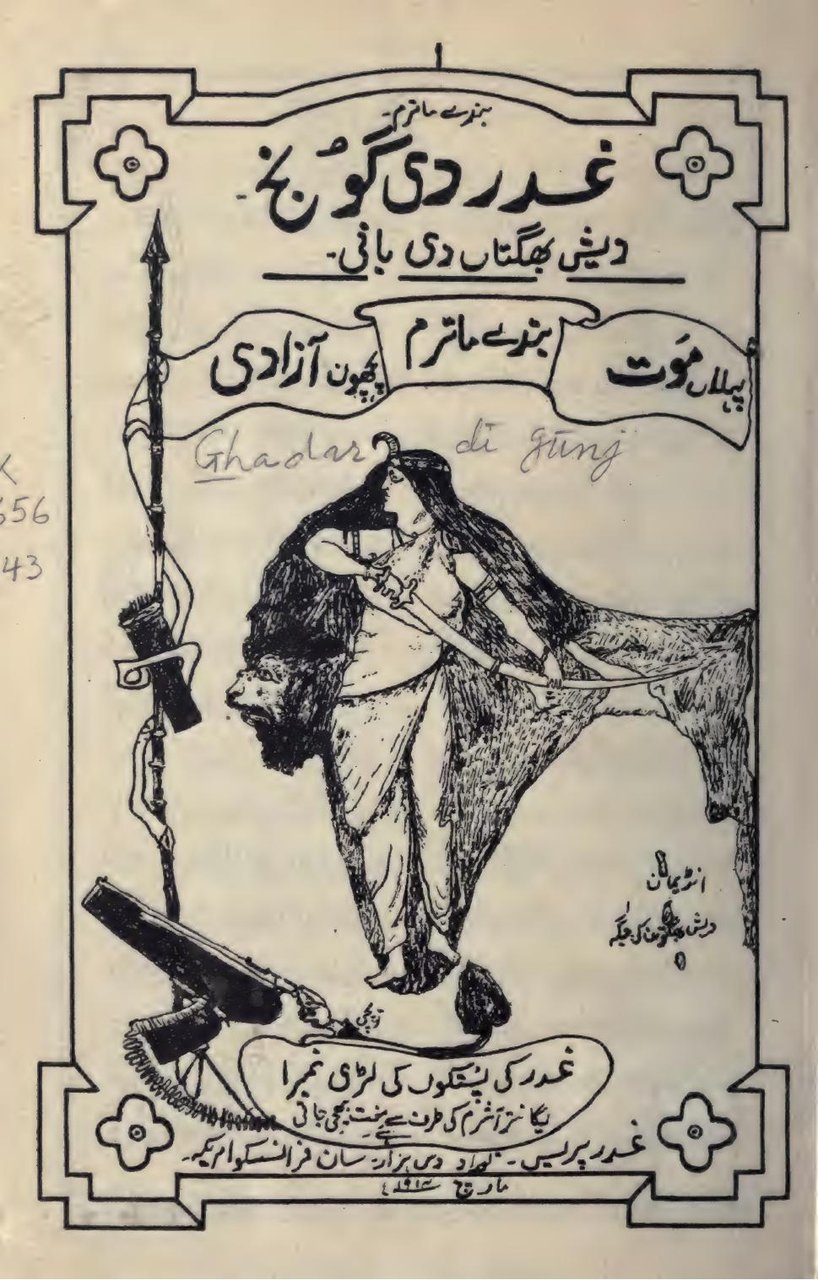
Ghadar di Gunj, verse pamphlet, cover (San Francisco, March 1914)
Ghadar di Gunj (San Francisco, 1914), "First death, afterwards freedom"
Cover of Ghadar di Gunj, Punjabi verse from the Ghadar Press, San Francisco, March 1914: banners read "First death" and "Afterwards freedom."
Techniques named on the archive record
Transfer
Date
March 1914
Made by
Ghadar Party (Hindustan Ghadar), Ghadar Press, San Francisco
Medium
Books and pamphlets
Country
United States
Regime
Wilson Administration
Source
Identified Openly sourced: the speaker is who they say they are
Source
Internet Archive (scan from the Robarts Library, University of Toronto) , retrieved October 2, 2026
Source
Public domain in the US: published 1914, before 1931; Internet Archive scan, no rights statement (NOT_IN_COPYRIGHT) Ghadar Press, San Francisco, March 1914; University of Toronto Robarts Library copy, via Internet Archive
Object, image, and catalog record from the FRAME archive. Text on this page is CC BY 4.0. Image rights are as the archive records.
The cover of Ghadar di Gunj, a pamphlet of Punjabi patriotic verse from the Ghadar Press in San Francisco, dated March 1914. A woman with a drawn sword stands before a spear, quiver, and rifle under three banners: "First death," "Bande Mataram," "Afterwards freedom." University of Toronto copy via the Internet Archive.
Content note: the cover shows a woman with a drawn sword beside weapons, under a slogan of death before freedom. It is described as printed.
The cover
A woman holds a drawn sword. Behind her stand a spear, a quiver, and a rifle, and beside her lies a large animal hide with a lion's head. Over the scene run three banners. The lettering is in Punjabi, written in the Shahmukhi (Urdu) script, and the archive's transcriber marks the small labels and the bottom oval as only partly legible rather than guessing at them.
بندے ماترم
غدر دی گونج
دیشی بھگتاں دی بانی
[banner, left] پچھوں آزادی
[banner, centre] بندے ماترم
[banner, right] پہلاں موت
[...]
غدر پریس - تعداد دس ہزار - سان فرانسسکو امریکہ
مارچ ۱۹۱۴ء
[English, from the archive's translation:]
Bande Mataram
Echo of the Ghadar (Revolt)
Voice/utterance of the country's devotees (patriots)
[banners] Afterwards freedom / Bande Mataram / First death
[...]
Ghadar Press - print run ten thousand - San Francisco, America
March 1914
Reading the banners
Read from right to left, the order the archive's description follows, the banners give a sequence: first death, then Bande Mataram, then freedom. The cover's one tag in the archive is transfer. The figure of a motherland with a sword, the weapons, and the lion's hide borrow the authority of the sacred and the heroic and lend it to armed resistance. The verse inside is described as patriotic; this page has only the cover.
The imprint is the most concrete line. It names the Ghadar Press, San Francisco, America, and dates the pamphlet March 1914. It also gives a print run that the transcriber reads, with a caution, as ten thousand.
Printed in America
This is propaganda for a cause abroad, printed on American soil. The record does not say how copies traveled or who read them. What it shows is that a press in San Francisco could print, in 1914, a cover that praised armed resistance and named its press and its city on the front.
A free country can let people print what other governments would suppress, and still punish acts that break its own laws. Printing and doing are different things, and a republic should keep them apart. The Wilson administration essay covers how the federal government treated speech in these years. Another paper printed in California for a movement across a border, the Spanish-language Regeneración in Los Angeles, attacked the U.S. government directly.
Sources
FRAME object record, Ghadar di Gunj, verse pamphlet, cover (San Francisco, March 1914). Ghadar Party (Hindustan Ghadar), Ghadar Press, San Francisco. Translation as given by the archive, labeled a machine translation not verified by a fluent reader.
Internet Archive, scan from the Robarts Library, University of Toronto, archive.org, retrieved by the archive 2 October 2026. Rights as recorded: public domain in the US (published 1914, before 1931); no rights statement on the scan (NOT_IN_COPYRIGHT).