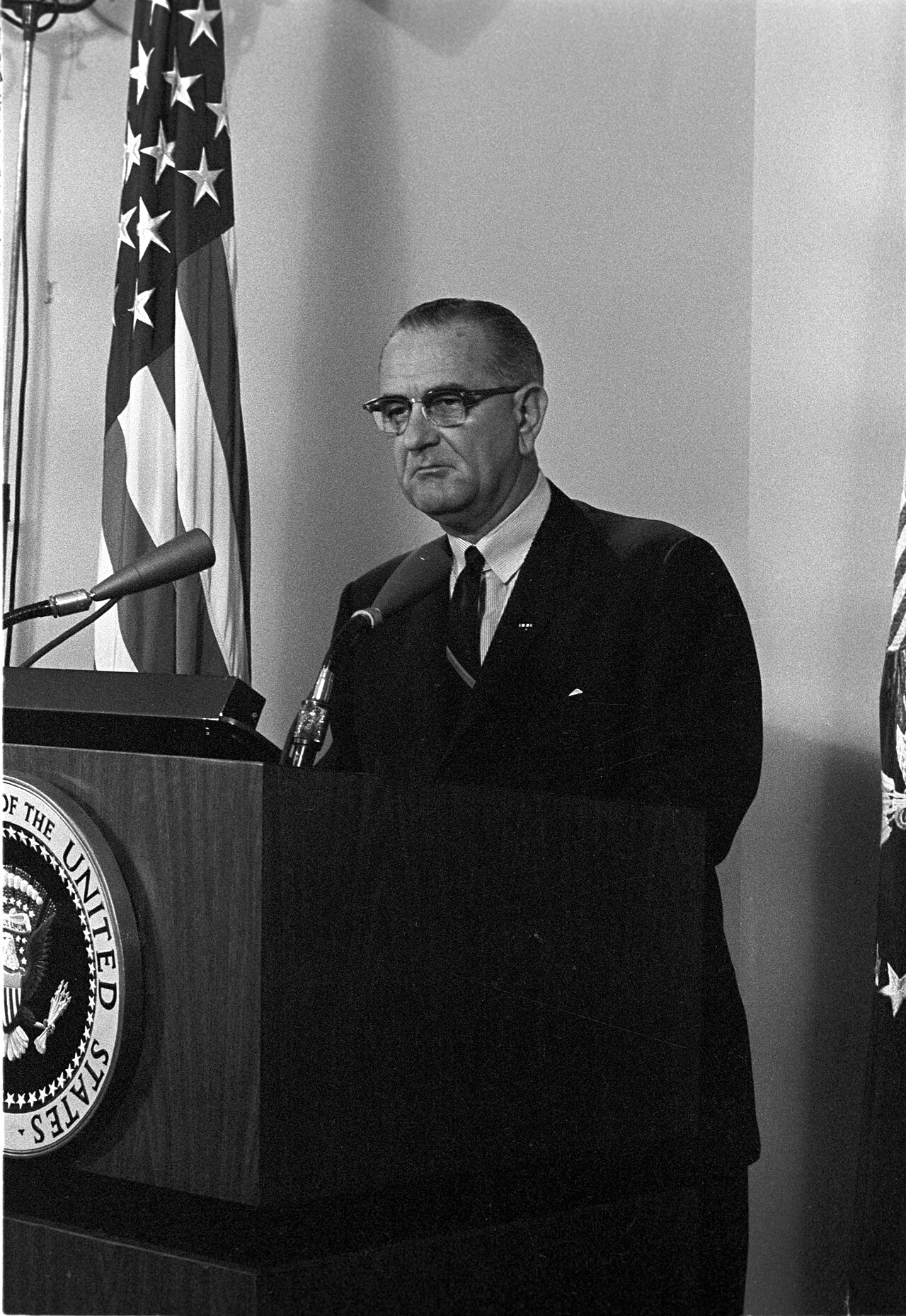
A White House photograph shows President Lyndon Johnson at the lectern for his televised address of 4 August 1964, reporting a second North Vietnamese attack on U.S. destroyers and announcing air strikes. NSA's historian later concluded the attack did not occur.
What the photograph shows
The object is a photograph of the broadcast, not a transcript of it. Johnson stands at a lectern bearing the presidential seal. The only legible words are fragments of that seal, which the FRAME transcription records as:
...OF THE UNITED STATES [visible arc of the Presidential Seal on the front of the lectern] / ...UNUM [fragment of the eagle's beak banner, the rest hidden behind the eagle's head]
The seal is the point of the picture. A president speaking late at night from behind it is the office itself vouching for what it says. The photograph is a White House Photo Office image held by the LBJ Presidential Library, part of the National Archives; the archive took it from Wikimedia Commons on 27 September 2026 as a public-domain government work.
What he said, and what followed
That night Johnson reported a second assault by North Vietnamese boats on American destroyers in the gulf and said U.S. aircraft would strike back. Three days on, Congress passed the Gulf of Tonkin Resolution. Later, Robert J. Hanyok, a historian at the National Security Agency, found that the second assault never happened, according to the archive record, and that the signals intercepts offered as proof had been shown selectively, without the rest of that day's traffic.
The constitutional angle
The Constitution gives Congress the power to declare war. In 1964 Congress used a resolution instead, and it acted on a report from the executive that turned out to be wrong. That is the lesson of this photograph, stated plainly: a legislature that votes within three days is voting on the word of the branch that wants the vote. The safeguard is evidence shown in full, and time to weigh it. Neither was there.
The case study Caveats in the vault, certainty at the podium sets this night beside a later one, the 2003 mobile-labs slide.
Sources
- FRAME object record, "President Johnson's Gulf of Tonkin 'Midnight Address'," 4 August 1964. U.S. government (President Lyndon B. Johnson). White House Photo Office, LBJ Presidential Library (NARA), via Wikimedia Commons, retrieved by the archive 27 September 2026. Rights as recorded: public domain (U.S. government work).