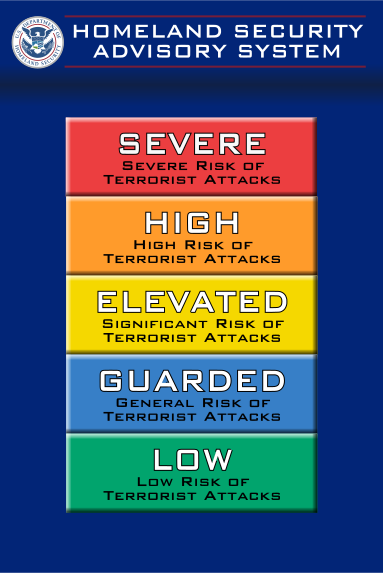
The Homeland Security Advisory System chart, a U.S. government graphic used from 2002 until its retirement in March 2011, ranked the national risk of terrorist attack in five colored levels from Low to Severe.
What the chart prints
Five stacked bands, green at the bottom and red at the top, under the department's seal. Each band has a one-word name and a short phrase. Read from the top down:
HOMELAND SECURITY
ADVISORY SYSTEM
SEVERE — Severe Risk of Terrorist Attacks
HIGH — High Risk of Terrorist Attacks
ELEVATED — Significant Risk of Terrorist Attacks
GUARDED — General Risk of Terrorist Attacks
LOW — Low Risk of Terrorist Attacks
Issuer and dates
The issuer is the U.S. Department of Homeland Security, and the chart is a federal work in the public domain. The archive dates the object to 2002 and its rights line gives the system's span as 2002 to 2011, ending with its retirement in March 2011. The image is the department's chart as kept on Wikimedia Commons.
How to read it
Notice the bottom band. Even "Low" is a risk of terrorist attacks. There is no level at which the chart tells the public nothing is expected. The scale only moves between degrees of danger.
The FRAME record names what the colors left out. There was no base rate attached to any level, so a citizen could not tell how likely "High" actually was. There was usually no place named and no specific thing to do beyond being watchful. And the intelligence that moved the dial up or down was rarely made public. The archive tags this as fear appeal and card stacking. The color carried the message, and the evidence stayed inside the government.
That last point is the libertarian concern. A warning system can be honest and still be unaccountable. When the public is told the level but not the reason, it cannot judge whether a change reflects new facts or something else, and it cannot weigh the warning against the powers requested in its name. Trust in such a system depends on disclosure the system was not built to give.
The same department later stood up and then shut down a Disinformation Governance Board, under an administration of the other party. The question each case raises is the same: what is the office for, and what will it not do?
Sources
FRAME object record, Homeland Security Advisory System threat-level chart, 2002. Issuer: U.S. Department of Homeland Security.
U.S. Department of Homeland Security, via Wikimedia Commons, Hsas-chart_with_header.svg, retrieved by the archive 25 September 2026. Rights as recorded: public domain (U.S. government work); system in use 2002-2011, retired March 2011.