How to Fight Fire Bombs (1942), the Office of Civilian Defense's revised method
The Office of Civilian Defense's 1942 fire-bomb sheet, revised July 1942, tells householders to hit an incendiary with a jet of water first, sand only as
Techniques named on the archive record
Plain folks
Date
1942
Made by
U.S. Office of Civilian Defense
Medium
Poster
Country
United States
Regime
Roosevelt Administration
NARA
NAID 514544; Record Group 44
Source
Identified Openly sourced: the speaker is who they say they are
Source
U.S. National Archives and Records Administration, Record Group 44, World War II Posters , retrieved October 4, 2026
Source
Public domain (U.S. government work) U.S. Office of Civilian Defense. National Archives and Records Administration, RG 44, 44-PA-1018 (NAID 514544).
Object, image, and catalog record from the FRAME archive. Text on this page is CC BY 4.0. Image rights are as the archive records.
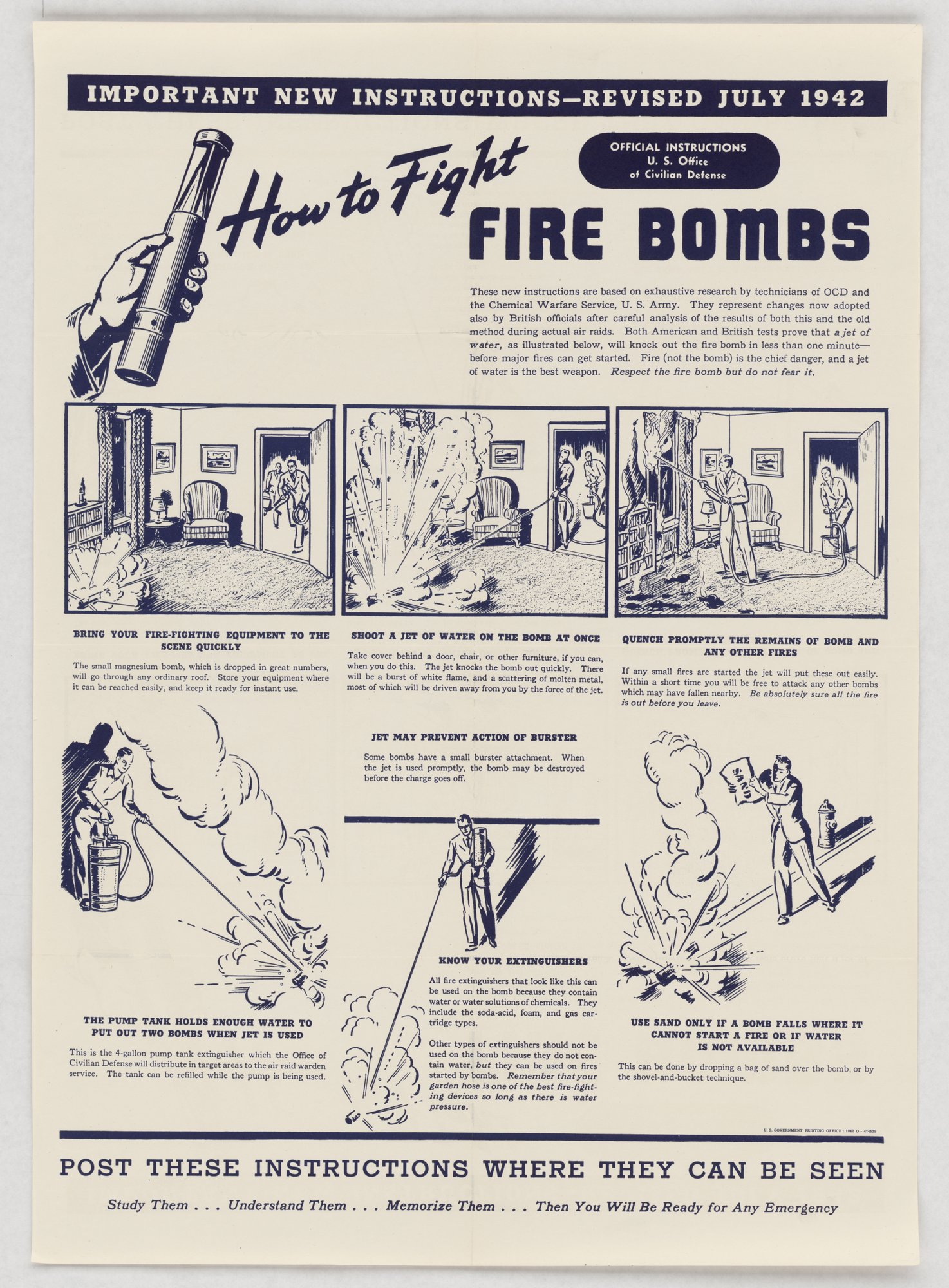
How to Fight Fire Bombs is a 1942 Office of Civilian Defense instruction sheet marked as revised in July 1942. Drawn panels show a householder in suit and tie putting out an incendiary bomb with a jet of water from a pump tank, with sand as the fallback (NAID 514544).
A sheet to memorize
This is a manual printed as a poster. The archive describes six drawn panels in which a man in a suit and tie attacks an incendiary bomb with a pump-tank water jet, an extinguisher, and sand. The text runs longer than the pictures and ends by telling the reader to post it, study it, and memorize it.
IMPORTANT NEW INSTRUCTIONS---REVISED JULY 1942
How to Fight FIRE BOMBS
OFFICIAL INSTRUCTIONS U. S. Office of Civilian Defense
[...] Both American and British tests prove that a jet of water, as illustrated below, will knock out the fire bomb in less than one minute---before major fires can get started. Fire (not the bomb) is the chief danger, and a jet of water is the best weapon. Respect the fire bomb but do not fear it.
[...]
USE SAND ONLY IF A BOMB FALLS WHERE IT CANNOT START A FIRE OR IF WATER IS NOT AVAILABLE
[...]
POST THESE INSTRUCTIONS WHERE THEY CAN BE SEEN
Study Them . . . Understand Them . . . Memorize Them . . . Then You Will Be Ready for Any Emergency
What changed in July
The headline announces a revision, and the opening paragraph explains it. The new method, the sheet says, rests on research by technicians of the Office of Civilian Defense and the Army's Chemical Warfare Service, and British officials had adopted the same change. Water now comes first. Sand is demoted to a fallback for a bomb that cannot start a fire, or for when water is not available. The 4-gallon pump tank, the sheet adds, would be handed out by the OCD to the air raid warden service in target areas, and a garden hose counts as one of the best tools while the water pressure holds.
The record files the sheet under the purpose "Warn or inform," and the archive calls the technique faint: ordinary men in ordinary rooms show the steps. The tone is calm on purpose. "Respect the fire bomb but do not fear it" is the line a fear appeal would never print.
How to read it
As government messaging goes, this sheet is easy to defend. It tells adults how to protect their own houses, explains why the advice changed, and names who did the testing. It asks for no money and no silence, and it names no enemy. It does make a strong empirical claim, that American and British tests "prove" a jet of water beats a fire bomb in under a minute, and it cites no report a reader could check. The record says nothing about where copies were posted or whether anyone ever used the method.
FRAME object record, How to Fight Fire Bombs, 1942. U.S. Office of Civilian Defense. Rights as recorded: public domain (U.S. government work).
U.S. National Archives and Records Administration, Record Group 44, World War II Posters, 44-PA-1018, NAID 514544, retrieved by the archive 4 October 2026.