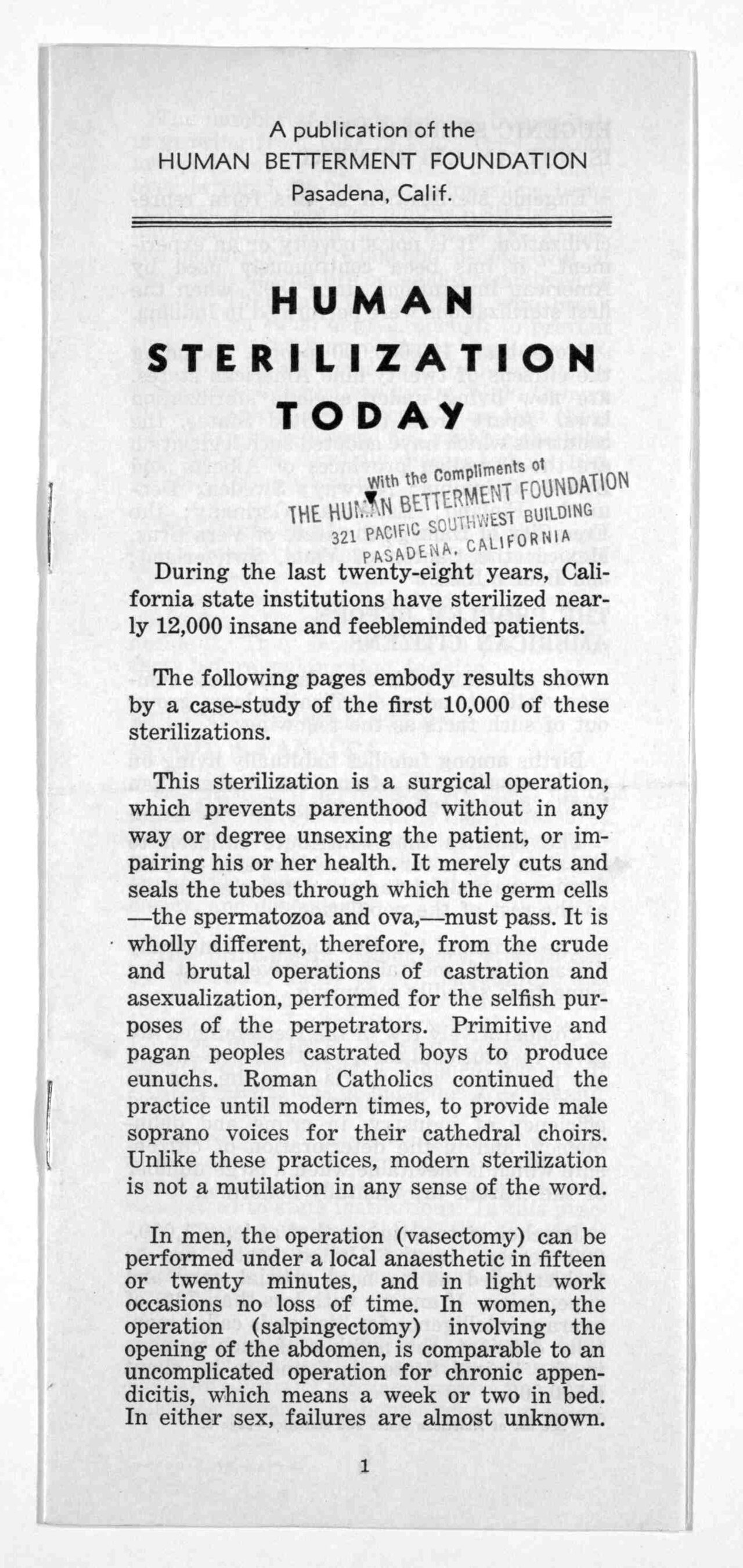
Human Sterilization Today is a 1938 pamphlet from the Human Betterment Foundation of Pasadena, California, a private group. Its first page reports that California state institutions had sterilized nearly 12,000 patients and describes the operation as "not a mutilation in any sense of the word".
Content note: the pamphlet calls patients "insane and feebleminded" and makes a disparaging remark about Catholics. It is quoted as printed.
What the page says
Only the first page is in the record. It carries the title, a rubber-stamped "With the Compliments of" line with the foundation's Pasadena address, and four short paragraphs. The first gives a number. The rest explain why the reader should not be troubled by it.
During the last twenty-eight years, California state institutions have sterilized nearly 12,000 insane and feebleminded patients.
The following pages embody results shown by a case-study of the first 10,000 of these sterilizations.
This sterilization is a surgical operation, which prevents parenthood without in any way or degree unsexing the patient, or impairing his or her health. It merely cuts and seals the tubes through which the germ cells—the spermatozoa and ova,—must pass. [...] Unlike these practices, modern sterilization is not a mutilation in any sense of the word.
Who issued it
The Human Betterment Foundation was private. The sterilizations it reports were done by state institutions. That division of labor is the point of the pamphlet: a private group, using a hopeful name and the format of a medical case study, explains and defends what public hospitals were doing to people in their custody. The copy is in the Library of Congress Rare Book and Special Collections Division.
What was wrong
The page argues entirely about the surgery: it is quick, it does not unsex, failures are almost unknown. The question it never asks is who agreed to it. The patients are named only by a category, "insane and feebleminded," which the institution assigned to them. A state that holds people and then removes their ability to have children, on the strength of a label it gave them, has taken something no anesthetic makes small. That was a wrong, and the gentle verbs ("merely cuts and seals") are how the pamphlet keeps the reader from seeing it.
FRAME tags the page for euphemism, glittering generalities, and transfer. The word "betterment" carries the second. The borrowed authority of clinical prose carries the third. The pamphlet also contrasts modern surgery with castration practiced, in its words, by "Primitive and pagan peoples" and by "Roman Catholics". That swipe at a religious minority is part of the sales method, and it is quoted here for that reason.
Readers who know the Institute for Propaganda Analysis list will recognize the devices. What the list cannot supply is the due-process question, and that is the one that matters most here. The eugenics case study quotes this pamphlet's sterilization figures and its jab at Catholic critics.
Sources
- FRAME object record, Human Sterilization Today, 1938. Human Betterment Foundation, Pasadena, California. Page 1 only.
- Library of Congress, Rare Book and Special Collections Division, via Wikimedia Commons, Human Sterilization Today, retrieved by the archive 27 September 2026. Rights as recorded: public domain (U.S. publication without copyright notice).