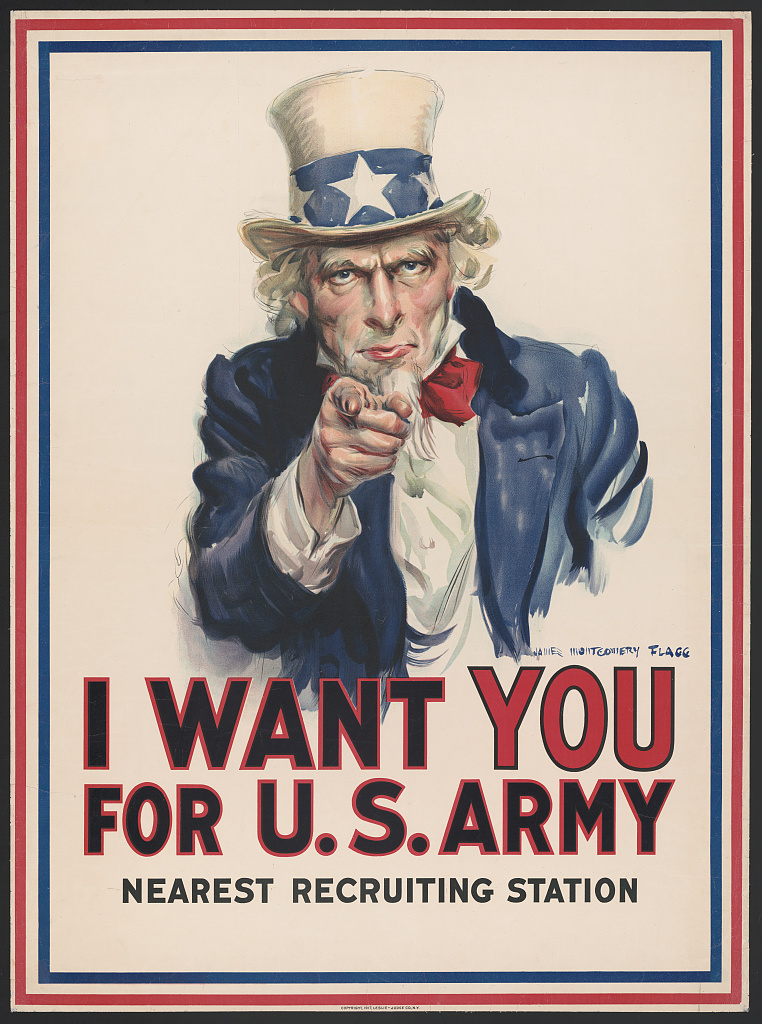
What it said
I WANT YOU
FOR U.S. ARMY
NEAREST RECRUITING STATION
Uncle Sam wears the starred top hat and the flag colors, and the finger leaves the picture plane. There is no casualty figure, no term of service, and no reason given beyond the want.
Who made it and why
FRAME credits U.S. Army recruiting and the artist James Montgomery Flagg, 1917, under the Wilson administration. The Library of Congress copy is cited as LC-DIG-ppmsc-03521, public domain in the United States as a work published before 1931, retrieved 27 September 2026. The purpose field on the record is recruiting. The audience is the domestic public.
The device is transfer in the archive's own tagging: a national figure borrows the country's standing so the artist does not have to argue. That description fits the sheet. The person who wants "you" is not a named officer. He is the costume of the republic.
What it got right or wrong
It got the ask right, in a narrow sense. The Army did want volunteers, and a recruiting station was a real place. It got the authority wrong if a viewer took the glare as the law. Uncle Sam cannot enlist anyone. Congress raises armies. The president is commander in chief of forces that exist. A poster that collapses those offices into a pointing man is good advertising and a bad civics lesson.
Flagg's later reuse of the same face, including a 1940 "I want you for the U.S. Army, enlist now," shows the picture was a tool that outlived 1917. Fame is not evidence that the 1917 claim was complete.
The constitutional and liberty angle
The Selective Service Act of 18 May 1917 is not printed on this sheet, and this page will not pretend the poster is the draft. What the picture does is blur a free choice into a personal summons from the nation. A free people can answer a recruiting call. They should know when the call has become a statute, because the statute has penalties and the picture does not. Conscription is the coercive fact of that war. This object is the voluntary pitch beside it. Keeping them apart is the constitutional point.
Its legacy
The finger is now shorthand for any government want. That afterlife is the poster's victory as design and its failure as an explanation. "I want you" never said why, for how long, or what would happen if the viewer walked past the recruiting station. Those were the questions that belonged to Congress and to the man being pointed at.
Sources
- FRAME object record, "I Want You for U.S. Army," 1917. Maker: U.S. Army recruiting; James Montgomery Flagg. Library of Congress, LC-DIG-ppmsc-03521. Public domain in the U.S. (published before 1931).