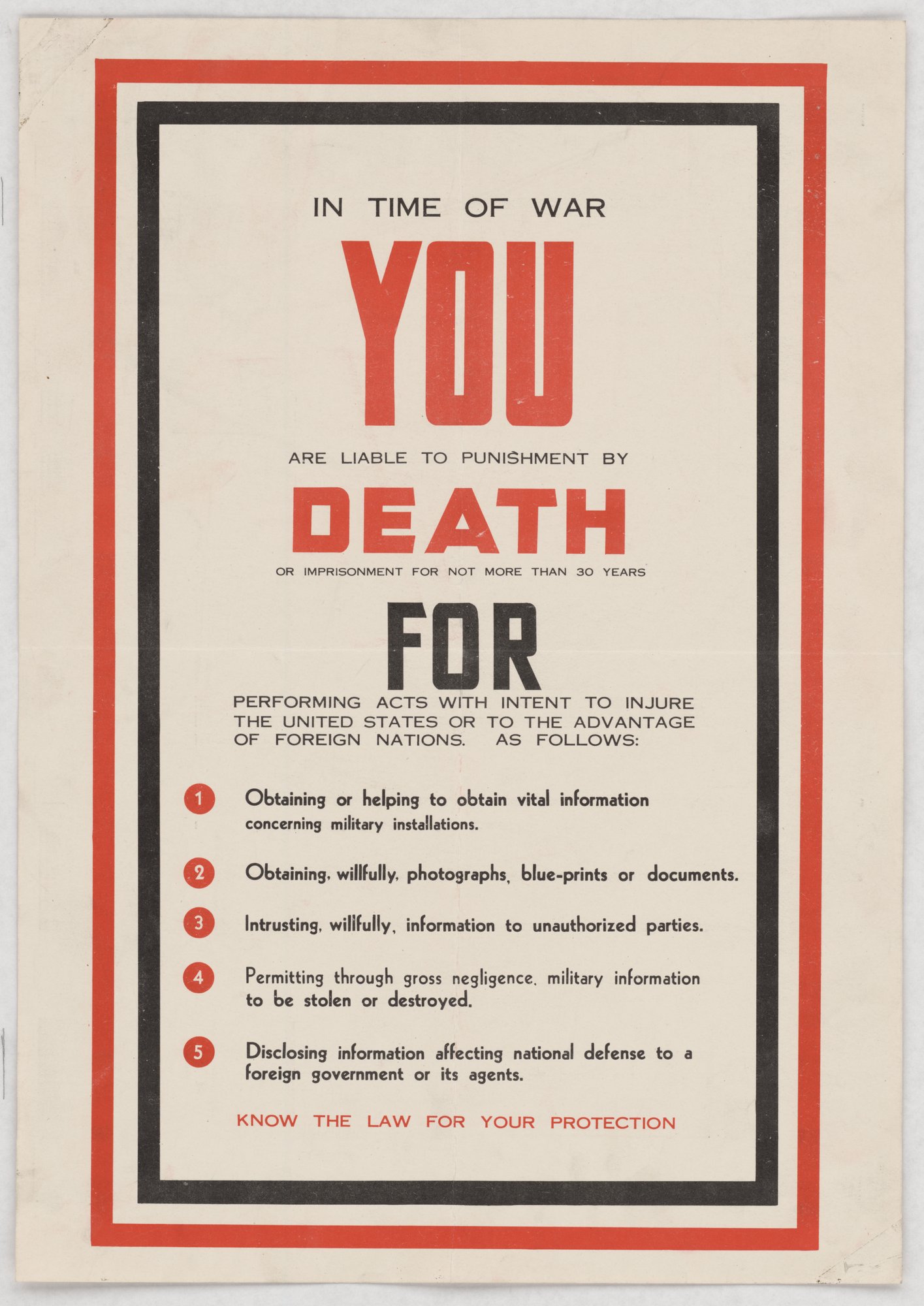
A text-only warning poster catalogued at 1941 prints "In time of war you are liable to punishment by death or imprisonment for not more than 30 years," with "YOU" and "DEATH" in large red type, followed by five numbered acts and "Know the law for your protection." No issuer is printed. NAID 514622.
What the sheet prints
No illustration appears. Two words are set far larger than the rest, in red: the reader, and the penalty. Between double borders the sheet lists five kinds of conduct and closes with advice.
IN TIME OF WAR
YOU
ARE LIABLE TO PUNISHMENT BY
DEATH
OR IMPRISONMENT FOR NOT MORE THAN 30 YEARS
FOR
PERFORMING ACTS WITH INTENT TO INJURE THE UNITED STATES OR TO THE ADVANTAGE OF FOREIGN NATIONS. AS FOLLOWS:
1 Obtaining or helping to obtain vital information concerning military installations.
2 Obtaining, willfully, photographs, blue-prints or documents.
3 Intrusting, willfully, information to unauthorized parties.
4 Permitting through gross negligence, military information to be stolen or destroyed.
5 Disclosing information affecting national defense to a foreign government or its agents.
KNOW THE LAW FOR YOUR PROTECTION
Who issued it
The sheet prints no issuer and the record does not supply one. The National Archives holds it in Record Group 44 as 44-PA-1095. The archive slug calls it an espionage-law poster, but the sheet itself names no statute, section, or court. FRAME lists the purpose as warning or informing, the themes as security and home front, and tags one device, fear appeal.
How to read it
A government is right to tell people what the law forbids. Spying for a foreign power is a real crime, and a notice that says so is not propaganda simply for existing. The issue is how this notice says it.
The typography does the arguing. "YOU" and "DEATH" are the words a passerby takes away. The qualifiers that actually limit the law, "with intent to injure the United States" and "willfully," are in small type. Item 4 goes further and reaches "gross negligence," which is not intent at all. A worker who glances at this sheet learns that he could be executed; he is less likely to learn that, by the sheet's own wording, most of the listed acts require intent.
The closing line, "Know the law for your protection," is the strangest part. The poster does not give the law. It gives a summary with no citation, so a reader who wanted to know exactly what was forbidden had nowhere to look. Due process starts with laws people can find and read. A notice that frightens without citing is asking for caution in place of understanding.
The earlier wartime use of espionage law against speech is covered on the Committee on Public Information page, and the 1917 statute and the prosecutions under it on the First World War censorship page.
Sources
- FRAME object record, In time of war you are liable to punishment by death or imprisonment for not more than thirty years, catalogued 1941. Issuer not printed.
- U.S. National Archives and Records Administration, Record Group 44, NAID 514622 (44-PA-1095), retrieved by the archive 4 October 2026. Rights as recorded: public domain (U.S. government work).