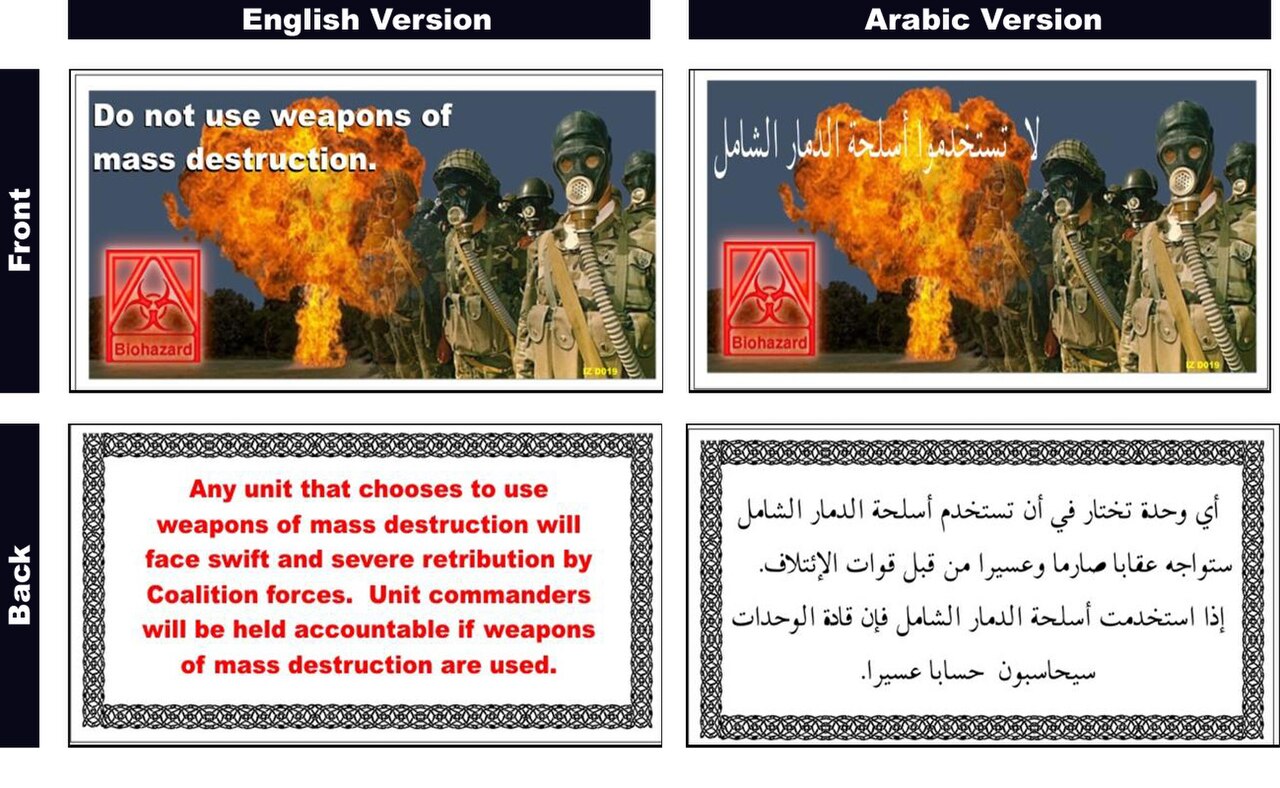
Coalition leaflet warning Iraqi units not to use weapons of mass destruction
Do not use weapons of mass destruction, a Coalition leaflet for Iraqi units, 2003
A February 2003 Coalition leaflet told Iraqi units "Do not use weapons of mass destruction" and warned that unit commanders "will be held accountable."
Techniques named on the archive record
Fear appeal
Date
February 24, 2003
Made by
Coalition forces in Iraq (U.S.-led psychological operations), published by the U.S. Navy
Medium
Leaflet
Country
United States
Regime
George W. Bush Administration
Source
Identified Openly sourced: the speaker is who they say they are
Source
Wikimedia Commons , retrieved September 29, 2026
Source
Public domain (U.S. government work) U.S. Navy (VIRIN 030224-D-0000X-001), public domain, via Wikimedia Commons.
Object, image, and catalog record from the FRAME archive. Text on this page is CC BY 4.0. Image rights are as the archive records.
A Coalition leaflet in English and Arabic, shown by the U.S. Navy in an image dated 24 February 2003, pictures gas-masked soldiers, a fireball and a biohazard sign over the words "Do not use weapons of mass destruction," and warns on the back that unit commanders "will be held accountable."
Both sides of the leaflet
Content note: the leaflet shows gas-masked soldiers, an explosion and a biohazard sign, and threatens retribution.
The front is a picture with one line. A row of soldiers in gas masks stands before a fireball, with a biohazard symbol and a short instruction in English and Arabic. The back is all text, again in both languages, and names who will pay if the instruction is ignored. A code, IZ D019, is printed on the front.
Front
Do not use weapons of mass destruction.
[Biohazard]
IZ D019
لا تستخدموا أسلحة الدمار الشامل
Back
Any unit that chooses to use weapons of mass destruction will face swift and severe retribution by Coalition forces. Unit commanders will be held accountable if weapons of mass destruction are used.
أي وحدة تختار في أن تستخدم أسلحة الدمار الشامل
ستواجه عقابا صارما وعسيرا من قبل قوات الإئتلاف.
إذا استخدمت أسلحة الدمار الشامل فإن قادة الوحدات
سيحاسبون حسابا عسيرا.
The archive's English rendering of the Arabic, which it labels a machine translation not checked by a fluent reader, has the back saying that unit commanders "will be held severely to account."
Who it speaks to
The audience field is enemy forces, and the message is aimed lower than the government. It does not address Saddam Hussein or Baghdad. It addresses "any unit" and its commanders, and it gives each of them a personal reason to refuse an order. The archive tags it for fear appeal: a picture of the harm, and a named consequence for a specific reader.
As a wartime message to soldiers, that is legitimate. A warning that using these weapons will be punished is better than no warning, and it gives an officer a reason to say no.
The premise
A leaflet that says "do not use" these weapons assumes there were weapons to use. On that point the record later went the other way. The case study on the public case for the war records that the Iraq Survey Group reported in 2004 that Iraq had destroyed its chemical and biological stocks after 1991, and that nothing was stockpiled in 2003. The leaflet did not invent that premise. It carried the same certainty that, in the case study's account, was being presented to the public.
FRAME object record, Coalition leaflet warning Iraqi units not to use weapons of mass destruction, 24 February 2003. Coalition forces in Iraq (U.S.-led psychological operations), published by the U.S. Navy. English translation of the Arabic as given by the archive, labelled unverified.
Wikimedia Commons, U.S. Navy image VIRIN 030224-D-0000X-001, file page, retrieved by the archive 29 September 2026. Rights as recorded: public domain (U.S. government work).
.jpg)