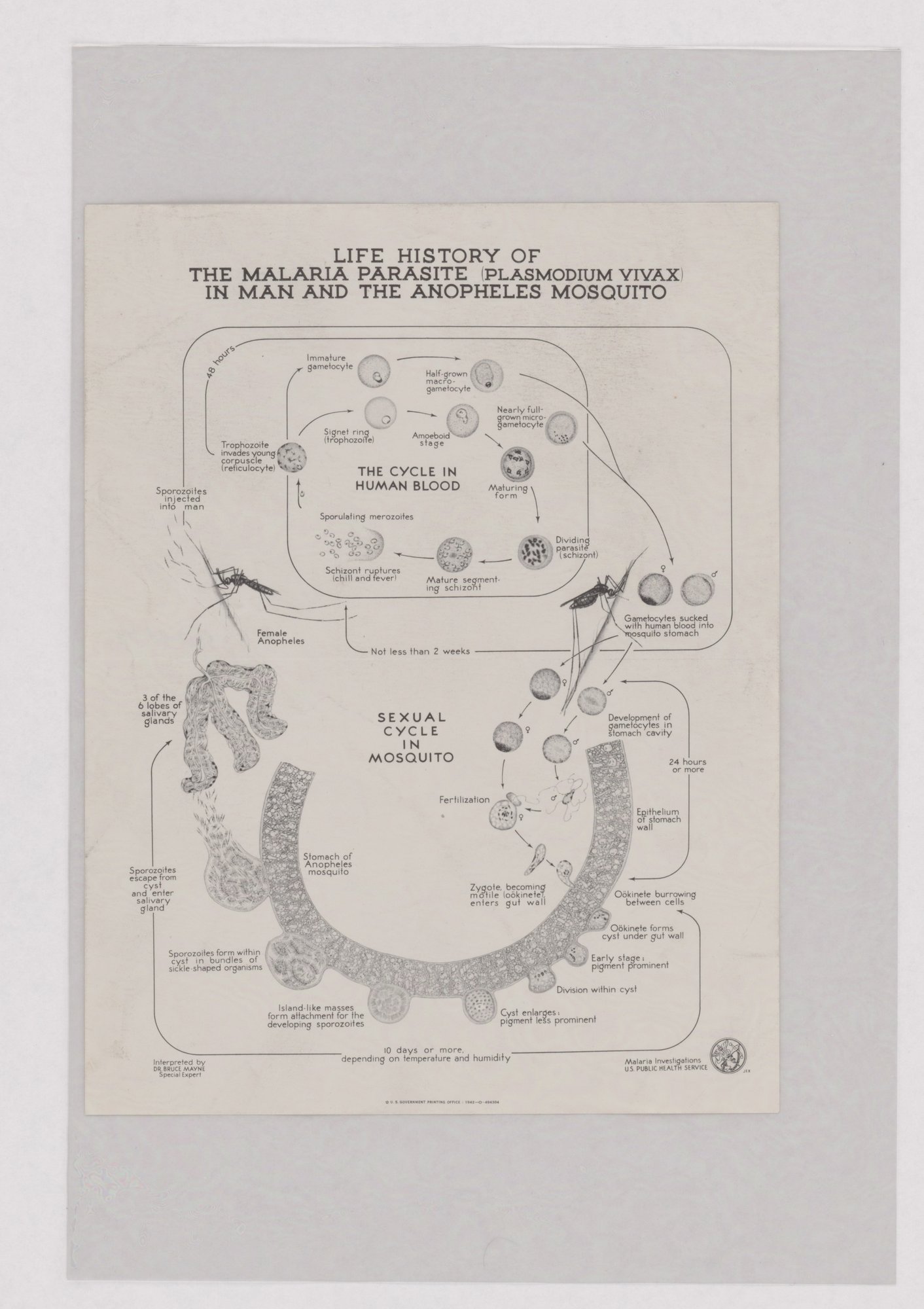
A 1942 U.S. Public Health Service chart, interpreted by Dr. Bruce Mayne of Malaria Investigations, traces Plasmodium vivax through a 48-hour cycle in human blood and a sexual cycle in the Anopheles mosquito, in labeled black-and-white stages (NAID 514892).
What the chart shows
This black-and-white sheet is a scientific chart, in the archive's words. Arrows carry the parasite through two loops: a cycle in human blood and a sexual cycle in the mosquito. The stages are labeled, and time spans are printed along the way.
LIFE HISTORY OF
THE MALARIA PARASITE (PLASMODIUM VIVAX)
IN MAN AND THE ANOPHELES MOSQUITO
The cycle in human blood
48 hours
[...]
Schizont ruptures (chill and fever)
[...]
Gametocytes sucked with human blood into mosquito stomach
SEXUAL CYCLE IN MOSQUITO
[...]
Sporozoites escape from cyst and enter salivary gland
[...]
10 days or more, depending on temperature and humidity
Interpreted by
DR. BRUCE MAYNE
Special Expert
Malaria Investigations
U.S. PUBLIC HEALTH SERVICE
[imprint:] U. S. GOVERNMENT PRINTING OFFICE : 1942-O-494304
Who made it
The credit line says the chart was interpreted by Dr. Bruce Mayne, Special Expert, Malaria Investigations, U.S. Public Health Service. The Government Printing Office number dates the printing to 1942. Per the archive, the intended audience was mixed and the purpose was warning or informing, under health and science. The National Archives holds it with the World War II posters in Record Group 44, though nothing on the chart mentions the war. Nothing in the record gives a print run or says where copies were used.
Why it is here
The archive is candid about this one. It calls the sheet an explanatory diagram rather than a persuasion piece, and says the technique is faint. The only tag is transfer: the borrowed authority of the Public Health Service and a named expert. That is a light charge. A named specialist signing a diagram is how a reader is supposed to judge a diagram.
That makes the chart a useful baseline. Most sheets in the wartime file ask for something, a bond, a silence, a scrap drive. This one asks the reader to understand a parasite. It shows its sources on its face, it states its time spans with qualifications ("not less than 2 weeks," "10 days or more, depending on temperature and humidity"), and it leaves the reader free to draw the conclusion.
The Public Health Service's 1943 poster Keep Out Malaria Mosquitoes turns the same subject into a cartoon with a talking mosquito and a torn window screen. The Roosevelt administration essay groups the war years' posters by their request.
Sources
- FRAME object record, Life history of the malaria parasite (Plasmodium vivax) in man and the Anopheles mosquito, 1942. U.S. Public Health Service, Malaria Investigations (interpreted by Dr. Bruce Mayne).
- U.S. National Archives and Records Administration, Record Group 44, World War II Posters, 44-PA-1286, NAID 514892, retrieved by the archive 4 October 2026. Rights as recorded: public domain (U.S. government work).