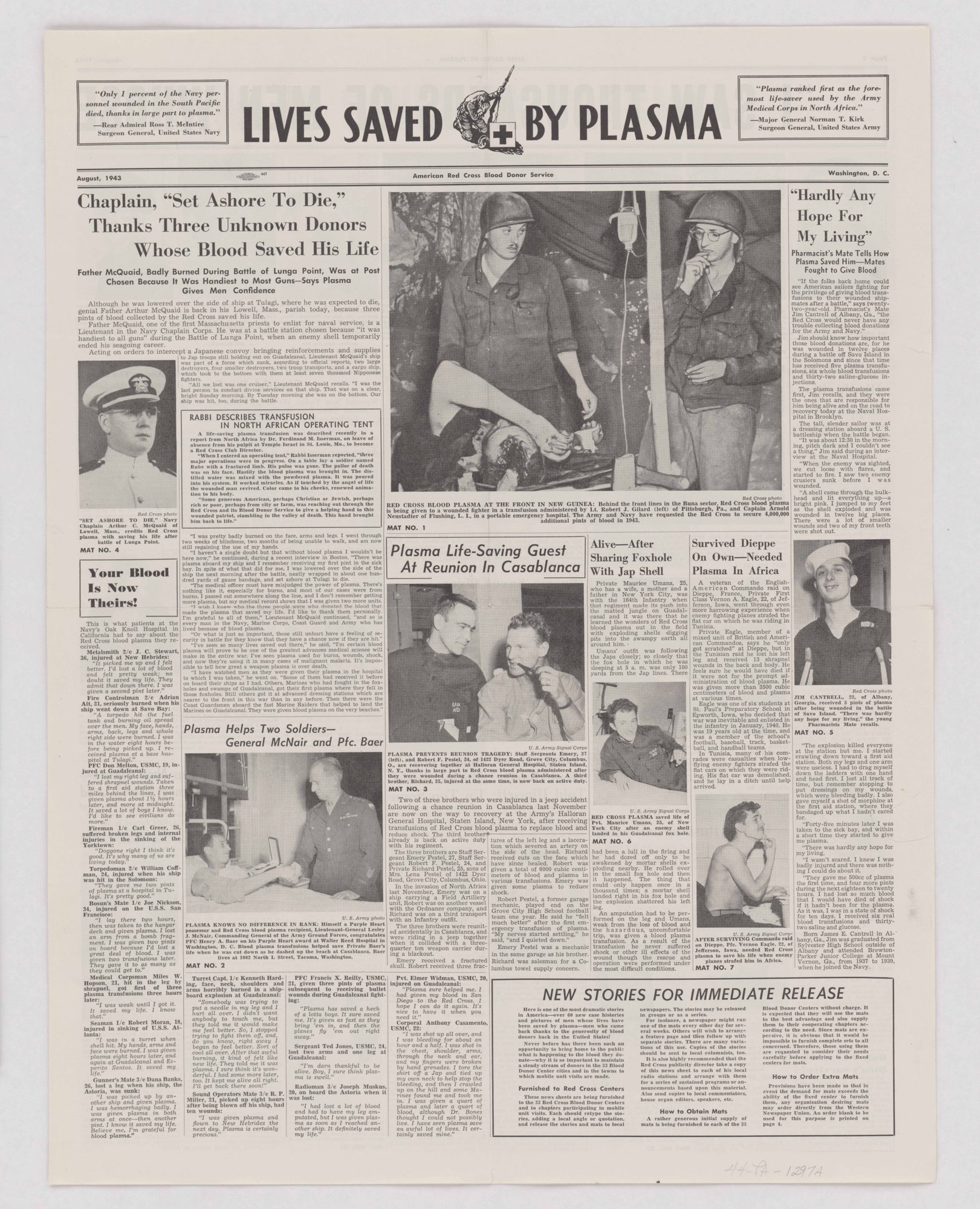
Lives Saved by Plasma (August 1943), a Red Cross Blood Donor Service sheet for local papers
An August 1943 Red Cross Blood Donor Service news sheet: two surgeons general on plasma, a burned Navy chaplain, and a rabbi's account from North Africa.
Techniques named on the archive record
TestimonialTransfer
Date
1943
Made by
American Red Cross, Blood Donor Service
Medium
Newspaper pages
Country
United States
Regime
Roosevelt Administration
NARA
NAID 514903; Record Group 44
Source
Identified Openly sourced: the speaker is who they say they are
Source
U.S. National Archives and Records Administration, Record Group 44, World War II Posters , retrieved October 4, 2026
Source
Public domain (U.S. government work) American Red Cross, Blood Donor Service. National Archives and Records Administration, RG 44, 44-PA-1297 (NAID 514903).
Object, image, and catalog record from the FRAME archive. Text on this page is CC BY 4.0. Image rights are as the archive records.
Lives Saved by Plasma is an August 1943 news sheet from the American Red Cross Blood Donor Service in Washington. Quotations from the Navy and Army surgeons general frame columns of stories and photographs of wounded servicemen, written for newspapers to reprint (NAID 514903).
A page built for reprinting
Content note: the sheet includes photographs of wounded servicemen, one of them bloodied and receiving a transfusion, and its text uses period wartime wording, including a slur, for the Japanese enemy. This page quotes them as they appear.
This is a newspaper page, laid out by the Red Cross so that local editors could lift stories from it. The archive describes columns of servicemen's stories, photographs, and numbered mats. The masthead sits between two quotations from the military's medical chiefs.
"Only 1 percent of the Navy personnel wounded in the South Pacific died, thanks in large part to plasma."
-Rear Admiral Ross T. McIntire, Surgeon General, United States Navy
LIVES SAVED BY PLASMA
"Plasma ranked first as the foremost life-saver used by the Army Medical Corps in North Africa."
-Major General Norman T. Kirk, Surgeon General, United States Army
August, 1943
American Red Cross Blood Donor Service
[...]
Acting on orders to intercept a Japanese convoy bringing reinforcements and supplies to Jap troops still holding out on Guadalcanal, [...]
[...]
"I haven't a single doubt but that without blood plasma I wouldn't be here now," [...]
The stories
The lead story is about Father Arthur McQuaid, a Lowell, Massachusetts priest serving as a lieutenant in the Navy Chaplain Corps. The sheet says he was badly burned at the Battle of Lunga Point, set ashore at Tulagi to die, and saved by three pints of blood the Red Cross had collected. A second story quotes Rabbi Ferdinand M. Isserman of Temple Israel in St. Louis, serving as a Red Cross club director, on a plasma transfusion he watched in a North African operating tent. He imagines the donor as "perhaps Christian or Jewish, perhaps rich or poor."
How to read it
The archive tags testimonial and transfer: named patients, a priest, a rabbi and two surgeons general vouch for plasma, and the sheet's aim is more donors. The archive files the purpose as fundraising. Its issuer, the Red Cross, is a non-governmental body, though the quotations it leads with come from the Navy's and the Army's surgeons general.
The figures in the masthead are the two surgeons general's claims, quoted. The sheet does not show how they were counted, and neither does the archive. The battle details in the McQuaid story are likewise given "according to official reports," and the sheet gives no further source.
What the sheet asked for was blood, freely given. A donor chose to give or not. The persuasion is human interest, and the rabbi's account says outright that the donor could be Christian or Jewish, rich or poor. The slur in the excerpt sits in a sentence of battle summary, in a story otherwise about a burned chaplain's recovery.
FRAME object record, Lives saved by plasma, 1943. American Red Cross, Blood Donor Service, Washington, D.C.
U.S. National Archives and Records Administration, Record Group 44, World War II Posters, 44-PA-1297, NAID 514903, retrieved by the archive 4 October 2026. Rights as recorded: public domain (U.S. government work).