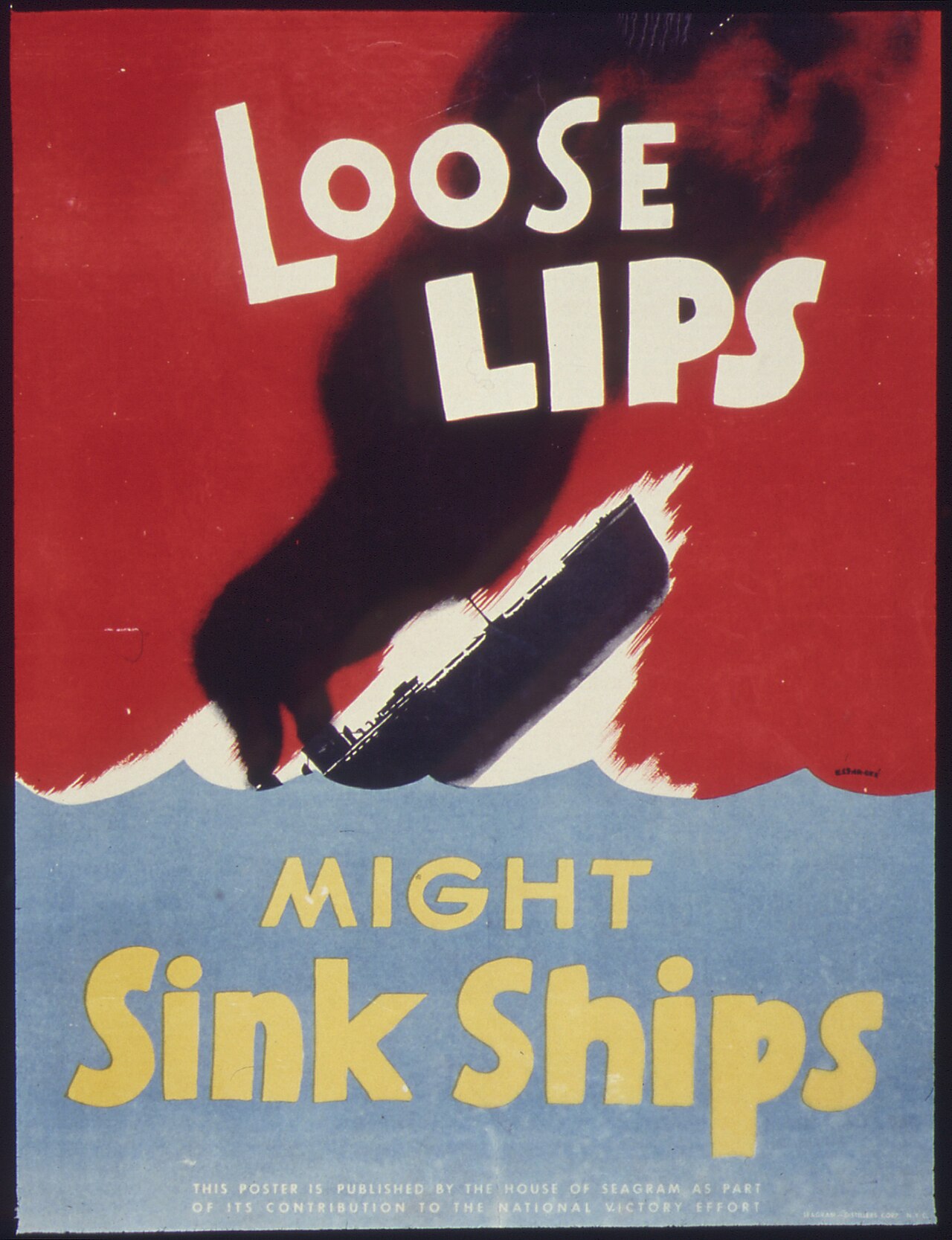
What it said
LOOSE LIPS
MIGHT
Sink Ships
THIS POSTER IS PUBLISHED BY THE HOUSE OF SEAGRAM AS PART OF ITS CONTRIBUTION TO THE NATIONAL VICTORY EFFORT
SEAGRAM-DISTILLERS CORP., N.Y.C.
The picture, per the archive, is a ship on fire and going down. The modal verb is "might." The layout treats the chance as the fact.
Who made it and why
FRAME dates it 1942 and calls the maker a U.S. government home-front security campaign, Roosevelt administration, purpose "warn or inform." The imprint on the sheet itself says the House of Seagram published it as a contribution to the victory effort. Both can be true: a government slogan, a private printer. The rights line cites the National Archives and Records Administration via Wikimedia Commons, retrieved 25 September 2026, public domain as a U.S. government work, "War and Conflict Number 830 (1941-1945)." That is the identifier the archive gives. It does not print a separate NAID on this record.
What it got right or wrong
Careless talk can reveal a sailing. That narrow warning is fair in a war with submarines. What the picture gets wrong is the collapse of causes. Weather, machinery, a U-boat that never heard a rumor, and a convoy order all sink ships. The poster leaves one cause the viewer can personally stop, and draws it as the cause. "Might" is the honest word. The burning hull argues past it.
The constitutional and liberty angle
Silence asked of a dockworker who knows a departure is not the same as silence asked of a citizen who doubts the war. This sheet does not draw that line. Office of Censorship rules, created by executive order on 19 December 1941, were the compulsory system. Roosevelt's statement that day said Americans "abhor censorship" and that "some degree of censorship is essential in wartime." The poster is the voluntary echo: no statute on the paper, a moral accusation instead. A free country can ask people not to publish troop movements. It should say so as a rule with a scope, not as a burning ship blamed on whoever spoke.
Its legacy
"Loose lips" outlived the convoys and became a joke, which is a kind of correction. The serious remainder is the sponsor line. Seagram said it was contributing. The government, if this was its campaign, let a whiskey company carry the warning. Read the imprint. Then decide whether the danger named is the danger you were actually in a position to cause.
Sources
- FRAME object record, "Loose Lips Might Sink Ships," 1942. NARA via Wikimedia Commons, War and Conflict Number 830.
- Franklin D. Roosevelt, statement on the executive order establishing the Office of Censorship, 19 December 1941, as quoted on the FRAME Roosevelt administration page. American Presidency Project.