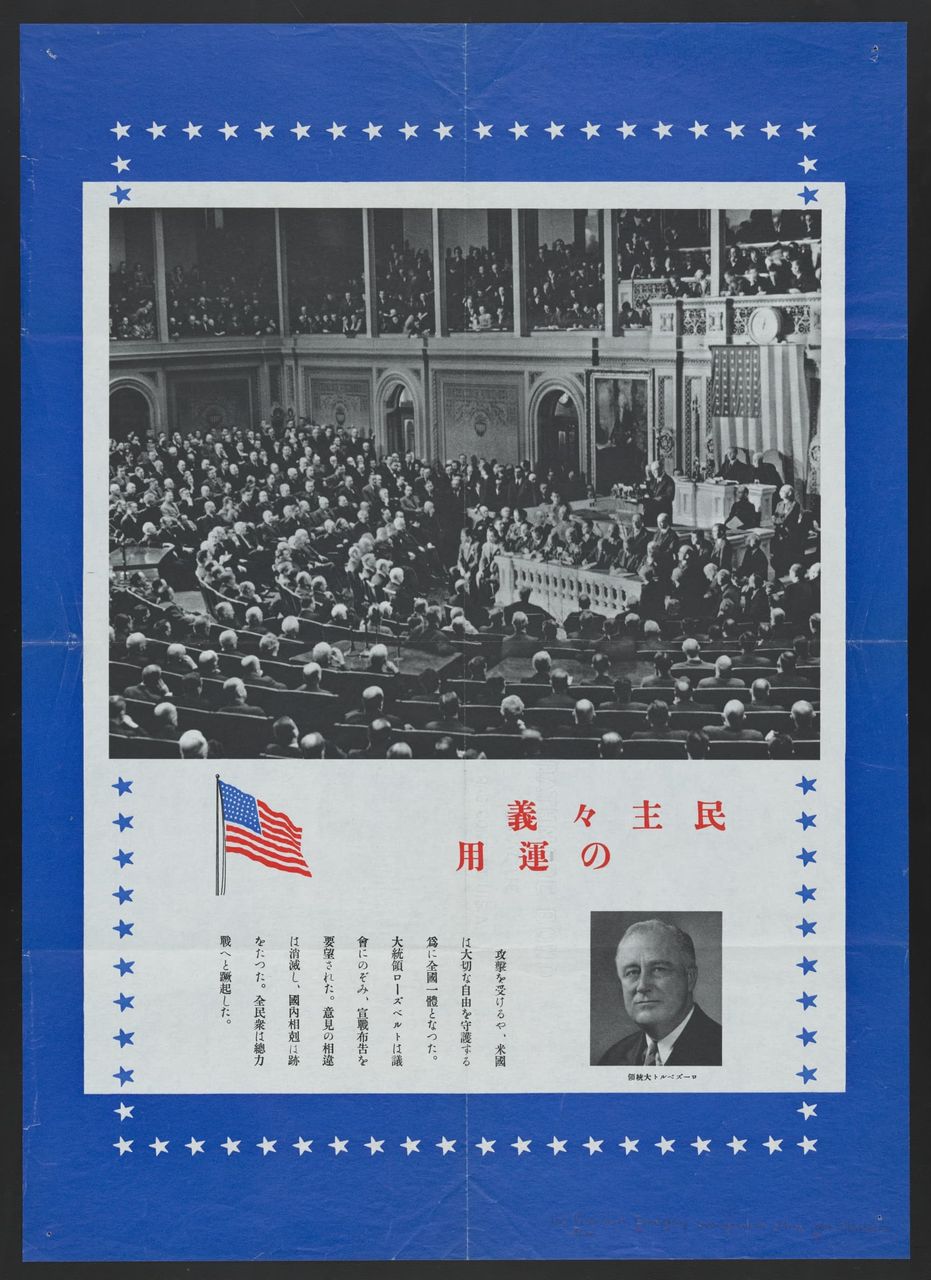
The Operation of Democracy (Minshushugi no un'yo) is a 1944 Japanese-language poster published through the U.S. Government Printing Office. A photograph of Congress in session and a portrait of President Roosevelt sit beside a short text saying that after the attack differences of opinion disappeared.
What it shows
The archive describes two pictures and a paragraph. One picture is a photograph of Congress in session; the other is a portrait of President Roosevelt. The text sits under a red title and is set in vertical columns read from right to left.
民主々義の運用
攻撃を受けるや、米國は大切な自由を守護する為に全國一體となつた。大統領ローズベルトは議會にのぞみ、宣戰布告を要望された。意見の相違は消滅し、國内相剋は跡をたつた。全民衆は総力戰へと蹴起した。
ローズベルト大統領
The archive gives an English translation and labels it a machine translation by Claude, not verified by a fluent reader. In that version the text says that when attacked, America became one body to protect precious freedom; that President Roosevelt went before Congress and asked for a declaration of war; and that the whole populace rose for total war. The sentence between those two reads: "Differences of opinion disappeared and internal discord was cut off." The portrait caption reads "President Roosevelt."
Who made it, and for whom
No agency is printed on the sheet. The archive identifies it as a federal Government Printing Office publication and notes that a library pencil note at the bottom edge appears to read "War information." It records the audience only as mixed. The record does not say where the poster was shown or who was meant to read Japanese on it, and this page does not guess.
The problem with unanimity
The archive tags glittering generalities and bandwagon. Freedom and national unity are offered as virtues; the claim that everyone rose together invites the reader to join. Both tags fit.
The deeper trouble is the poster's idea of democracy. It presents the disappearance of disagreement as the proof that self-government works. That gets the matter backwards. A democracy is the system in which disagreement is allowed to continue, even in war. The Roosevelt administration essay makes that case from the record: Congress kept sitting, elections ran on schedule, and most newspapers by number backed the Republican in 1944. Those are signs that opinion had not vanished.
A government describing itself to readers in another language has every reason to put its best face forward. It still owes them an accurate one. Compare the Chinese-language America's Resources Are China's Resources, which also names no agency, and the Office of War Information's The State of This Nation Is Good, which set four lines of Roosevelt's 1943 message to Congress as a poster.
Sources
- FRAME object record, The Operation of Democracy (Minshushugi no un'yo), Japanese-language U.S. poster, 1944. U.S. federal government (Government Printing Office publication; issuing agency not printed on the sheet). English translation in the record: machine translation by Claude, not verified by a fluent reader.
- Northwestern University Libraries, World War II Poster Collection, object no. VII.9, digital collections item, retrieved by the archive 2 October 2026. Rights as recorded: public domain (U.S. government publication; Northwestern: No Copyright - United States).