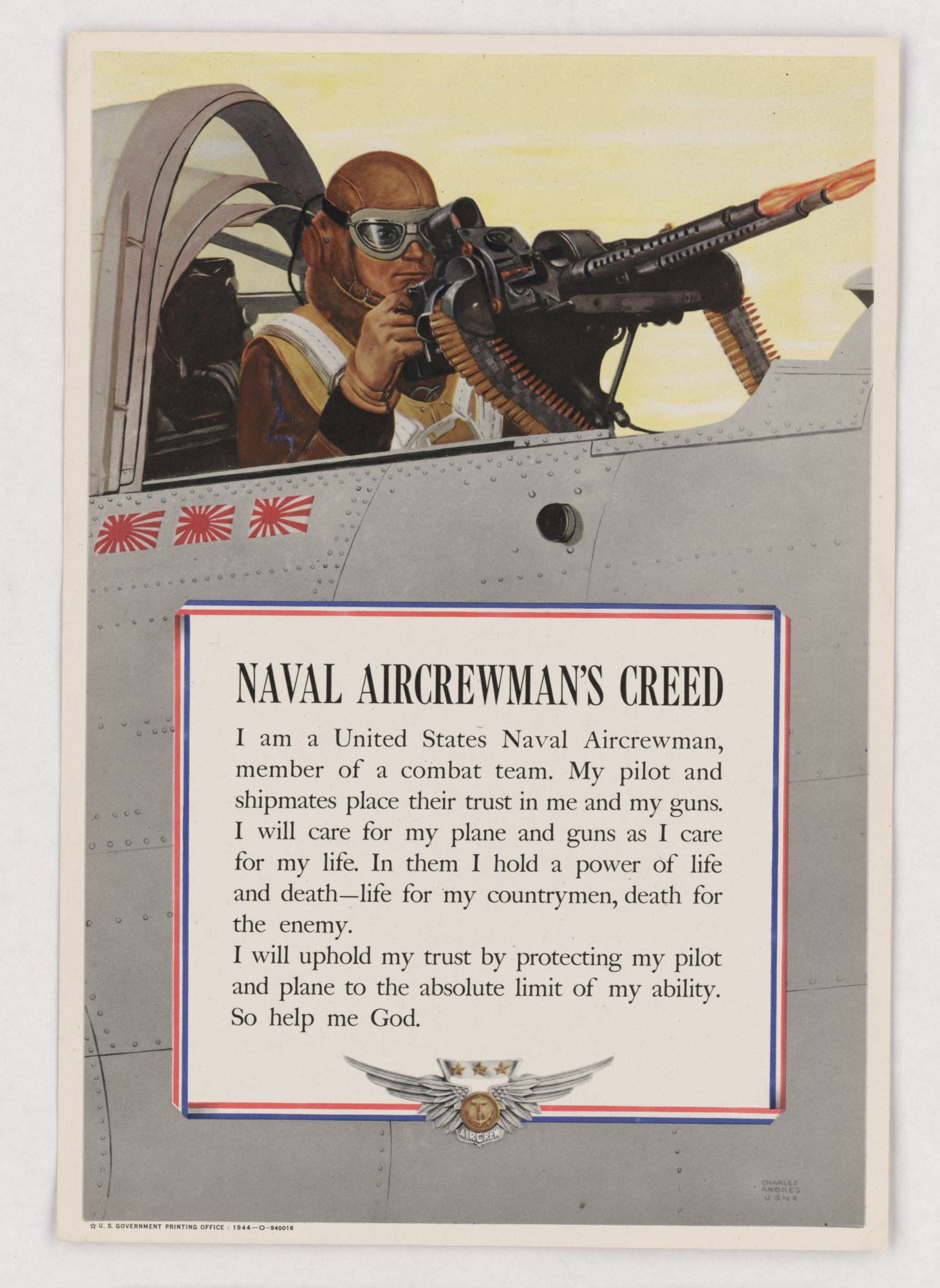
Naval Aircrewman's Creed is a 1944 U.S. Navy poster signed Charles Andres, USNR. A gunner in flying helmet and goggles fires a twin machine gun from an aircraft, three rising-sun flags painted on the fuselage, with a boxed creed above an aircrew wings badge (NAID 515049).
A gunner and a tally
The painting shows a naval gunner in a flying helmet and goggles firing a twin machine gun from an aircraft cockpit. Three Japanese rising-sun flags are painted on the fuselage, the archive says as a tally. A boxed text sets out the creed above an aircrew wings badge.
NAVAL AIRCREWMAN'S CREED
I am a United States Naval Aircrewman, member of a combat team. My pilot and shipmates place their trust in me and my guns. I will care for my plane and guns as I care for my life. In them I hold a power of life and death—life for my countrymen, death for the enemy.
I will uphold my trust by protecting my pilot and plane to the absolute limit of my ability. So help me God.
[badge: AIR CREW]
[signature: CHARLES ANDRES USNR]
[imprint: U.S. GOVERNMENT PRINTING OFFICE: 1944-O-940016]
Printed for the Navy's own men
The sheet is signed by Charles Andres, USNR, and printed by the Government Printing Office in 1944. FRAME credits the U.S. Navy as issuer, records the audience as "Own forces" and gives the purpose as "Reassure". The National Archives holds it in Record Group 44, World War II Posters. The record does not say where the creed came from or whether men were asked to recite it.
What the creed asks of a crewman
The creed is written in the first person, so the reader speaks it rather than hears it. It names duties a crewman would recognize: care of the plane and the guns, trust from the pilot and shipmates, protection of both "to the absolute limit of my ability." It ends "So help me God."
FRAME tags glittering generalities and calls the technique mild. The broad words are there, "trust" and "life and death", but they sit beside concrete tasks. The creed's sharpest line is plain about what the job was: life for one side, death for the other. A poster that tells a gunner exactly what his guns are for is being frank with him.
In the archive's description the enemy appears only as the rising-sun flags of the tally: flags, not faces. That is a different choice from the Navy's 1944 Your Enemy the Jap, which names the enemy with a slur. The anti-Japanese propaganda hub gathers sheets aimed at Japan, and the Roosevelt administration essay treats the war years as a whole.
Sources
- FRAME object record, Naval Aircrewman's Creed, 1944. U.S. Navy; artist Charles Andres, USNR. Rights as recorded: public domain (U.S. government work).
- U.S. National Archives and Records Administration, Record Group 44, World War II Posters, 44-PA-1390, NAID 515049, retrieved by the archive 4 October 2026.