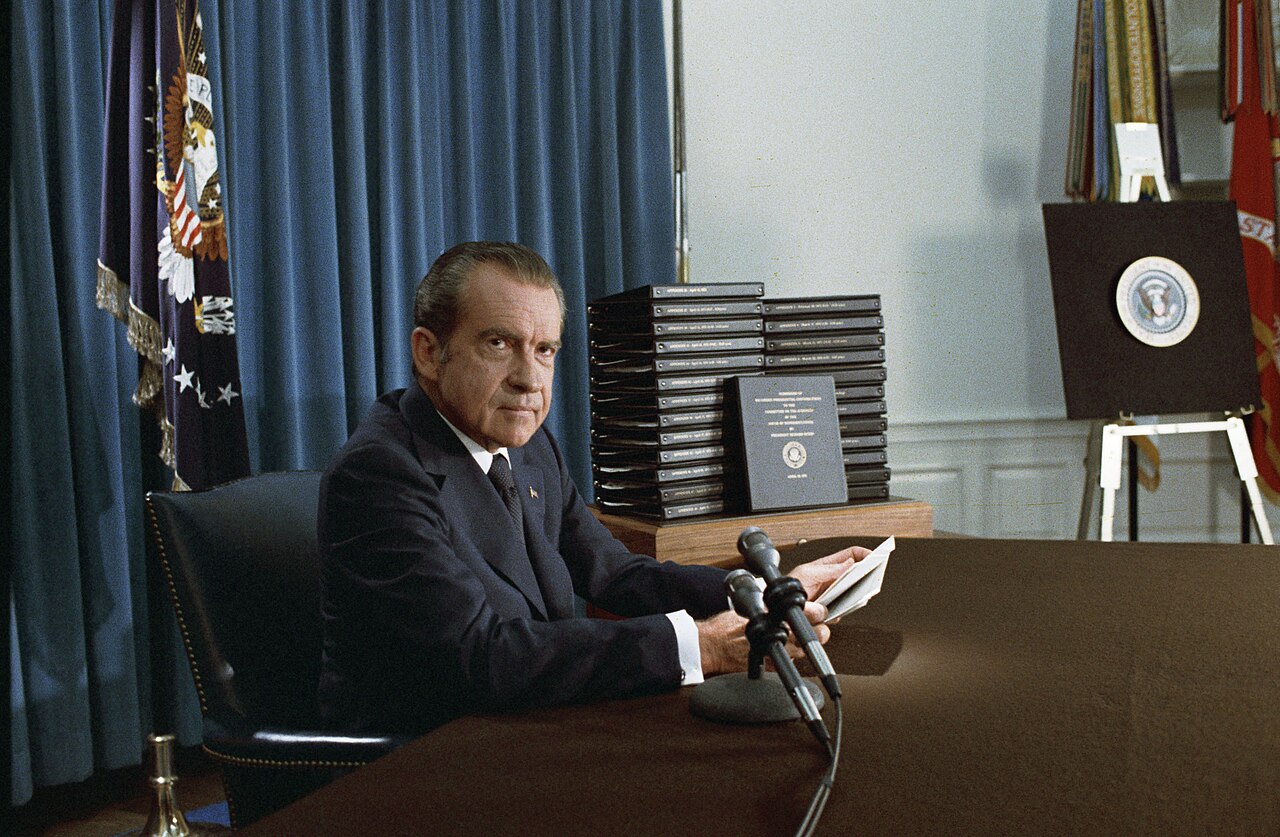
A White House photograph of April 29, 1974 shows President Richard Nixon addressing the nation beside stacked binders of edited transcripts of his tapes, offered in place of the recordings that had been subpoenaed.
What the photograph shows
President Nixon speaks to a national television audience. Beside him is a tall stack of bound volumes, one standing upright with a presidential seal on its cover. The binders are the point of the picture. They are what the audience was meant to see.
The archive did not transcribe the lettering on the spines or the cover. At this resolution it blurs, and the record says so rather than guess. This page does the same, so there is no quotation block here.
What was being offered
The FRAME record states the context. The House Judiciary Committee and the Watergate special prosecutor had subpoenaed recordings made in the White House. The President answered with edited transcripts instead of the recordings, and offered that large but partial record as full disclosure. About three months later the Supreme Court ordered the tapes themselves produced. One of them, from June 23, 1972, led to his resignation.
The archive's term for the method is limited hangout. The phrase describes a release that is large, visible, and partial: enough material to look like full disclosure, chosen so that the part that matters stays out. The stack of binders is the visual form of that idea. Volume reads as candor.
Why it matters
This is an elected official using the tools of his office to manage an investigation into his own conduct. The record that undid the effort was not a better press release. It was a subpoena enforced by the Supreme Court, alongside a committee of Congress doing its oversight job. Both are checks the Constitution builds in on purpose, and both worked here against a President who did not want it to.
The lesson is not limited to one party or one decade. Any administration can stack paper in front of a camera. The question for a citizen is always the same: is this the record, or a selection from it, and who chose?
Sources
- FRAME object record, Nixon with the edited White House tape transcripts, April 29, 1974. Issuer: U.S. government (President Richard Nixon).
- Wikimedia Commons, Nixon_edited_transcripts.jpg, retrieved by the archive 27 September 2026. Rights as recorded: public domain (U.S. government work), White House Photo Office (NARA), WHPO C1269-20.