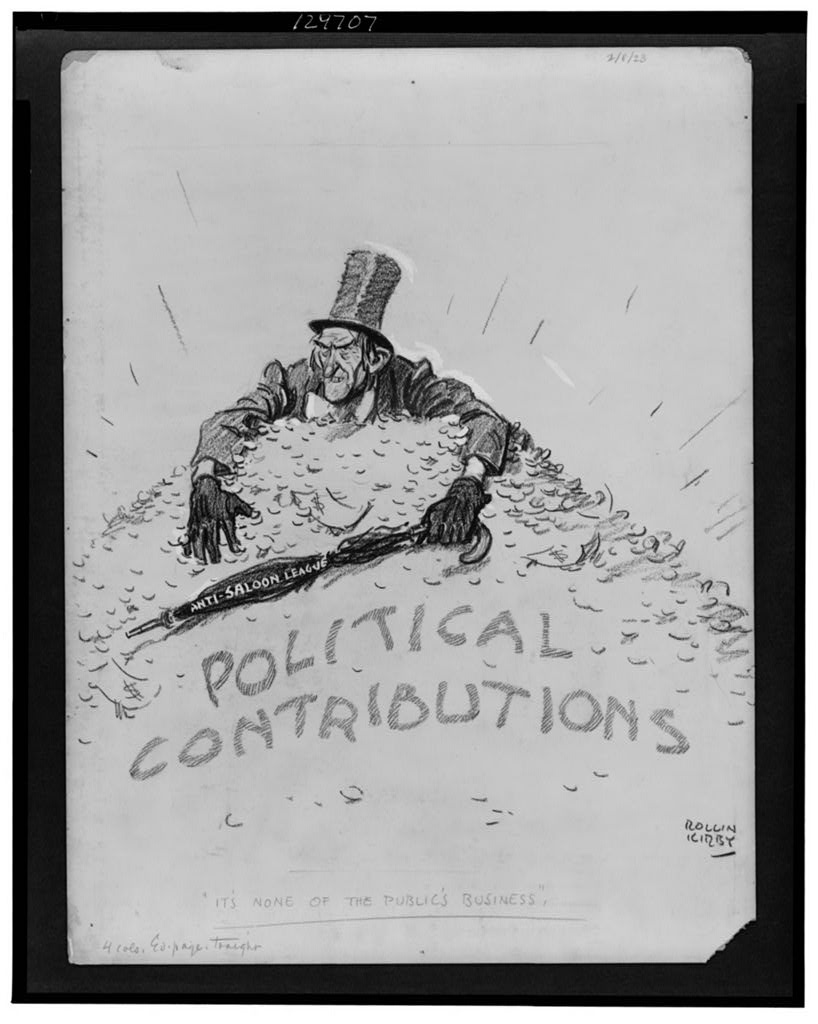
A Rollin Kirby cartoon for the New York World, dated 8 February 1923, shows his "Mr. Dry" figure sprawled over coins labelled "Political Contributions," with an Anti-Saloon League umbrella and the caption "It's none of the public's business".
What the drawing shows
Rollin Kirby drew editorial cartoons for the New York World. His recurring "Mr. Dry," a sour man in a top hat, stood for the prohibition side as a whole. Here he lies across a heap of coins. The umbrella beside him names the Anti-Saloon League. The caption puts a single sentence in his mouth.
ANTI-SALOON LEAGUE
POLITICAL CONTRIBUTIONS
ROLLIN KIRBY
"IT'S NONE OF THE PUBLIC'S BUSINESS"
What it answered
FRAME ties the drawing to a real event: in February 1923 a League official declined to answer questions about the League's funds. That refusal is the news peg. The record does not say anyone spoke the caption's exact words; it reads as Kirby's compression of the refusal. The record tags the cartoon for name-calling, because one scowling figure is made to carry the conduct of every dry voter in the country.
How to read it
Two things are true here. A lobby that spent money to shape national law was a fair subject for questions about where its money came from and where it went. A newspaper cartoonist mocking that lobby is the free press doing its ordinary work, and no one had to license him first.
The drawing is also unfair in the usual cartoon way. Most people who supported Prohibition gave no money to anyone and answered no reporter's questions. Kirby gives them all one face and one sneer. Read it as an argument about one organization's accounts, not as evidence about the people who agreed with it.
Whether private donors to a political cause should be named is a question Americans still argue about, and it cuts in both directions: disclosure checks the powerful, and anonymity protects the unpopular. Kirby's cartoon takes one side of that question. The record shows his side, not the answer. The temperance case study discusses Kirby's Mr. Dry as one caricature made to stand for millions of prohibitionists.
Sources
FRAME object record, "It's none of the public's business," Rollin Kirby, New York World, 8 February 1923.
Library of Congress, Prints and Photographs Division, item 2016682736, retrieved by the archive 27 September 2026. Rights as recorded: public domain (Kirby d. 1952; LoC: no known restrictions).