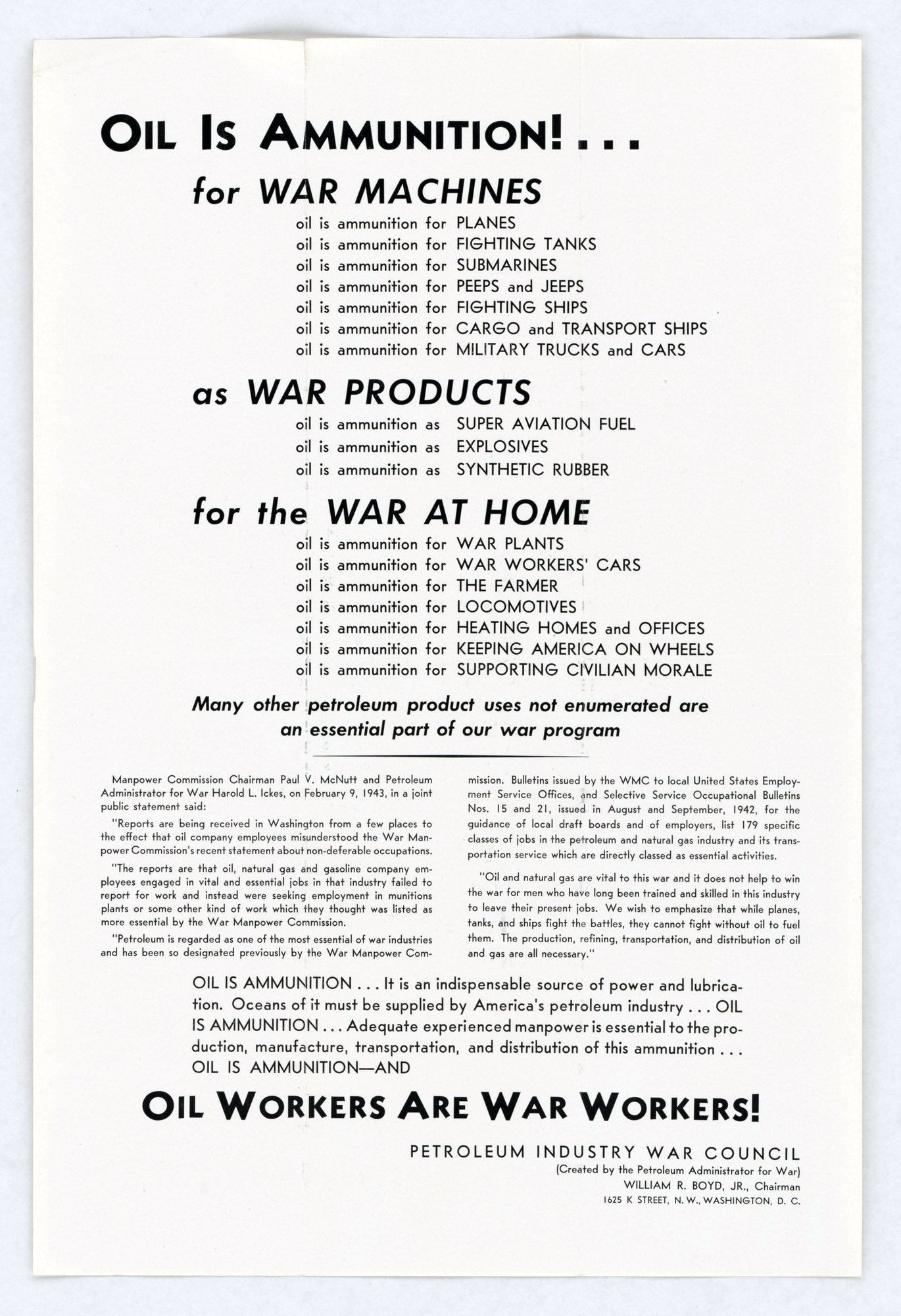
Oil is ammunition! Oil workers are war workers! is a 1943 text broadside of the Petroleum Industry War Council. It repeats its slogan down three lists of uses, then quotes a 9 February 1943 statement by Paul V. McNutt and Harold L. Ickes asking oil employees not to leave their jobs (NAID 515104).
A column of type
The broadside has no image; it is a column of type that says "oil is ammunition" over and over, under three headings: for war machines, as war products, and for the war at home. The list runs from planes, tanks and submarines to synthetic rubber, farmers, home heating and "supporting civilian morale." Then the sheet changes register and prints a government statement.
Manpower Commission Chairman Paul V. McNutt and Petroleum Administrator for War Harold L. Ickes, on February 9, 1943, in a joint public statement said:
"Reports are being received in Washington from a few places to the effect that oil company employees misunderstood the War Manpower Commission's recent statement about non-deferable occupations. [...]
"Oil and natural gas are vital to this war and it does not help to win the war for men who have long been trained and skilled in this industry to leave their present jobs. [...]"
[...] OIL IS AMMUNITION—AND
OIL WORKERS ARE WAR WORKERS!
PETROLEUM INDUSTRY WAR COUNCIL
(Created by the Petroleum Administrator for War)
The council behind it
The signature block names the Petroleum Industry War Council, "Created by the Petroleum Administrator for War," with William R. Boyd, Jr. as chairman and an address on K Street in Washington. The quoted statement explains what prompted the sheet. Some oil, gas and gasoline employees, it says, had stopped reporting for work and were looking for jobs in munitions plants, believing those jobs ranked as more essential. The statement adds that draft-board bulletins from August and September 1942 listed 179 classes of petroleum jobs as essential activities.
Repetition as argument
Transfer and identity fusion are the archive's two tags. The metaphor moves the urgency of ammunition onto fuel, and the last line makes the job itself a war role. The repetition is the method: the reader meets the same three words eighteen times before reaching the quoted statement.
What stands out is that the request is made in public and argued. Two officials say employees "misunderstood," explain why, and cite the bulletins. The sheet asks workers to stay; it does not, in the text printed here, threaten them. A worker deciding where his labor mattered most was exercising a free choice, and the government answered with reasons rather than an order. Whether manpower rules elsewhere left that choice fully free is a question this record does not settle.
The same idea, that a job is a post in the war, drives Production Lines Are Battle Lines! and Days Off Cost Lives!. The Roosevelt administration essay sorts the war offices by the powers they held.
Sources
- FRAME object record, Oil is ammunition! Oil workers are war workers!, 1943. Petroleum Industry War Council (created by the Petroleum Administrator for War).
- U.S. National Archives and Records Administration, Record Group 44, World War II Posters, NAID 515104, local id 44-PA-1441, catalog record, retrieved by the archive 4 October 2026. Rights as recorded: public domain (U.S. government work).