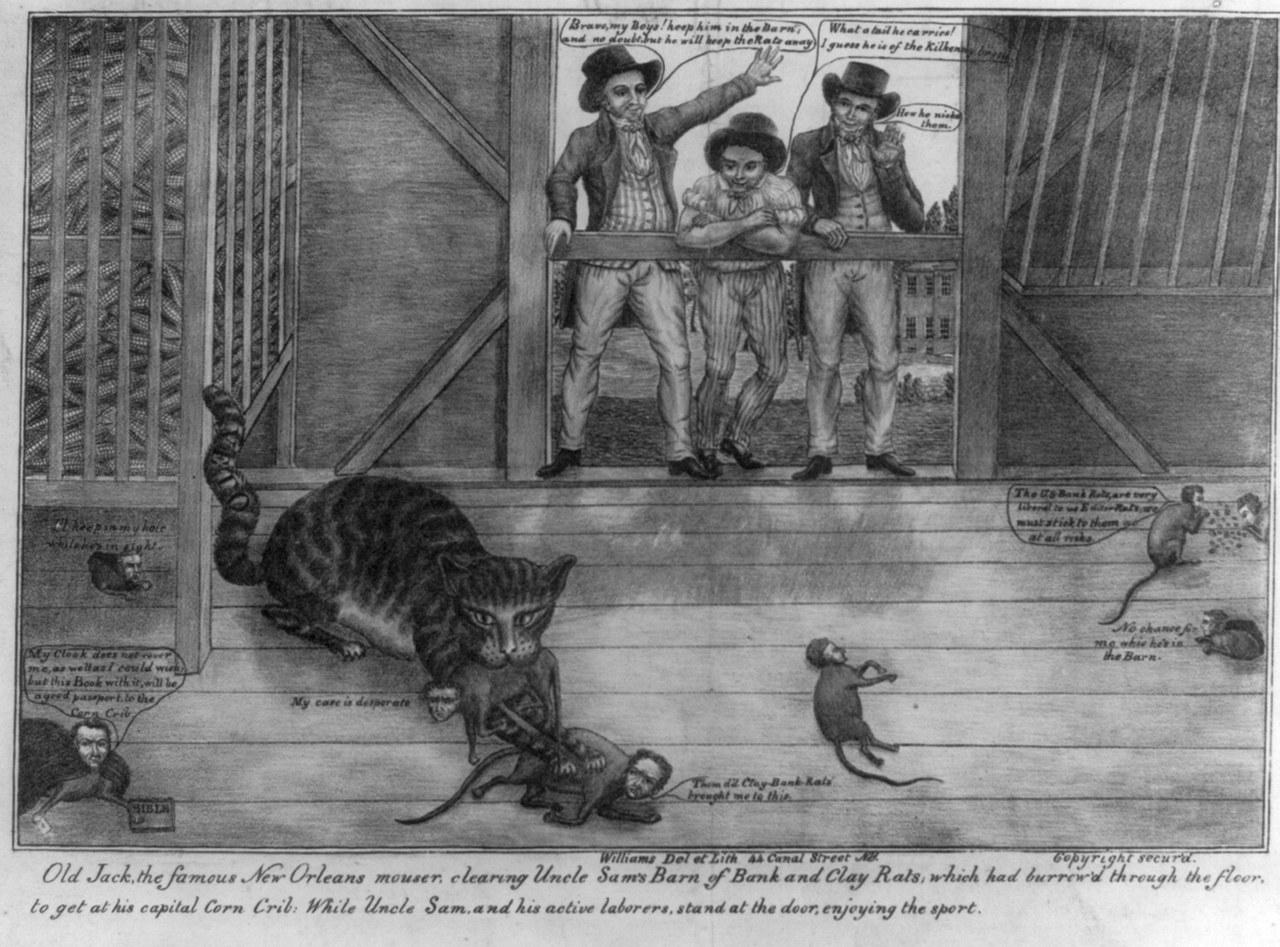
Michael Williams's 1832 New York lithograph draws Andrew Jackson as a cat clearing "Uncle Sam's Barn" of rats labeled for the Bank of the United States and Henry Clay, while onlookers cheer.
What the print shows
A big cat stands on the floor of a barn with one rat in its mouth and another under its paws. More rats hide in holes or edge away. Three men at the door cheer. The long caption explains the joke: the cat is Andrew Jackson, tagged with New Orleans, the city his admirers tied to his name, and the rats are the friends of the United States Bank and of Henry Clay. Every rat gets a line.
Brave, my Boys! keep him in the Barn; and no doubt, but he will keep the Rats away.
My Cloak does not cover me, as well as I could wish, but this Book with it, will be a good passport to the Corn Crib. [the book is labelled BIBLE]
Them d'd Clay-Bank Rats brought me to this.
The US Bank Rats are very liberal to us Editor Rats, we must stick to them at all risks.
Old Jack, the famous New Orleans mouser, clearing Uncle Sam's Barn of Bank and Clay Rats, which had burrow'd through the floor, to get at his capital Corn Crib: While Uncle Sam, and his active laborers, stand at the door, enjoying the sport.
Who made it
Michael Williams drew and lithographed the print in New York, at 44 Canal Street, and secured a copyright on it. The archive dates it 1832, a presidential election year, and files it under the Jackson administration. No party or committee is named. It is a commercial print taking Jackson's side.
How to read it
The argument is in the animals. A cat does not debate a rat. Once the opposition is drawn as vermin that "burrow'd through the floor" to reach the public grain, the only question left is how fast the cat works. The disputed policy, whether a national bank served the country or preyed on it, never appears as a policy. It appears as an infestation.
Two rats are worth a second look. One hides under a cloak with a Bible, mocking religious respectability as a disguise for self-interest. Another speaks for "Editor Rats" paid by the Bank. That second line is a charge that the press was bought. It may have had targets in fact. The print offers no names and no evidence, only the accusation.
Contempt for the other side's supporters was a habit of the form. Eight years later, an anti-Whig sheet in New Orleans drew the other party's crowds as loafers crawling into a cider trap.
Sources
- FRAME object record, "Old Jack, the famous New Orleans mouser" (pro-Jackson print, 1832). Michael Williams, lithographer, New York.
- Library of Congress, Prints and Photographs Division, LC-USZ62-55185. loc.gov/pictures/item/2008661752, retrieved by the archive 2 October 2026. Rights as recorded: public domain, no known restrictions on publication.