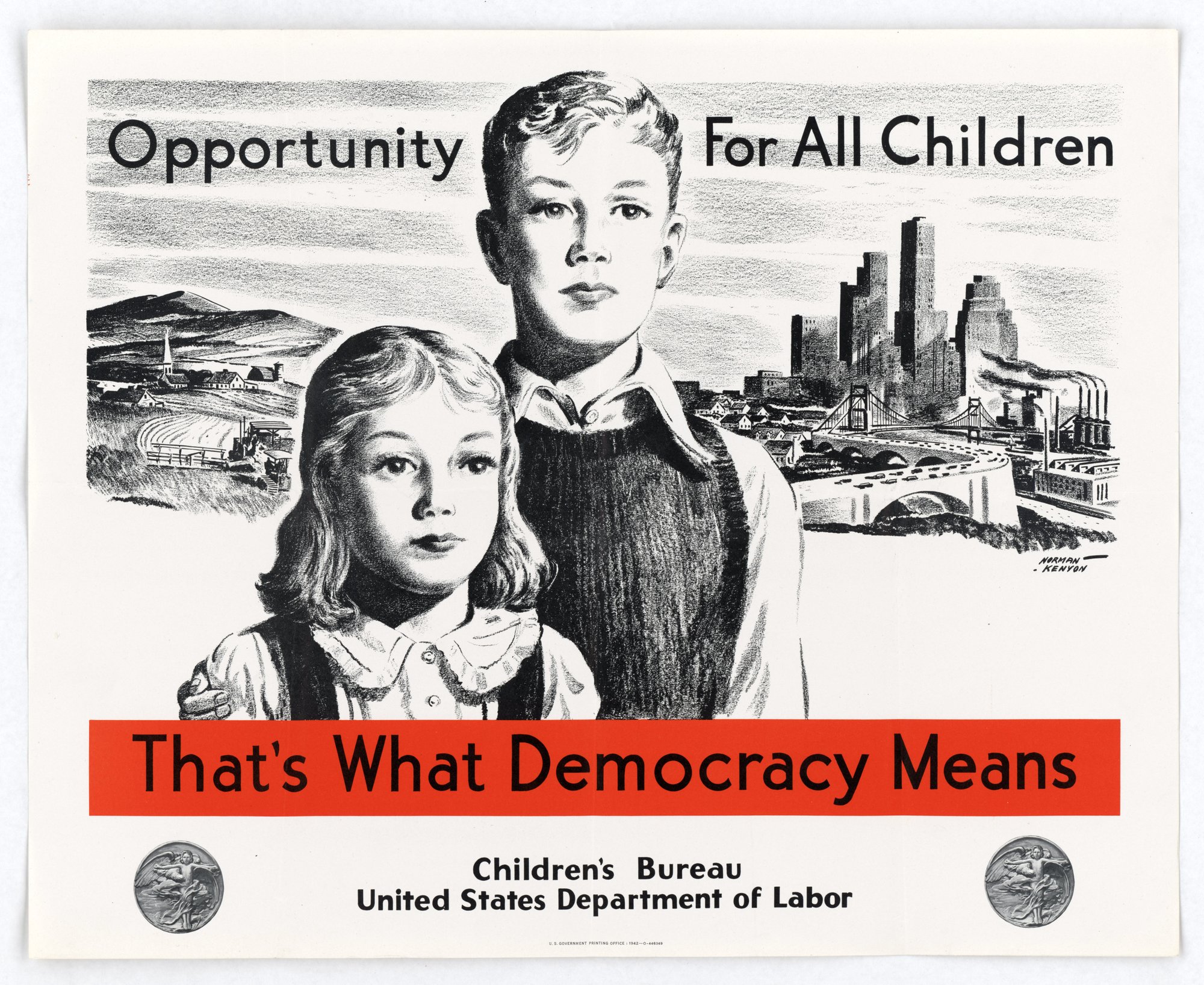
Opportunity for all children is a 1942 poster of the Children's Bureau, U.S. Department of Labor, signed Norman Kenyon. A boy and a girl stand in front of a farm and church on one side and a city of bridges and factories on the other, above a red band: "That's What Democracy Means" (NAID 515134).
The scene
A government bureau for children chose to define democracy, and this poster is its answer. Kenyon puts a boy and a girl in the foreground. Behind them, the archive notes, a farm and a church sit to the left and a city with bridges and factories to the right. The headline runs across the top, and a red band carries the second line.
Opportunity For All Children
That's What Democracy Means
Children's Bureau
United States Department of Labor
[signature:] NORMAN KENYON
[imprint:] U. S. GOVERNMENT PRINTING OFFICE : 1942—O—446349
Issuer
The Children's Bureau of the U.S. Department of Labor is printed on the sheet, with Kenyon's signature and a Government Printing Office job number dated 1942. The record classes it as a state-issued poster for a "Domestic public," with the purpose "Persuade or win support" and the home front as its theme. It does not say where the poster hung or how many were printed.
The same bureau's Good Child-Labor Legislation sheet, also from 1942, maps state minimum working ages. That one argues with data. This one argues with a slogan.
A word stretched
The archive tags glittering generalities and transfer. "Democracy" is the virtue word, and the poster pins it to children's welfare, a cause few would oppose. The farm, the church, and the factory city say that the promise reaches every kind of American place.
The definition is the part to read slowly. Democracy, in the constitutional sense, is a method: citizens choose and remove the people who govern them, under a law that binds the governors too. Opportunity for children is a good aim, and a democracy may pursue it. Calling the aim the meaning of the method lets an agency present its own program as the substance of self-government. Nothing on this sheet is false. It is a federal office describing self-government in the terms of its own mandate.
For the wartime government that issued it, see the Roosevelt administration essay. A private plant poster from the same year, Produce for Victory, reaches for a different founding text, the Bill of Rights.
Sources
- FRAME object record, Opportunity for all children: That's what democracy means, 1942. Children's Bureau, U.S. Department of Labor; artist Norman Kenyon. Rights as recorded: public domain (U.S. government work).
- U.S. National Archives and Records Administration, Record Group 44, World War II Posters, 44-PA-1470, NAID 515134, retrieved by the archive 4 October 2026.