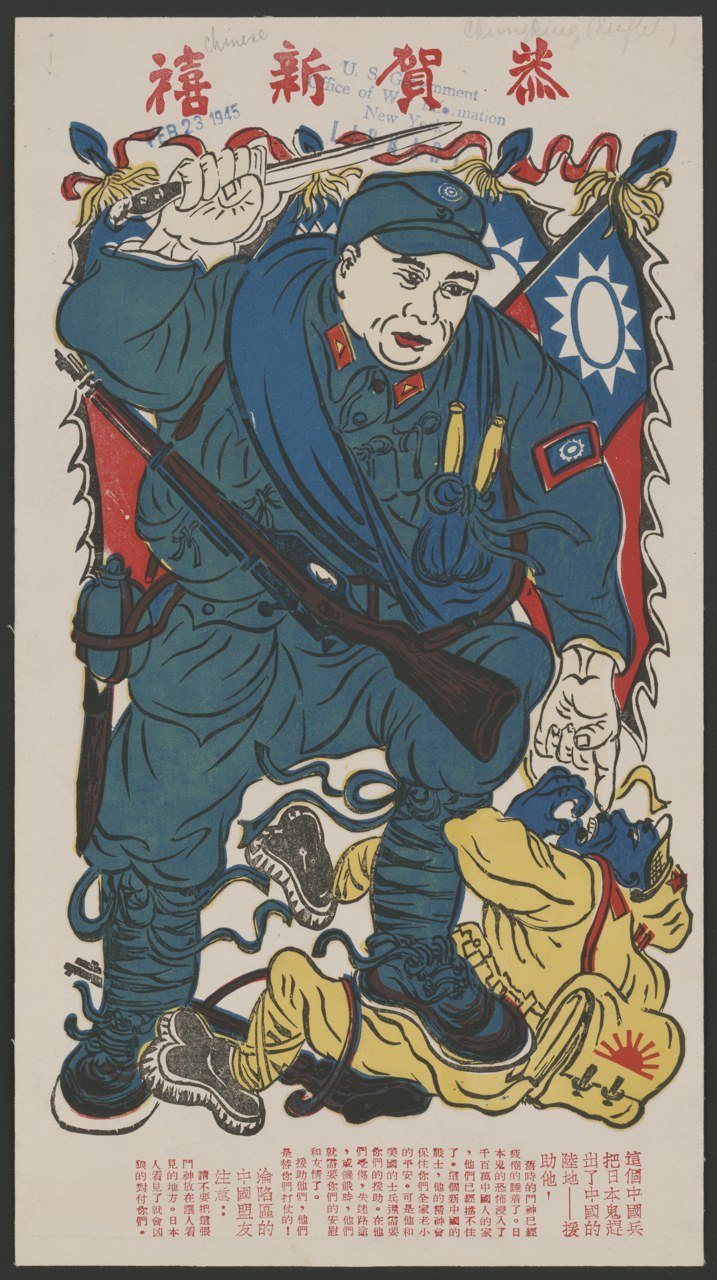
恭賀新禧 (Happy New Year): Chinese soldier as door god, Chinese-language poster stamped Office of War Information
A Chinese New Year door god for the war, stamped by the OWI in 1945
A 1945 Chinese New Year door-god poster with an OWI stamp: a Chinese soldier stamps on a Japanese one, and the text asks help for Chinese and US troops.
Techniques named on the archive record
TransferName-calling
Date
1945
Made by
Chinese-language poster, publisher not identified on the sheet; held with the stamp of the U.S. Office of War Information, New York library, in the Library of Congress Artist Posters series
Library of Congress, Prints and Photographs Division, Artist Posters series (item 2015646606) , retrieved October 2, 2026
Source
Public domain (stamped U.S. OWI federal record; LOC states it holds no rights) Library of Congress, Prints and Photographs Division, Artist Posters (item 2015646606); stamped U.S. Office of War Information.
Object, image, and catalog record from the FRAME archive. Text on this page is CC BY 4.0. Image rights are as the archive records.
恭賀新禧 (Happy New Year) is a Chinese-language door-god print in woodblock style, held with a U.S. Office of War Information, New York, stamp dated February 23, 1945. A Chinese soldier stamps on a Japanese soldier, and the text asks readers to help Chinese and American troops.
A soldier in the place of the old guardians
The archive calls this a New Year door-god (menshen) print. In this woodblock-style print the guardian is a giant Chinese soldier in Nationalist uniform with his bayonet raised. Under his feet is a Japanese soldier marked with the rising-sun badge. The text tells readers that the old door gods have fallen asleep and that this soldier now keeps the household safe. It then asks for help for him and for American soldiers, and ends with a warning about where to hang the sheet.
恭賀新禧
這個中國兵把日本鬼趕出了中國的陸地——援助他!
[...] 淪陷區的中國盟友注意:
請不要把這張門神放在讓人看見的地方。日本人看見了就會兇狠的對付你們。
[Stamp:] U.S. Government / Office of War Information / New York / FEB 23 1945
A federal stamp, no publisher's name
The sheet itself does not name a publisher. What ties it to Washington is a stamp reading "U.S. Government / Office of War Information / New York", dated 23 February 1945. The Library of Congress holds it in its Artist Posters series as item 2015646606. FRAME marks the source "Unidentified", its label for a source that is blurred, and still files the issuer type as "State". The audience is "Foreign public", the purpose "Persuade or win support", and the event the Second Sino-Japanese War. Who drew, printed or carried it is not recorded.
Borrowed custom, and one changed word
The archive's reading is that a familiar household image was borrowed to carry a wartime request. The request is concrete: comfort and friendship for soldiers who are wounded, lost or hungry. The warning to readers in occupied areas is the most honest line on the sheet, since it admits that hanging it in view could bring harsh treatment.
The archive holds another poster in the same door-god format, This American Airman Drives the Jap from China's Skies, credited to the OWI. Its Chinese headline says the airman drove 日本人, "the Japanese", from China's skies. This sheet says the soldier drove out 日本鬼, which FRAME translates as "Japanese devils"; the record's technique tags for this sheet include name-calling and demonization. The record does not say whether the same hand wrote both.
FRAME object record, 恭賀新禧 (Happy New Year): Chinese soldier as door god, Chinese-language poster stamped Office of War Information, 1945. Publisher not identified on the sheet. Translation by FRAME, machine-assisted, not verified by a fluent reader.
Library of Congress, Prints and Photographs Division, Artist Posters series, item 2015646606, retrieved by the archive 2 October 2026. Rights as recorded: public domain (stamped U.S. OWI federal record; LOC states it holds no rights).
FRAME object record, This American Airman Drives the Jap from China's Skies: Give Him Your Help! (Chinese New Year poster), 1945, U.S. Office of War Information; Library of Congress LC-USZC4-702.