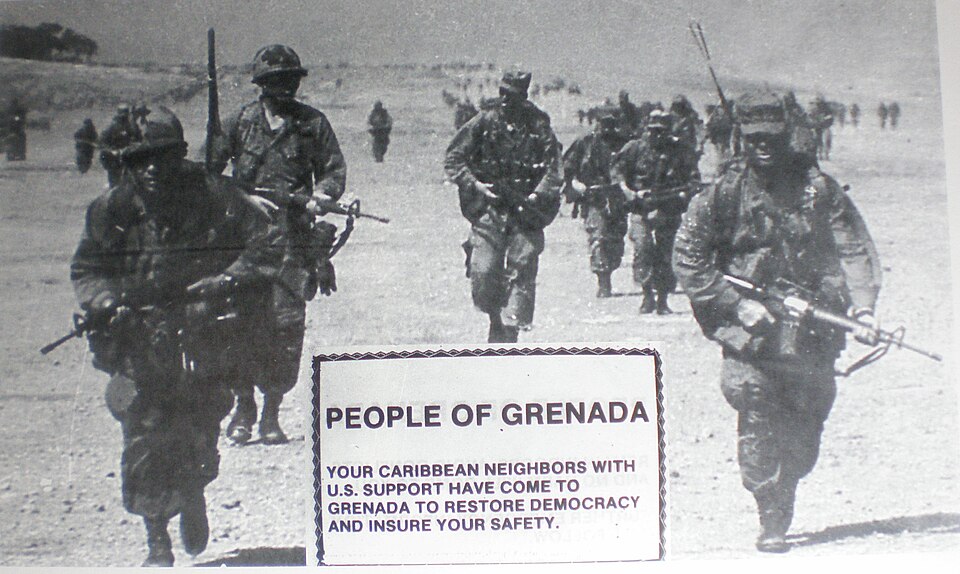
A US Army psychological-operations handbill from Operation Urgent Fury, October 1983, tells the people of Grenada that their Caribbean neighbors, with U.S. support, have come to restore democracy and insure their safety.
What the handbill prints
Most of the sheet is a halftone photograph: helmeted soldiers with rifles moving across open ground. A boxed notice is set into the picture. It is one sentence long, under a three-word address.
PEOPLE OF GRENADA
YOUR CARIBBEAN NEIGHBORS WITH
U.S. SUPPORT HAVE COME TO
GRENADA TO RESTORE DEMOCRACY
AND INSURE YOUR SAFETY.
Who issued it
The handbill does not name its maker. The archive attributes it to US Army psychological operations during Operation Urgent Fury, the October 1983 invasion of Grenada, and marks the source as blurred for that reason. The image is a Wikimedia Commons file uploaded by EDomingos and tagged as a U.S. military work in the public domain. FRAME holds a second record of the same text, from a different photograph of a leaflet, under a separate entry.
How to read it
Look at the order of the sentence. The subject is "your Caribbean neighbors," and the United States enters only as "support." The picture beside the words shows armed troops. The archive points out that the regional partners come first and the American role second, and files the sheet under glittering generalities: "restore democracy" and "insure your safety" are the whole explanation, with no terms, no timetable, and no account of who would govern next.
Those are good words. A promise of democracy can be sincere. It is still a promise, and a reader has no way to test it from the page. The fair standard is the one any citizen would apply to a government announcement at home: what is being done, by whom, under what authority, and for how long.
For American readers there is a second point. A war power used by the President and explained abroad in a single sentence still has to be explained at home, to Congress and the public, in more than one. This sheet was written for Grenadians. It is not the account Americans were owed.
Sources
- FRAME object record, "People of Grenada": US forces handbill, Operation Urgent Fury, October 1983. Issuer as recorded: US Army psychological operations; issuer not named on the handbill.
- Wikimedia Commons, Handbill distributed by US Forces during the invasion of Grenada, uploaded by EDomingos, retrieved by the archive 2 October 2026. Rights as recorded: public domain (U.S. military work).