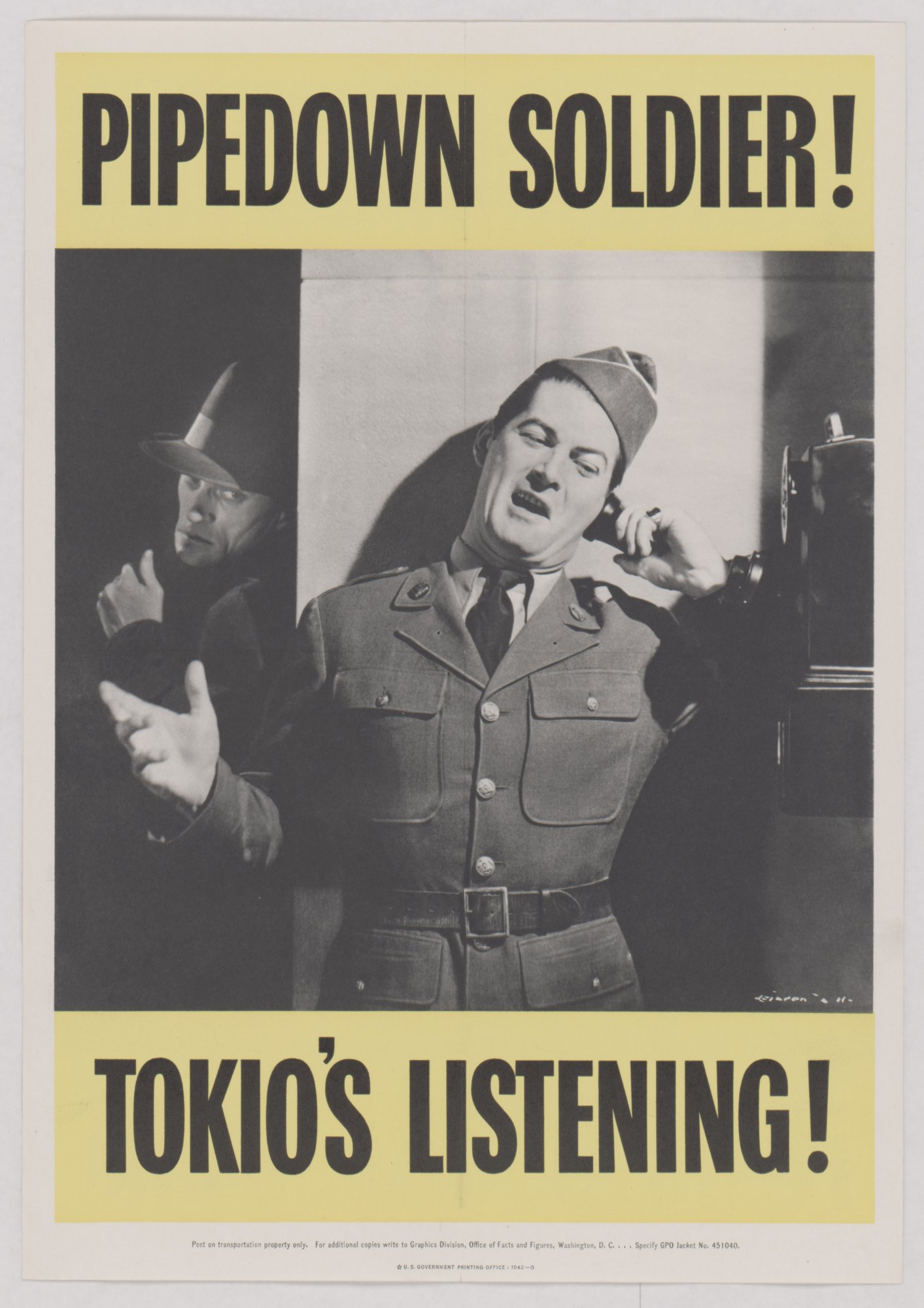
Pipedown Soldier! Tokio's Listening! is a 1942 security poster of the Office of Facts and Figures, marked for posting on transportation property only. A uniformed soldier talks on a telephone while a shadowed man in a hat listens around a corner (NAID 515176).
What the sheet prints
A soldier in uniform leans into a telephone, mouth open. Behind a corner, half in shadow, a man in a hat is listening. The headline is an order in service slang. The small print below says where the poster was supposed to go.
PIPEDOWN SOLDIER!
TOKIO'S LISTENING!
Post on transportation property only. For additional copies write to Graphics Division, Office of Facts and Figures, Washington, D. C. . . . Specify GPO Jacket No. 451040.
U. S. GOVERNMENT PRINTING OFFICE : 1942-O
Who issued it
The Office of Facts and Figures was a federal information office whose work was folded into the Office of War Information in 1942. Its Graphics Division is named on this sheet as the place to order copies. The instruction "post on transportation property only" aims it at places where servicemen traveled; the record does not say which carriers or stations actually posted it. The FRAME collection also holds companion sheets in the same series that name Berlin instead of Tokio and address sailors as well as soldiers.
How to read it
This is a narrow and defensible request. It is aimed at servicemen, who were under military discipline and could carry information about unit movements. It names a specific risk, a public phone in a public place. As security advice goes, that is concrete.
The listener is the part to watch. He is not drawn as a caricature; he is a man in a hat, which is to say, anyone. That keeps the sheet clear of the ethnic cartooning found on other 1942 posters, and it also asks every traveler to treat the stranger nearby as a possible agent. "Tokio" names the government that would receive the information, not the face of the listener. That is a better choice than many sheets of the year made.
Compare Someone Talked!, which aims a similar warning at civilians, and Silence Means Security, which addresses women in the Women's Army Auxiliary Corps. See the Office of War Information index and the OWI domestic branch study for the office that absorbed this one. The rumor clinics case study treats the newspaper columns that answered rumors as a separate campaign from security posters like this one, which warned against talk of any kind.
Sources
- FRAME object record, Pipedown Soldier! Tokio's Listening!, 1942. Office of Facts and Figures. Rights as recorded: public domain (U.S. government work).
- U.S. National Archives and Records Administration, Record Group 44, World War II Posters, 44-PA-1510, NAID 515176, retrieved by the archive 4 October 2026.