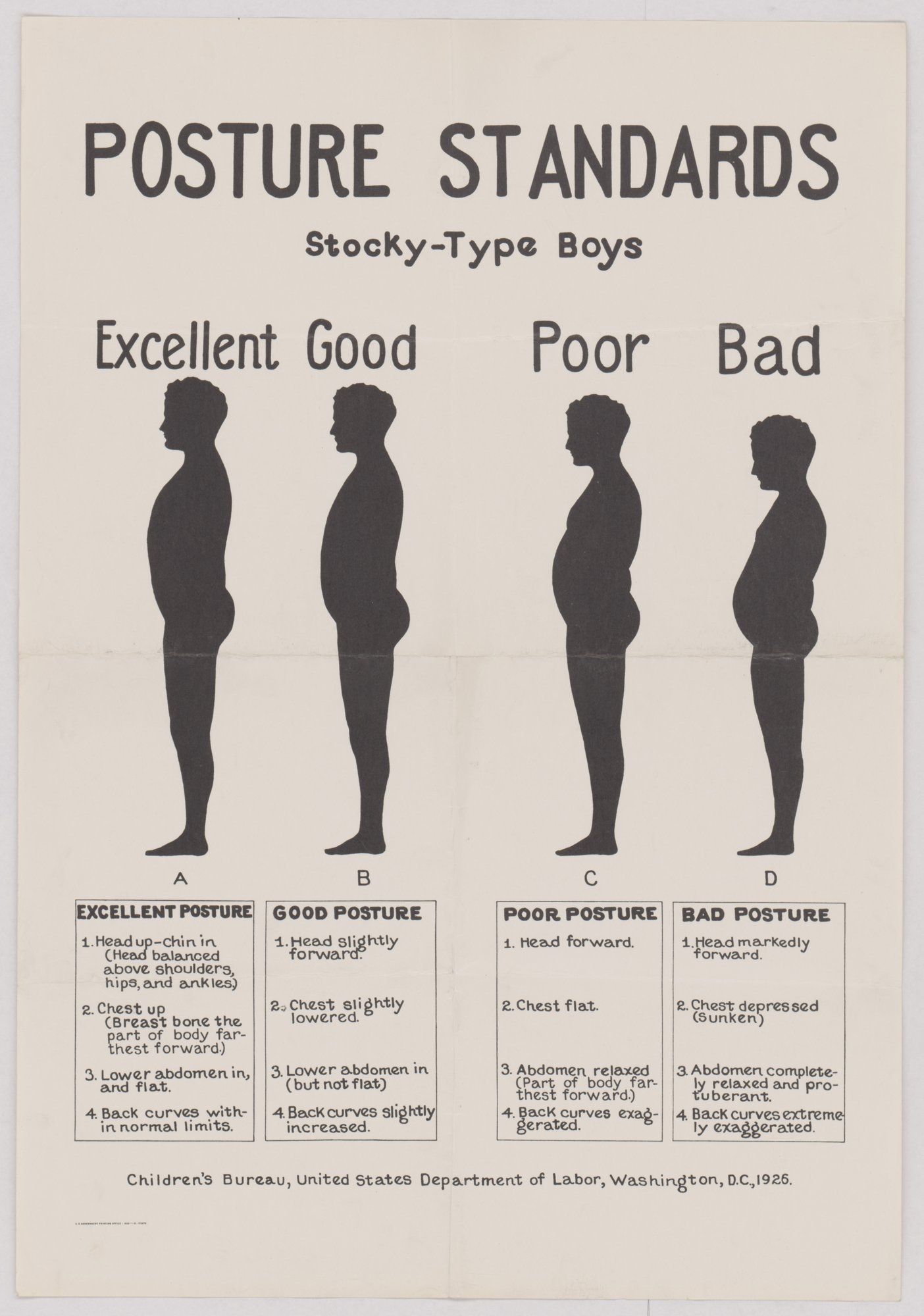
A federal chart grades four boys' bodies from Excellent to Bad, 1926
A 1926 Children's Bureau chart grades four stocky-type boys' postures as Excellent, Good, Poor, and Bad. National Archives NAID 515197.
Techniques named on the archive record
Glittering generalities
Date
1926
Made by
Children's Bureau, U.S. Department of Labor
Medium
Poster
Country
United States
Regime
Coolidge Administration
NARA
NAID 515197; Record Group 44
Source
Identified Openly sourced: the speaker is who they say they are
Source
U.S. National Archives and Records Administration, Record Group 44, World War II Posters , retrieved October 4, 2026
Source
Public domain (U.S. government work) Children's Bureau, U.S. Department of Labor. National Archives and Records Administration, RG 44, 44-PA-1532 (NAID 515197).
Object, image, and catalog record from the FRAME archive. Text on this page is CC BY 4.0. Image rights are as the archive records.
A 1926 health chart from the Children's Bureau of the U.S. Department of Labor shows four side-view silhouettes of stocky-type boys, lettered A to D and graded Excellent, Good, Poor, and Bad, each with four points on head, chest, abdomen, and back. NAID 515197.
What the chart prints
Four dark profiles stand in a row, A through D. Under each is a short checklist covering the same four parts of the body. The wording moves from praise to alarm as the letters go down: a flat abdomen becomes "relaxed," then "protuberant," and the back curves go from "normal limits" to "extremely exaggerated."
POSTURE STANDARDS
Stocky-Type Boys
Excellent Good Poor Bad
EXCELLENT POSTURE
1. Head up-chin in (Head balanced above shoulders, hips, and ankles)
2. Chest up (Breast bone the part of body farthest forward.)
3. Lower abdomen in, and flat.
4. Back curves within normal limits.
[...]
BAD POSTURE
1. Head markedly forward.
2. Chest depressed (Sunken)
3. Abdomen completely relaxed and protuberant.
4. Back curves extremely exaggerated.
Children's Bureau, United States Department of Labor, Washington, D.C., 1926.
Who issued it
The imprint names the Children's Bureau of the Department of Labor and the Government Printing Office. The National Archives holds the sheet in Record Group 44 as 44-PA-1532, in a series catalogued as World War II posters even though the chart is dated 1926. The same data set holds a companion sheet for intermediate-type boys, NAID 515198. FRAME files this one under health, with the stated purpose to warn or inform.
How to read it
As propaganda this is mild. FRAME tags it for glittering generalities and calls the technique faint. The persuasion lives in four words, Excellent, Good, Poor, and Bad, set over drawings that are otherwise a plain description. A chart that says "head forward" informs. A chart that says "bad" judges.
The useful question is one of scale. A federal office in Washington had drawn up a standard for how a boy's body ought to stand and printed it for display. Nothing on the sheet compels anyone to do anything, and parents and teachers were free to ignore it. Still, the sheet shows national government defining a normal body and grading children against it, which is a different job from telling parents what a doctor might look for. The chart is honest about what it is. A reader can take the advice and still notice who is giving the grades.
Sources
FRAME object record, Posture standards. Stocky-type boys, 1926. Children's Bureau, U.S. Department of Labor.
U.S. National Archives and Records Administration, Record Group 44, NAID 515197 (44-PA-1532), retrieved by the archive 4 October 2026. Rights as recorded: public domain (U.S. government work).