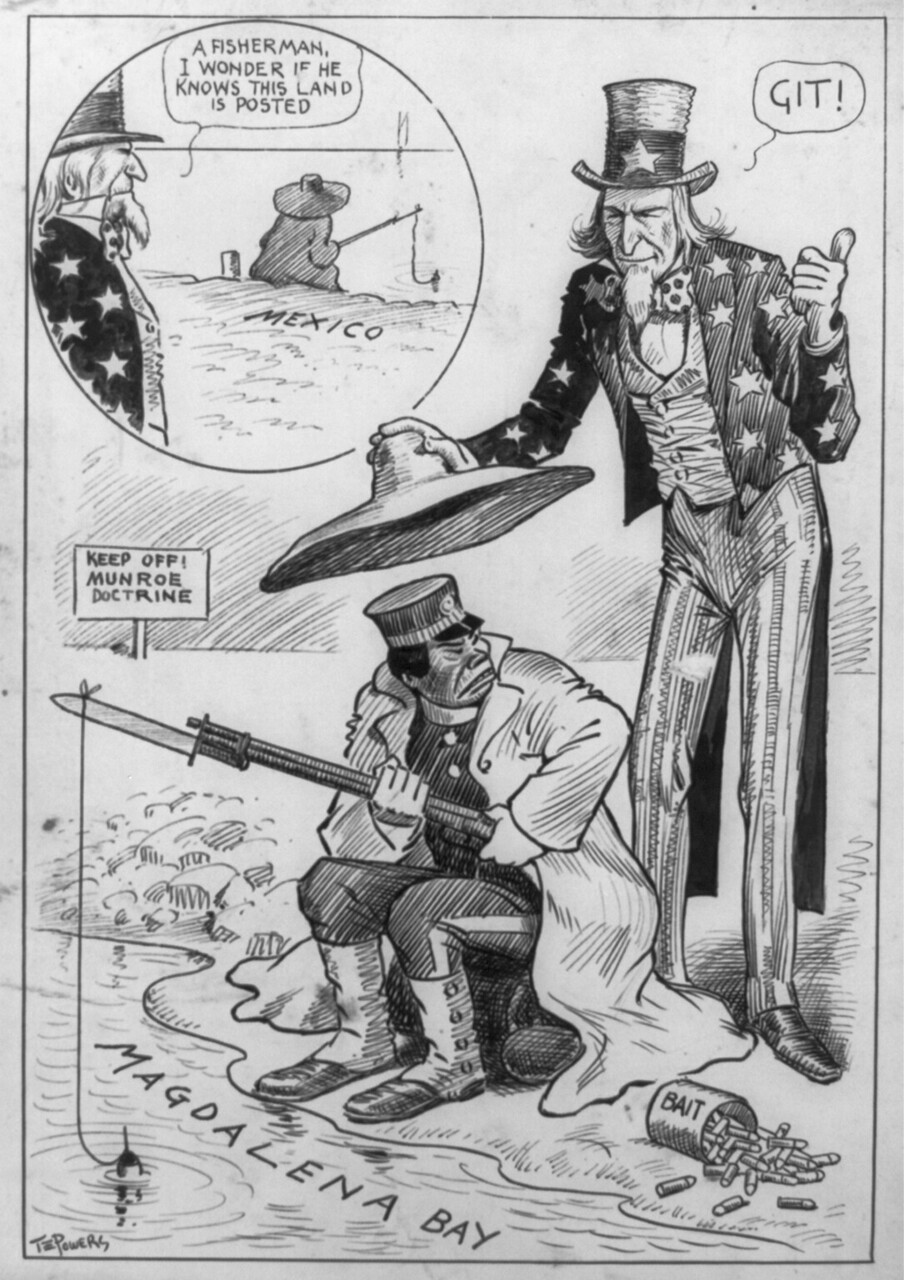
Keep Off! Monroe Doctrine, T. E. Powers's 1912 Magdalena Bay cartoon
T. E. Powers's 1912 cartoon has Uncle Sam unmask a Magdalena Bay "fisherman" as a Japanese soldier with cartridges for bait. Library of Congress.
Techniques named on the archive record
Fear appeal
Date
1912
Made by
Thomas E. Powers, newspaper cartoonist (publishing paper not stated in the LOC record)
Medium
Cartoon
Country
United States
Regime
Taft Administration
Source
Identified Openly sourced: the speaker is who they say they are
Source
Library of Congress, Prints and Photographs Division , retrieved October 2, 2026
Source
Public domain (published in the U.S. in 1912; LOC: no known restrictions on publication, no renewal in Copyright Office) T. E. Powers, "Keep off! Monroe doctrine", 1912; Library of Congress Prints and Photographs Division, Swann Collection of Caricature and Cartoon; LC-USZ62-85448
Object, image, and catalog record from the FRAME archive. Text on this page is CC BY 4.0. Image rights are as the archive records.
Keep Off! Monroe Doctrine is a 1912 cartoon by T. E. Powers. Uncle Sam lifts the sombrero off a squatting "fisherman" at Magdalena Bay, Mexico, and finds a Japanese soldier with a bayonetted rifle and a can of cartridges marked "Bait," then orders him off with "Git!"
The cartoon
Content note: the cartoon caricatures a Japanese soldier disguised as a fisherman. It is described here as drawn.
In a small inset, Uncle Sam spots a figure fishing on the Mexican coast. In the main panel he has lifted the man's sombrero and found a Japanese soldier underneath, holding a rifle with a bayonet. A line hangs in the water of Magdalena Bay. The bait can is full of cartridges. A sign carries the doctrine, misspelled.
[speech balloon, inset circle at upper left, Uncle Sam speaking] A FISHERMAN, I WONDER IF HE KNOWS THIS LAND IS POSTED
[inset ground] MEXICO
[speech balloon, upper right, Uncle Sam] GIT!
[sign] KEEP OFF! MUNROE DOCTRINE
[water] MAGDALENA BAY
[can of cartridges] BAIT
[signature, lower left] T.E. POWERS
What it claims
The archive tags the cartoon for fear appeal and files it under the Magdalena Bay incident of 1912. Its description says the cartoon draws fishing as a cover for a military landing, which was the claim behind the scare. The drawing presents that claim as already proven. There is no evidence on the sheet, only the reveal under the hat.
The cartoon takes a suspicion and draws it as a discovery. A reader who sees the rifle under the sombrero has been shown the conclusion without the investigation. Every Japanese fisherman on that coast is, in this picture, a soldier in disguise until Uncle Sam says otherwise.
The other notable thing is the sign. "Land is posted" treats a bay in Mexico as American property, fenced off by a doctrine, and the cartoon does not ask what Mexico thought. Uncle Sam does all the talking.
Who drew it
The archive credits Thomas E. Powers as a newspaper cartoonist and notes that the Library of Congress record does not name the paper. It files the purpose as "warn or inform" and the issuer as media. Nothing in the transcription ties it to the government.
FRAME object record, "Keep off! Monroe doctrine" (T. E. Powers, 1912). Thomas E. Powers, newspaper cartoonist (publishing paper not stated in the LOC record).
Library of Congress, Prints and Photographs Division, Swann Collection of Caricature and Cartoon, LC-USZ62-85448, catalog record, retrieved by the archive 2 October 2026. Rights as recorded: public domain (published in the U.S. in 1912; no renewal in Copyright Office).