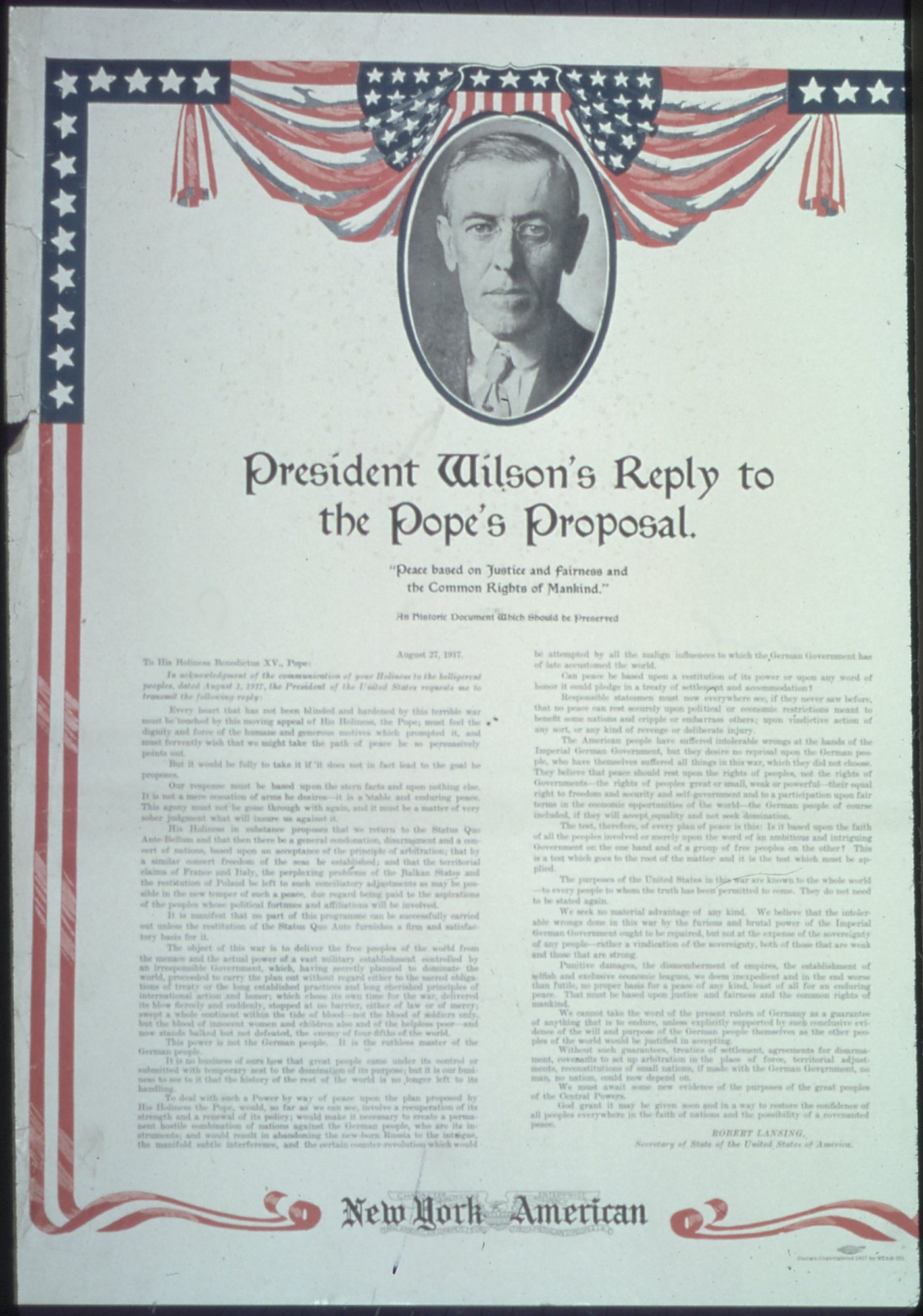
President Wilson's Reply to the Pope's Proposal (1917), reprinted by the New York American
The New York American's 1917 sheet of Wilson's reply to Pope Benedict XV, signed by Robert Lansing, framed by flag bunting and a portrait. NARA RG 4.
Techniques named on the archive record
TransferGlittering generalities
Date
1917
Made by
New York American (William Randolph Hearst); text issued by U.S. Department of State (Robert Lansing)
Medium
Poster
Country
United States
Regime
Wilson Administration
NARA
NAID 512439
Source
Identified Openly sourced: the speaker is who they say they are
Source
U.S. National Archives (NARA), RG 4 (U.S. Food Administration), World War I Posters (NAID 512439) , retrieved October 3, 2026
Source
NARA Unrestricted; hosted by owner decision New York American (William Randolph Hearst); text issued by U.S. Department of State (Robert Lansing). National Archives and Records Administration, 4-P-213.
Object, image, and catalog record from the FRAME archive. Text on this page is CC BY 4.0. Image rights are as the archive records.
A 1917 New York American sheet reprints the United States' reply of 27 August 1917 to Pope Benedict XV's peace proposal, signed by Secretary of State Robert Lansing, under a portrait of Wilson and flag bunting. It calls itself "An Historic Document Which Should be Preserved."
A state paper set as a poster
The archive describes a portrait of President Wilson in an oval under draped flag bunting, with the whole reply below it in two dense columns of small type. The words are the government's: a note from Secretary of State Robert Lansing answering the Pope's communication "to the belligerent peoples," dated 1 August 1917. The layout is a newspaper's. The masthead is the New York American, and the design is copyrighted to the Star Co.
President Wilson's Reply to the Pope's Proposal.
"Peace based on Justice and Fairness and the Common Rights of Mankind."
An Historic Document Which Should be Preserved
[...]
The object of this war is to deliver the free peoples of the world from the menace and the actual power of a vast military establishment controlled by an irresponsible Government, [...]
This power is not the German people. It is the ruthless master of the German people.
[...]
ROBERT LANSING,
Secretary of State of the United States of America.
New York American
Design Copyrighted 1917 by STAR CO.
Who made it
The record credits the New York American (William Randolph Hearst), with the text issued by the State Department. The issuer type is media. The archive tags transfer and glittering generalities: the flag and the portrait are wrapped around a long official text, under a headline about peace based on justice and the common rights of mankind. The themes are war and the military, and religion. The National Archives copy sits in Record Group 4, the Food Administration's World War I Posters series (NAID 512439), local identifier 4-P-213.
Reading it
This is a private paper choosing to print a government's argument in full and telling readers to keep it. Nothing on the sheet says an office asked for it. The note itself turns down the Pope's plan as a basis for peace, and it does so with a distinction worth keeping: the enemy named is the German government, "not the German people." The state council poster below names Germany itself as the enslaver.
FRAME object record, President Wilson's Reply to the Pope's Proposal, 1917. New York American (William Randolph Hearst); text issued by U.S. Department of State (Robert Lansing). Source classed as openly identified.
U.S. National Archives, RG 4, World War I Posters, series NAID 512439, catalog item 512651, local identifier 4-P-213, retrieved by the archive 3 October 2026. Rights as recorded: NARA unrestricted.