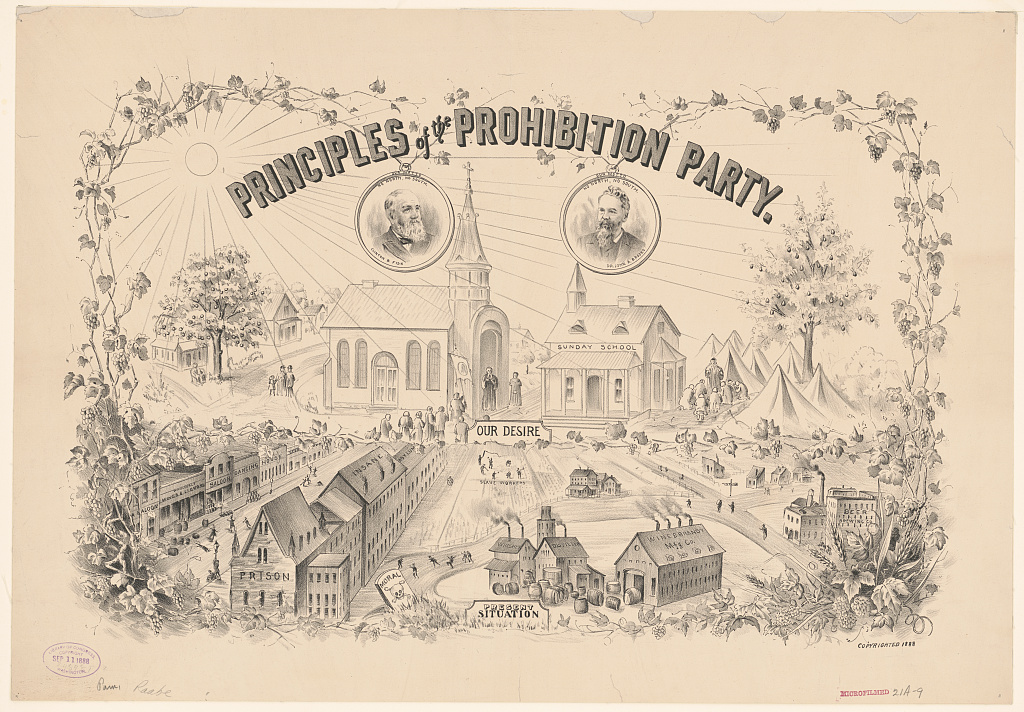
An 1888 lithograph for the Prohibition Party ticket of Clinton B. Fisk and John A. Brooks sets a town labeled "Our desire," with church and Sunday school, against a "Present situation" of saloons, a prison, and an asylum.
What the print shows
Two medallion portraits at the top present the party's ticket for 1888. Below them the sheet splits in two. One half, "Our desire," shows a town with a church, a Sunday school, and a camp meeting. The other half, "Present situation," shows a prison, an insane asylum, saloons, and a wine and brewing company. The viewer is asked to choose a town.
PRINCIPLES OF THE PROHIBITION PARTY.
CLINTON B. FISK [and] DR. JOHN A. BR[...]
NO NORTH, NO SOUTH.
OUR DESIRE / SUNDAY SCHOOL
PRESENT SITUATION / PRISON / INSANE / SALOON
COPYRIGHTED 1888
Who made it
The archive classes the issuer as the party and dates the copyright to 11 September 1888, during Grover Cleveland's term, ahead of that fall's election. The only maker's name it has is "Raabe," taken from a Library of Congress shelflist card, so the artist or printer is not firmly identified. This page does not guess further.
How to read it
The archive tags the print for card stacking and fear appeal. The card stacking is the layout. Each side of the sheet is built from chosen buildings. One town has only virtues and the other has only vices, as if no churchgoer ever drank and no saloon town ever had a school. The fear appeal is the line drawn from the saloon to the prison and the asylum. The print does not argue that drink causes crime and madness. It places them on the same street and lets the eye finish the sentence.
The slogan "No North, No South" is the one line about national politics. It offers the party as a way past the sectional divide of the Civil War generation, an honest thing to campaign on.
The liberty question is in the party's name. Prohibition meant using the law to stop adults from making and selling alcohol. Drunkenness does real harm, and Americans were free to preach against it, build churches, and vote for this ticket. Whether the state should ban the drink outright was a separate question, about how far government may reach into a private choice. The print answers it with a picture of a prison and never argues it. The temperance case study sets this lithograph's two towns inside the longer dry and wet argument that ran to repeal.
Sources
- FRAME object record, Principles of the Prohibition party, 11 September 1888. Associated name "Raabe" from the LOC shelflist card.
- Library of Congress, Prints and Photographs Division. loc.gov/item/2003677565, retrieved by the archive 2 October 2026. Rights as recorded: public domain by age, no known restrictions on publication.