What it said
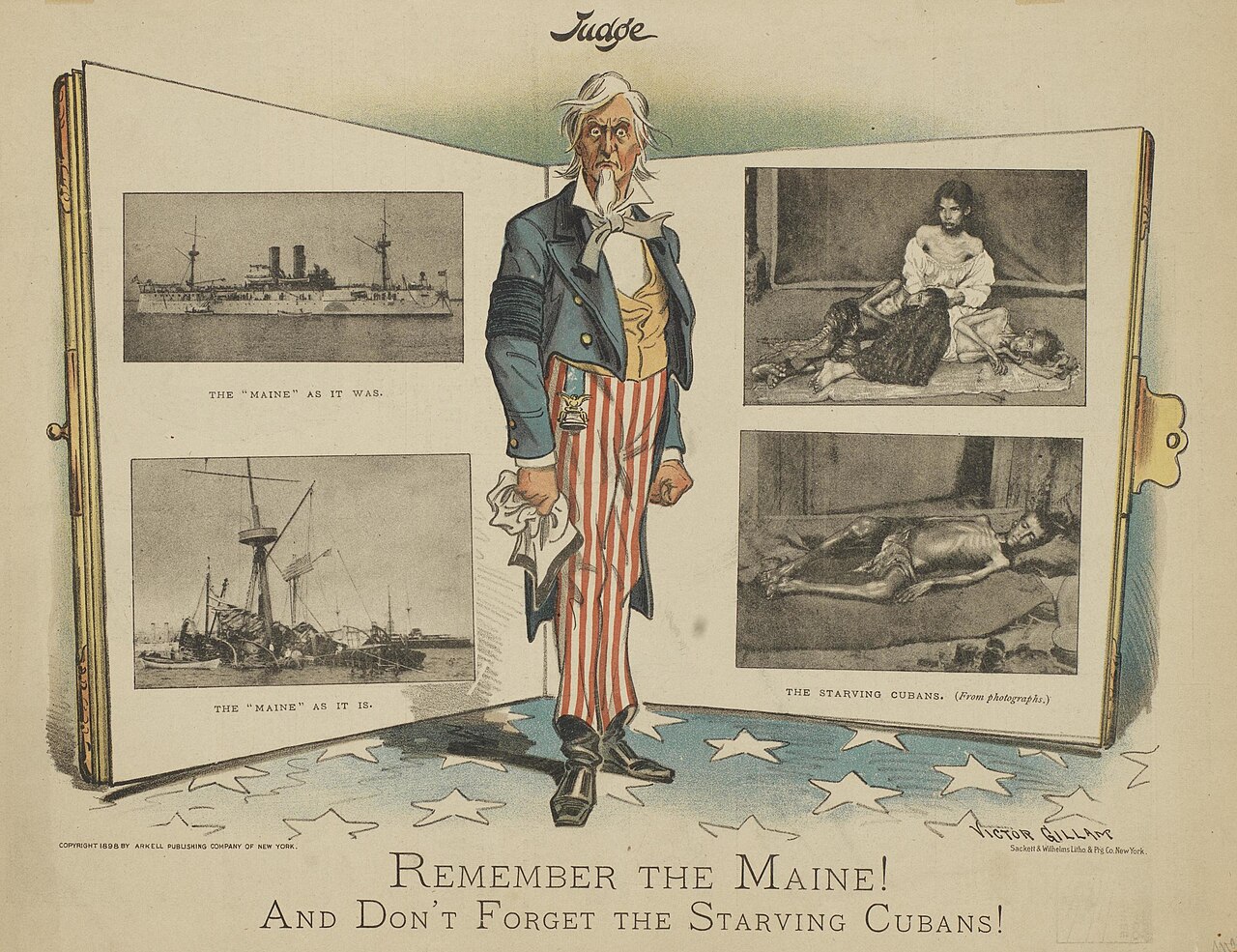
REMEMBER THE MAINE!
AND DON'T FORGET THE STARVING CUBANS!
THE "MAINE" AS IT WAS.
THE "MAINE" AS IT IS.
THE STARVING CUBANS. (From photographs.)
The archive describes Uncle Sam in a mourning band, fist closed, between an album's open pages: the ship before and after, then the civilians. The date on the record is 7 May 1898, after Congress had already moved toward war with Spain. McKinley's administration is the regime tag. The issuer is the magazine, not a department.
Who made it and why
Judge was a New York weekly, Arkell Publishing, cartoon by Gillam. FRAME's source is Wikimedia Commons, scan from the Historical Society of Pennsylvania, retrieved 29 September 2026, public domain as an 1898 publication. A commercial paper wanted readers, and 1898 rewarded papers that treated Cuba and the Maine as one story. The parenthetical "From photographs" asks to be believed as evidence.
What it got right or wrong
The Maine was destroyed in Havana harbor on 15 February 1898. That wreck was real, and the cartoon's "as it is" points at a real hulk. Spanish reconcentration in Cuba had killed a very large number of civilians; historians still dispute the count, and the FRAME case study on the yellow press records both the contemporary American figures, 400,000 or more, and John Lawrence Tone's later archival range of roughly 155,000 to 170,000. Starvation was not a hoax.
What the album gets wrong is the hinge. Side by side, the pages say the explosion and the hunger are one moral fact demanding one response. The cartoon does not know who sank the ship. A naval court and, much later, other inquiries argued about a mine and about an internal explosion. Gillam's fist has already decided. Pairing an unsolved blast with a photographed famine is card stacking by layout: two true pictures, one unproven cause.
The constitutional and liberty angle
This is a private magazine, and it had every right to print the fist. The First Amendment is at its strongest for a paper yelling at the president. The libertarian caution is about the yell's target. A war is a public act. Congress declares it. A cartoon that welds an accident, or a crime, to a humanitarian horror is allowed. It is not a declaration, and it is not a finding. Readers in a republic owe the pictures their attention and the caption their doubt. "Don't forget" is an order from a publisher. Forgetting the gap between the two pages would be the actual civic failure.
Its legacy
"Remember the Maine" became the short version, and the starving Cubans dropped out of the proverb. The cartoon's own second line is the part later memory found inconvenient, because it admits the war talk was never only about a ship. Keep both lines. Then ask, as the sheet does not, what a free government may do with grief before it knows the cause.
Sources
- FRAME object record, "Remember the Maine! And Don't Forget the Starving Cubans!", Judge, 7 May 1898, Victor Gillam. Historical Society of Pennsylvania via Wikimedia Commons.
- FRAME case study "Remember the Maine: the yellow press and Spain, 1895-1898," on reconcentration death estimates (contemporary figures and Tone 2006).