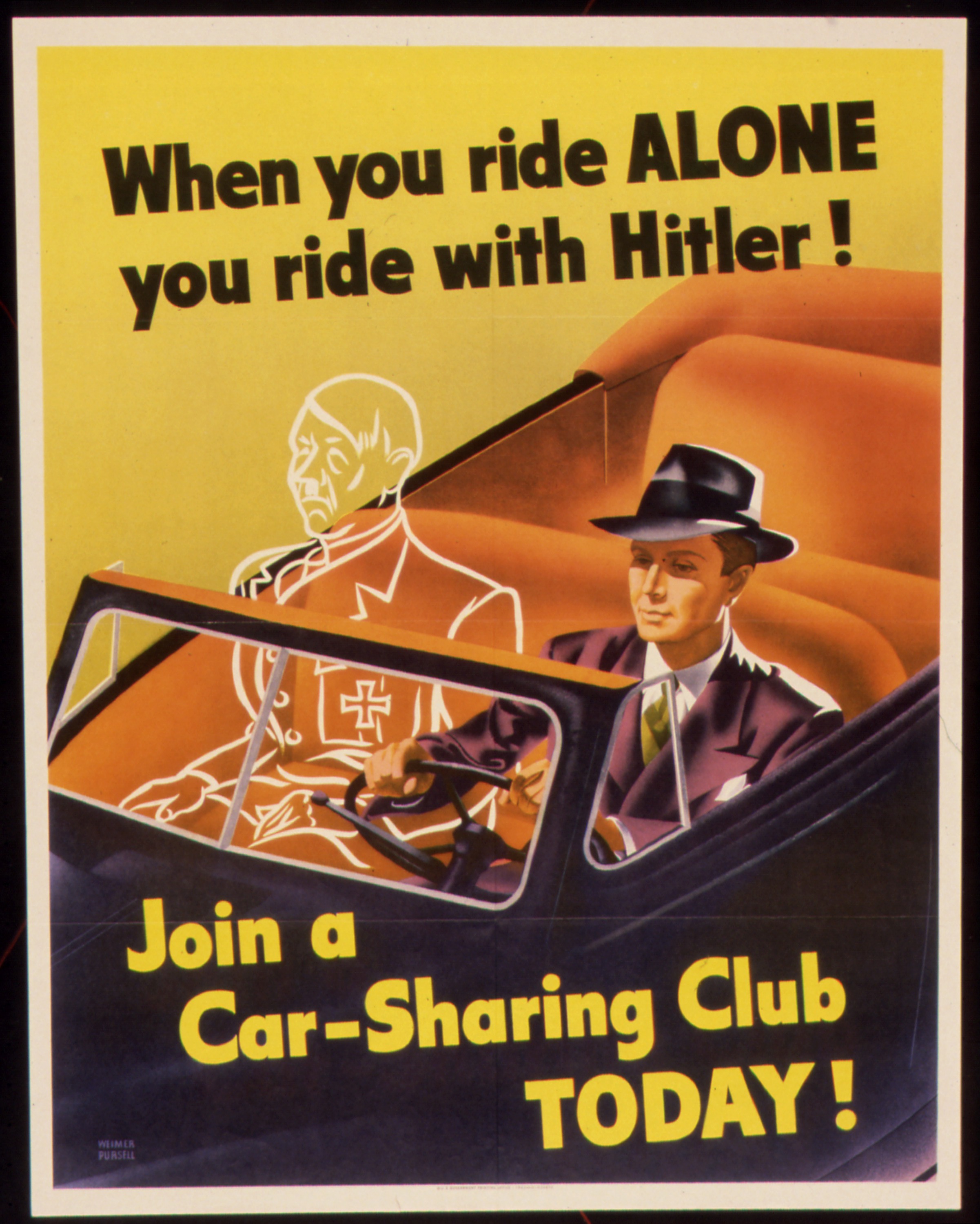
When you ride ALONE you ride with Hitler! is a 1943 American home-front poster signed Weimer Pursell. A man in a hat drives with an outlined Hitler, Iron Cross on his tunic, in the passenger seat, and the sheet urges the reader to join a car-sharing club.
Driver and passenger
A man in a hat sits at the wheel of a car, driving alone. The passenger seat is filled by an outline figure of Adolf Hitler with an Iron Cross on his tunic. The text runs in two blocks, with the word "alone" set in capitals.
When you ride ALONE
you ride with Hitler !
Join a
Car-Sharing Club
TODAY !
WEIMER
PURSELL
Who made it
The artist's name, Weimer Pursell, is printed at lower left. The archive describes the sheet as part of a U.S. government home-front campaign, but the credit line that would name the office cannot be read on the scan, and this page does not supply one. The archive cites Wikimedia Commons as its source, credits the rights to the National Archives, and lists no NAID. Rights are recorded as public domain, a U.S. government work.
Guilt by passenger
Name-calling and transfer are the tags on this record. The driver has done nothing but drive to wherever he was going, alone. The poster places the enemy's leader in the seat beside him, so that an ordinary habit carries his stigma. It is a sharp image, and it works by guilt.
The request itself was modest and voluntary. A car-sharing club is something neighbors choose to join, and the poster sells it as a choice. The method is the trouble. Equating a solo drive with riding alongside Hitler invites people to see a neighbor's empty passenger seat as disloyalty. A free country can ask citizens to share rides; it should be careful about calling those who don't the enemy's companions. How many clubs formed, and whether the poster moved anyone, is not recorded.
Hitler's face is used to a different effect in the OWI's What Do You Say, America?, which sets a line attributed to him under his photograph rather than seating him in an American car. For conservation asked without an enemy, see Use It Up, Wear It Out, Make It Do! The anti-Nazi hub gathers the period's sheets about the German regime.
Sources
- FRAME object record, When You Ride Alone, You Ride with Hitler, 1943. U.S. government home-front campaign (artist Weimer Pursell, signature printed lower left).
- Wikimedia Commons, file page, retrieved by the archive 2 October 2026. Rights as recorded: public domain (U.S. government work), U.S. National Archives and Records Administration.