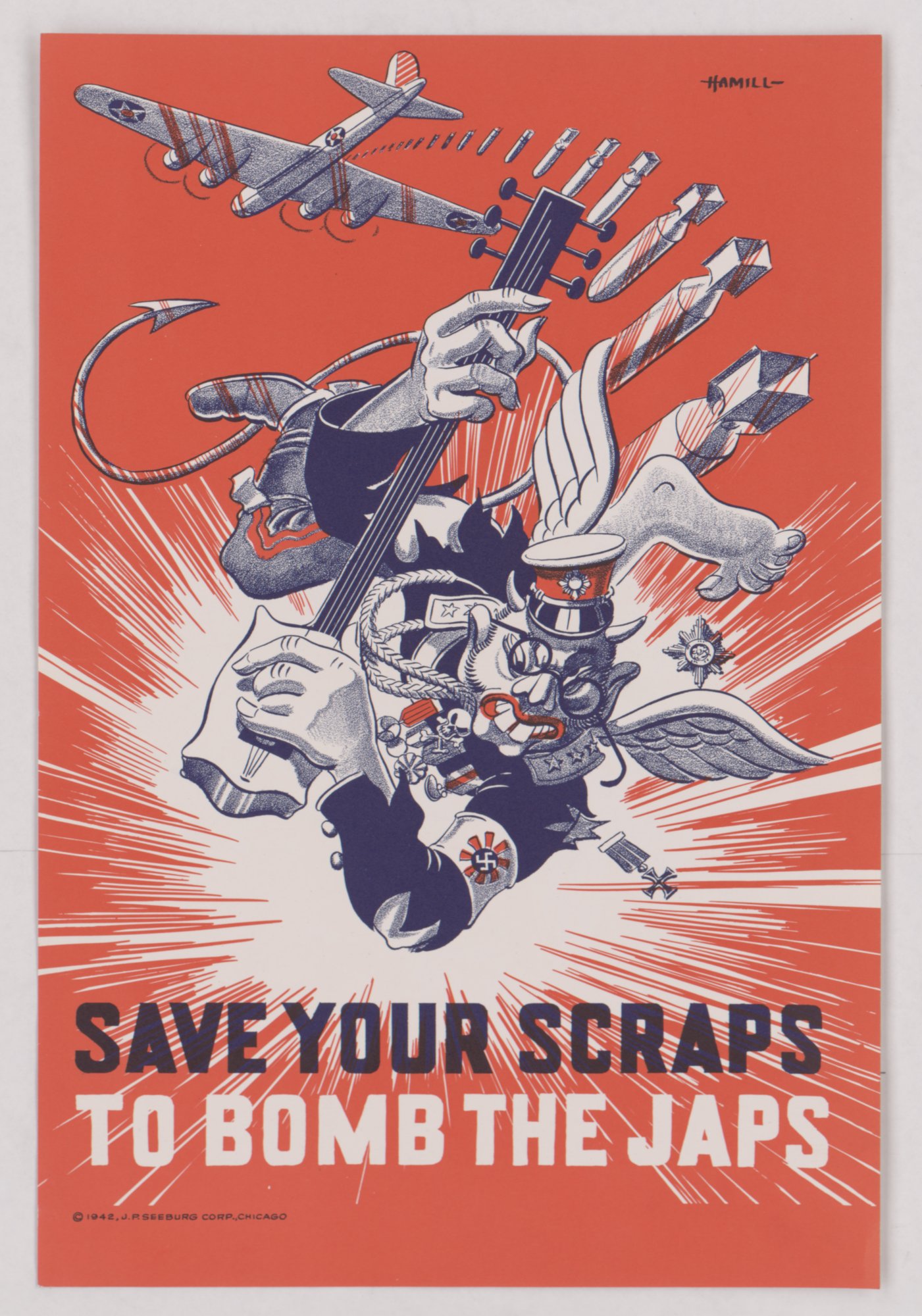
Save your scraps to bomb the Japs is a 1942 salvage poster copyrighted by J. P. Seeburg Corp. of Chicago and signed Hamill. A bomber drops scrap-metal bombs on an upside-down horned and tailed caricature wearing round glasses, buck teeth and a swastika armband (NAID 515349).
What the sheet prints
Content note: the slogan uses an ethnic slur for Japanese people, and the central figure is a racial caricature. Both are described here as printed.
A bomber crosses the top of the sheet, and the bombs falling from it are drawn as pieces of scrap metal. Below, upside down, is the target: a figure with horns, wings and a tail, in a military cap, with round glasses and protruding teeth. He wears medals, an Iron Cross and a swastika armband. The text is a rhyme.
SAVE YOUR SCRAPS
TO BOMB THE JAPS
Who made it
The poster carries a 1942 copyright of J. P. Seeburg Corp., a Chicago company, and an artist's signature, Hamill. No federal office is named on the sheet. The National Archives holds it with the World War II posters in Record Group 44, and the archive's rights line records it as public domain. The FRAME record gives no first name for the artist and no print run, and this page adds none.
What it gets wrong
The word in the second line is an ethnic slur, quoted here because it is the poster. The figure is drawn from the standard wartime caricature of a Japanese face, then given a devil's horns and tail, then dressed in German decorations. Three things are going on at once: an ethnic insult, a claim that the enemy is literally demonic, and a merger of two enemy states into one cartoon.
Scrap metal did go into war production, and asking people to save it was legitimate. The rhyme did not need the slur, and the drawing did not need the teeth. What the poster teaches is that the enemy is a race and a devil, not a government with soldiers. In 1942, Americans of Japanese ancestry were being removed from their homes on the basis of that same category (the exclusion order). A private company's salvage cartoon did not order that, and the record does not show what effect it had. It drew the same line by ancestry.
Compare the War Production Board's own can poster, Save Your Cans, which asks for the same kind of help with instructions instead of an enemy. More sheets like this one are gathered on the anti-Japanese propaganda hub and its poster gallery; Jap Trap is a corporate conservation poster from the same year. The Roosevelt administration essay sorts the period's posters by what they asked, and notes that not every sheet aimed at the Japanese came from the government.
Sources
- FRAME object record, Save your scraps to bomb the Japs, 1942. J. P. Seeburg Corp., Chicago (artist Hamill). Rights as recorded: public domain (U.S. government work).
- U.S. National Archives and Records Administration, Record Group 44, World War II Posters, 44-PA-1681, NAID 515349, retrieved by the archive 4 October 2026.